
Married man in his forties: dodging nagging as a way of life
A forty-something describes his married routine: dodging complaints, bringing home his salary and pretending not to calculate what leaving would cost. The portrait dividing readers.
English · Original discussion in Spanish · Published
Married man in his forties: dodging nagging as a way of life
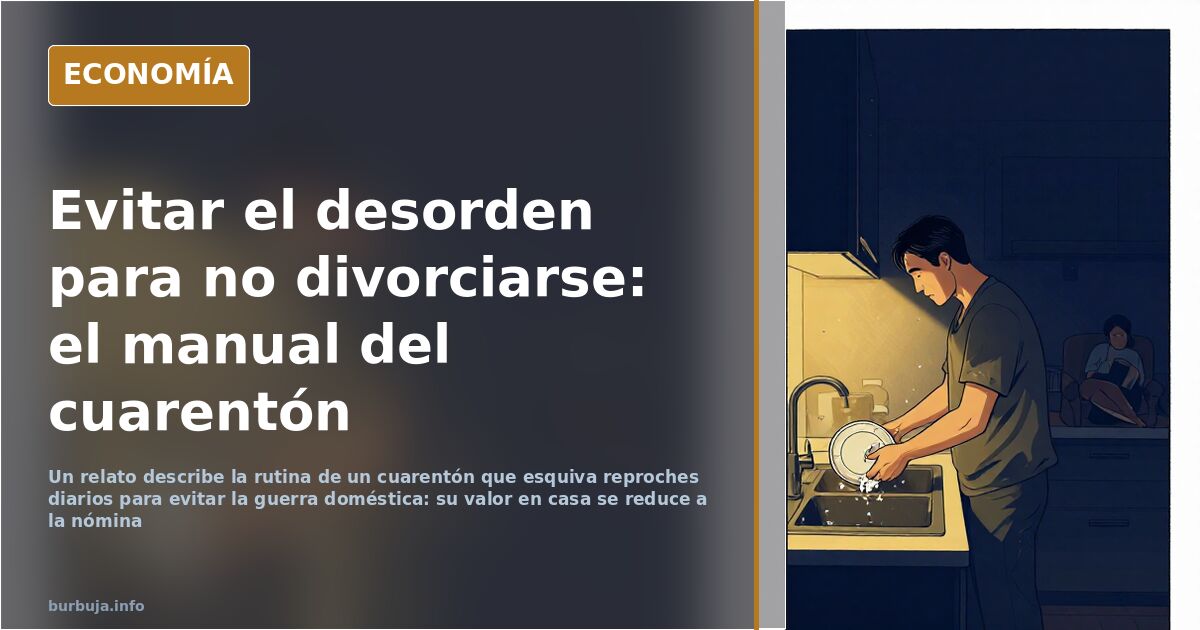
How much is domestic peace worth to a man in his forties? According to a story making the rounds on financial forums, the answer is a paycheck at the end of the month and a collection of silences. An internet user has laid out his married routine in prose that mixes Bukowski with a spreadsheet: hairs in the sink, crumbs on the floral tablecloth, the door that has to be eased shut all the way. No mess, no war. Excess of order and peace. And underneath, the suspicion that his only role at home is bringing in money while the rest of his presence is considered a burden.
The text opens with a motivational Instagram quote —the one saying that if you tolerate mess to avoid war, you'll get the mess first and the war later— and dismantles it without mercy. Because the author doesn't tolerate mess: he avoids it. Every morning. With the precision of an operator who knows the weak points of his emotional assembly line.
What lies behind the routine of avoiding a spouse's complaints?
The description is meticulous and recognizable to anyone who has ever lived with someone: using the watch's vibration so as not to wake their partner, not using paper napkins because they only smear, shaving more carefully. Every gesture is a bullet dodged, as another participant in the conversation puts it. The implicit thesis is uncomfortable: the day's success is measured not by achievements, but by the number of criticisms that never came to be.
Some argue that this calculation is a mental trap. The mind, the argument goes, can become your worst enemy when it devotes itself to tallying medals for not having sparked a conflict. And some go further: the author hasn't understood the quote he cites, because he is precisely tolerating an internal disorder —that of his own psyche— to avoid a bigger war, which would be divorce or loneliness. The likely outcome, according to this reading, is prolonged bitterness that ends in a breakup anyway.
The alternative of the one who left: spending, smoking and owing no explanations
Facing the story of endurance appears the story of the one who broke free. One participant describes his life after twenty years as a couple: getting up whenever he pleases, hiring a cleaner when it suits him, spending where and when he wants, smoking a cigar in the living room if he feels like it, eating on the sofa, not letting any woman stay more than one night at his place. And a clinching detail: he has never saved so much money.
The figure is not trivial. In a context of soaring cost of living, the household economy of the traditional couple stops being an advantage and becomes, for some, a burden. The full calculation of what it costs to run a two-person household —or what is freed up by dissolving one— yields surprising results, especially when crossed with the emotional bill.
The conversation soon drifts onto rougher ground. It debates whether a stable, loving marriage is the norm or the exception. One comment sums it up bluntly: normalizing a close family with parents who love each other is not the norm, it's a ing miracle. The odds of repeating one's parents' model are compared, without irony, to the odds of winning the EuroMillions.
Why do so many men in their forties feel they have failed?
Then comes the biological argument, stated without embellishment: if the only real reason men and women put up with each other is the reproductive instinct, accepting that fatherhood is no longer on the table is the saddest day and, at the same time, the most liberating. From then on, the argument goes, one starts living as one pleases, especially if one can afford it. The comparison thrown out —you need a colonoscopy more than you need to live with a woman— is hurtful, but it strikes a chord with a mood that goes beyond the individual.
It's not all self-pity. Someone quotes Chesterton to remind us that the most extraordinary thing in the world is an ordinary family of an ordinary husband and vvife with ordinary children. The quote works as a counterpoint: if that is the extraordinary, then the ordinary is something else. And the ordinary, according to the portrait drawn here, looks a lot like a man shaving carefully so as not to leave hairs in the sink.
The original text ends in surrender: You suck it up and dance with what you're dealt. The word "decide", the author says, cracks him up. On those terms, the question hanging over the conversation is not whether marriage is worth it, but how many men are willing to admit they run that calculation every morning in front of the mirror.
Also available in: Deutsch
Summary of a discussion on Burbuja.info - Foro de economía, actualidad y política., translated from Spanish and reviewed before publication. Read the full discussion (20 replies).
More summaries
-
Who sleeps by the door? The truth about bed sides
Men often sleep near the door, women on the opposite side. But prostate issues and habits debunk the defensive instinct theory.
-
Debate on couples sleeping in separate beds
A forum thread discusses the idea of partners using separate beds, sparking debates about intimacy and state intervention.
-
Couple returns from trip to find home occupied in Spain
A couple in Bujalance, Spain, returned from Almería to find their home occupied. The dispute led to assault and four arrests.
-
Meloni and Denmark lead migration group that leaves Spain out
Meloni and Frederiksen led an 18-country breakfast meeting on migration that excluded Spain; the debate focused on Spain's mass regularization programme.
-
Vox puts daily housing pressure at 2,000 new arrivals in Spain
Vox blames Spain's housing collapse on demographic pressure: building 5 homes a day cannot offset 2,000 arrivals. An in-depth analysis, with data.
-
8,900 euros for the World Cup final: extravagance or investment?
The package for the World Cup final costs 8,900 euros without a ticket. Consumer credit, irony and a debate about extravagance in times of energy crisis.