
Spanish forum users decry €20 basket as ruin
Spanish shoppers report a €50 normal grocery bill, blaming price hikes that started in 2021 and eroding household budgets.
English · Original discussion in Spanish · Published
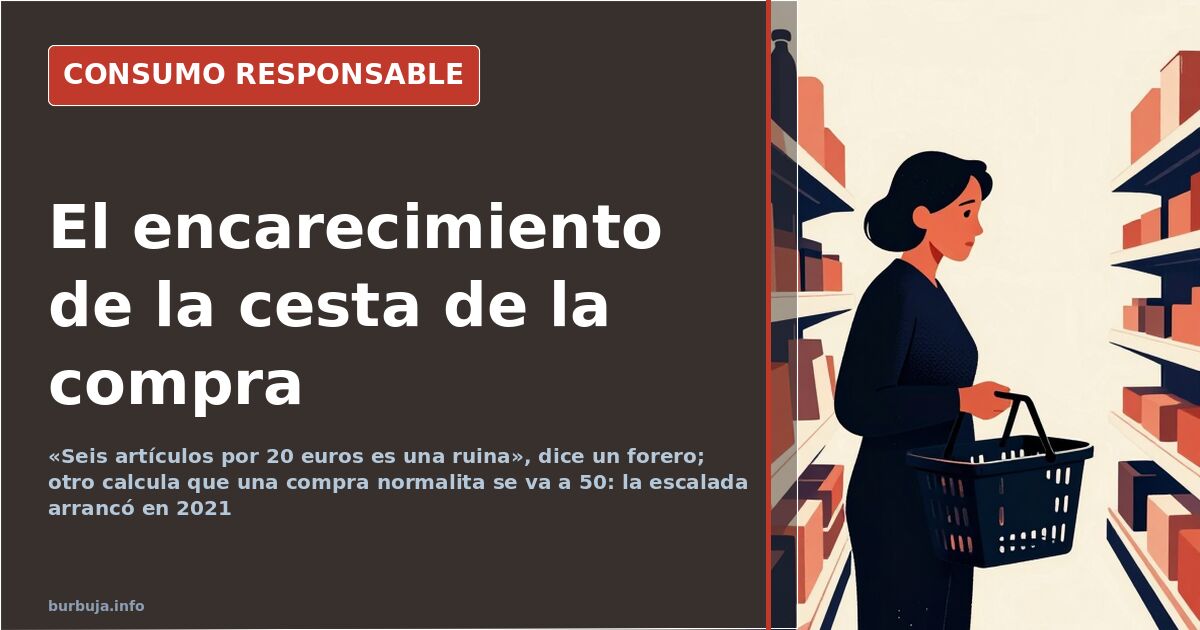
The shopping basket: from normal to financial ruin since mid-2021
As recounted in the thread, a bar in San Sebastián has found a way to balance its books: driving 15 kilometers round alucinación to France to buy the products it serves, because the savings outweigh the travel cost. It is the same logic that, according to another participant, led people to cross into Andorra forty years ago for chocolate or tobacco, now applied to the weekly shop. The price surge, forum users claim, began in mid-2021 and shows no sign of stopping. A standard shopping run easily hits €50 without effort, another message argues.
The receipt that never drops below €50
The photo looks familiar, but the price does not. Buying six items for €20 has become, according to one user, a silent bankruptcy for the average wallet, and the phenomenon ignores borders: the cost of living hits individuals and businesses alike, dragging on relentlessly since mid-2021. The most repeated diagnosis is that the system is fragile, with current expenses rising every time someone walks through a supermarket door.
The immediate consequence is that eating becomes non-negotiable. You might cut other things, but you have to eat, and that is where the basic food basket eats up the margin that previously went to any other expense. For those complaining, the increase is general.
Why don't prices come back down?
Because once a price goes up, it doesn't go down. This is the idea defended by a thread participant: the spike was abrupt and concentrated in a short time, but the underlying lesson is different. It doesn't matter what triggers the rise at a given moment: what goes up, stays up. The opposite would require a deflation that never arrives.
That the increase is explosive belongs to this cycle, but the general trend is only going up. What changes now is not the direction, but the slope, and people have not yet fully internalized that reality.
35% of dollars and the ECB's role
The monetary argument has its own calculation. It is claimed that 35% of circulating dollars were printed in just three years, and that money ended up somewhere. The theoretical question posed by economists is now answered in any supermarket: in the shopping basket.
The other front is the European Central Bank. The criticism is that even the ECB doesn't know how much money has been created out of thin air since 2008, and that virtually all debt issued by Spain is bought by the ECB itself. A mechanism that, according to this analysis, hides governments' flaws and passes the bill to the consumer.
The German mirror and stagnant wages
The European comparison stings. In Germany, it is argued, food prices are equal or even lower, while in Spain wages are low. The diagnosis: a characteristic of secondary economies is that everything is expensive and pay is low, compounded by the euro, which theoretically should cushion inflation much better than it actually does.
References to centralized banking policy and intervened energy markets feed a broader reading: part of the analysis attributes the mess to a model of monetary planning and regulation considered responsible for almost everything.
Counterargument: technology really does get cheaper
Not everyone accepts the narrative of total price increases. There is a current that focuses on the other side: countless products drop in price, especially technology. A giant TV costs less than €1,000 with quality unimaginable five years ago; computers and phones, once luxuries, are owned by children today; and branded chain clothing is accessible to anyone.
From this perspective, the debate is not whether everything rises, but what rises and what falls.
Local product vs. cheap imports: the orange case
There is an underlying tension about quality. Some argue that many end-of-month complaints hide poor purchasing choices: low-quality products disguised under a brand, cheap bulk goods versus local produce. The star example is Canary Islands oranges in midsummer, unrivaled in flavor and juice on paper.
The technical nuance, according to another participant, partly debunks the myth: August Canary oranges have been in freezers for months, because the latest variety in Gran Canaria is harvested in April. Even so, the recommendation to choose local products, even if more expensive, holds.
As one forum user summarizes, the conclusion hovering over the thread is that prices generally can only go up.
As recounted in the thread, a bar in San Sebastián has found a way to balance its books: driving 15 kilometers round alucinación to France to buy the products it serves, because the savings outweigh the travel cost. It is the same logic that, according to another participant, led people to cross into Andorra forty years ago for chocolate or tobacco, now applied to the weekly shop. The price surge, forum users claim, began in mid-2021 and shows no sign of stopping. A standard shopping run easily hits €50 without effort, another message argues.
The receipt that never drops below €50
The photo looks familiar, but the price does not. Buying six items for €20 has become, according to one user, a silent bankruptcy for the average wallet, and the phenomenon ignores borders: the cost of living hits individuals and businesses alike, dragging on relentlessly since mid-2021. The most repeated diagnosis is that the system is fragile, with current expenses rising every time someone walks through a supermarket door.
The immediate consequence is that eating becomes non-negotiable. You might cut other things, but you have to eat, and that is where the basic food basket eats up the margin that previously went to any other expense. For those complaining, the increase is general.
Why don't prices come back down?
Because once a price goes up, it doesn't go down. This is the idea defended by a thread participant: the spike was abrupt and concentrated in a short time, but the underlying lesson is different. It doesn't matter what triggers the rise at a given moment: what goes up, stays up. The opposite would require a deflation that never arrives.
That the increase is explosive belongs to this cycle, but the general trend is only going up. What changes now is not the direction, but the slope, and people have not yet fully internalized that reality.
35% of dollars and the ECB's role
The monetary argument has its own calculation. It is claimed that 35% of circulating dollars were printed in just three years, and that money ended up somewhere. The theoretical question posed by economists is now answered in any supermarket: in the shopping basket.
The other front is the European Central Bank. The criticism is that even the ECB doesn't know how much money has been created out of thin air since 2008, and that virtually all debt issued by Spain is bought by the ECB itself. A mechanism that, according to this analysis, hides governments' flaws and passes the bill to the consumer.
The German mirror and stagnant wages
The European comparison stings. In Germany, it is argued, food prices are equal or even lower, while in Spain wages are low. The diagnosis: a characteristic of secondary economies is that everything is expensive and pay is low, compounded by the euro, which theoretically should cushion inflation much better than it actually does.
References to centralized banking policy and intervened energy markets feed a broader reading: part of the analysis attributes the mess to a model of monetary planning and regulation considered responsible for almost everything.
Counterargument: technology really does get cheaper
Not everyone accepts the narrative of total price increases. There is a current that focuses on the other side: countless products drop in price, especially technology. A giant TV costs less than €1,000 with quality unimaginable five years ago; computers and phones, once luxuries, are owned by children today; and branded chain clothing is accessible to anyone.
From this perspective, the debate is not whether everything rises, but what rises and what falls.
Local product vs. cheap imports: the orange case
There is an underlying tension about quality. Some argue that many end-of-month complaints hide poor purchasing choices: low-quality products disguised under a brand, cheap bulk goods versus local produce. The star example is Canary Islands oranges in midsummer, unrivaled in flavor and juice on paper.
The technical nuance, according to another participant, partly debunks the myth: August Canary oranges have been in freezers for months, because the latest variety in Gran Canaria is harvested in April. Even so, the recommendation to choose local products, even if more expensive, holds.
As one forum user summarizes, the conclusion hovering over the thread is that prices generally can only go up.
Also available in: Deutsch
Summary of a discussion on Burbuja.info - Foro de economía, actualidad y política., translated from Spanish and reviewed before publication. Read the full discussion (127 replies).
More summaries
-
Shopping Basket Jumps 50% According to Receipts, Not CPI
Eroski shop goes from €98 to €156.41 while official CPI shows 10-15% rises, receipts reveal up to 50% on basic foods.
-
Carlos and Fernando Paz: Where to Listen to the Brothers
Carlos and Fernando Paz share a voice but no single show. Find their podcasts on YouTube, iVoox, and radio stations.
-
Cat Deterrents: Ultrasonic Devices, Sprays, and Physical Barriers
Ultrasonic repellers, sprays, sharp bamboo, and salt pellets form a growing market for deterring cats. Effectiveness depends on perimeter size and budget.
-
Free Adobe Acrobat Alternatives for PDF Editing
Users share free Adobe Acrobat alternatives like PDFGear, LibreOffice Draw, and PDF24, criticizing subscription costs.
-
Spain's V16 Beacon: €40 Cost and Compliance Doubts
Forums debate the mandatory V16 beacon in Spain, citing 500 models with half invalid and doubts about verification codes on packaging.
-
Shoes Indoors: Hygiene Issue or Cultural Clash?
Intense debate on Burbuja.info about whether wearing shoes indoors is unhygienic or a misunderstood cultural habit. What do the data say?