
Spain's V16 Beacon: €40 Cost and Compliance Doubts
Forums debate the mandatory V16 beacon in Spain, citing 500 models with half invalid and doubts about verification codes on packaging.
English · Original discussion in Spanish · Published
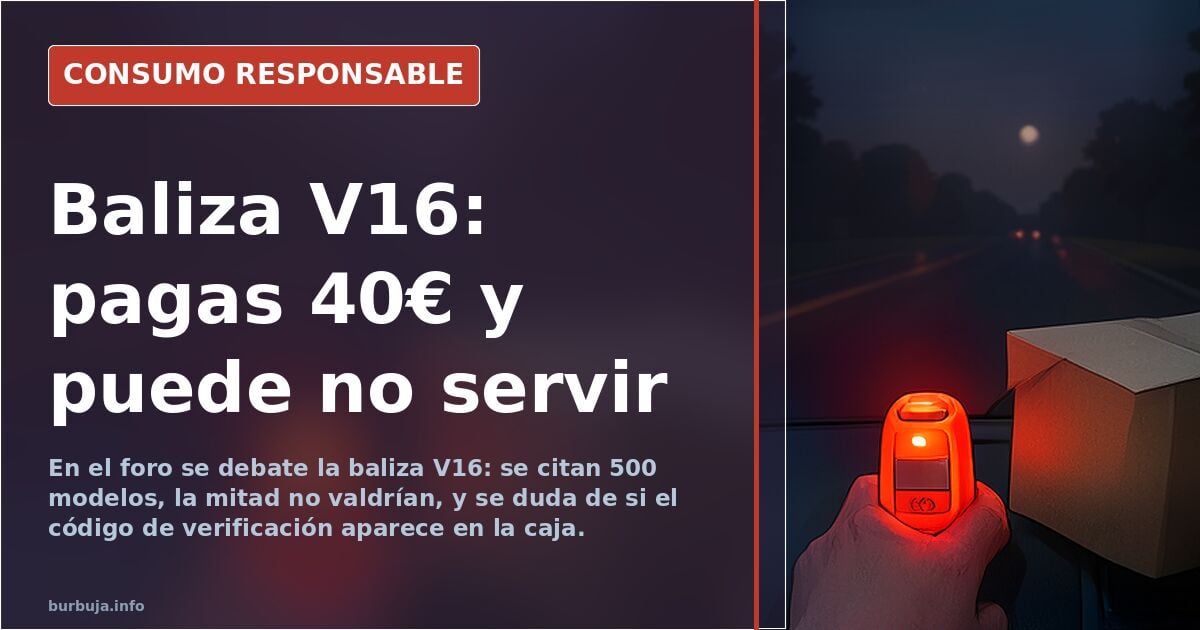
V16 Beacon: €40 for an Approval Nobody Checks
The V16 beacon stops being an accessory and becomes a legal obligation. From January 1st, driving without it is punishable by a fine of €200, according to the opening post of the discussion, which several participants later correct: €80, or €40 with prompt payment. The issue isn't the amount. The problem is that, as claimed in the thread, there are 500 different models on the market, half of which are not valid, and buyers have no way of knowing if theirs is on the official list before paying.
The initial message asks bluntly: if you must buy an approved one, why are five hundred non-approved variants allowed to be sold? The industry response circulating is that the DGT (Spanish Traffic Authority) seal doesn't come in the box. You have to go to the Traffic website, enter the model code, and check them one by one. This code, they warn, doesn't always appear in the product description, and when it does, it can be fake. The thread mentions reviews from people who spent €40 only to discover late that their beacon wasn't on the list.
How much does the V16 beacon cost and what is the fine for not having one?
The starting price hovers around €24 for recognized brands, although the same model has been seen at €40, according to one participant. Component stores offer beacons with direct links to the official list, allowing verification before purchase. The fine, according to corrections made within the conversation itself, is €80 with a possibility of reduction to €40 for prompt payment. It is not, therefore, the €200 penalty cited at the beginning.
The confusion is significant. Some drivers assume the sanction falls on the vehicle owner, as happens with the ITV (technical inspection). Others argue it falls on the driver, like seatbelts. This doubt matters in a market where rental companies have already warned they will not equip their fleets with the beacon, at least for now, because they expect to lose units.
The Mandatory App and the Registry Nobody Asked For
The beacon doesn't work alone. It connects to a mobile app that must be downloaded and registered with. This requirement, found in the fine print, is what frustrates many: paying for the device isn't enough; you must hand over data and maintain an active account for a function used only in case of breakdown or accident.
Comparison with previous episodes is inevitable. Warning triangles were also mandatory, also sold as essential, and also cost a fortune at the time. Later, they were given away with any purchase. The lingering question is how long this beacon will take to trinc the same path.
Is it mandatory to carry the V16 beacon in the car?
Yes, from January 1st according to the current calendar. It replaces triangles and its function is to signal a broken-down vehicle without the driver having to get out. The obligation includes carrying it in the vehicle and keeping it operational. The practical doubt is whether agents will ask for it during checks. Experience with triangles suggests enforcement relaxes over time: a couple of months of zeal and then oblivion.
Some directly refuse to buy it. The argument is that it's not a safety measure but a disguised tax, and that the fine amount doesn't justify the expense. Others calculate they will wait until summer, when they drive more kilometers, or until they are given away with purchases when there is excess stock. The bet is that demand will fall and so will the price.
The Approval Business and the Hidden List
The most uncomfortable point isn't the price. It's the mechanism. Approval becomes a barrier to entry that benefits those already inside and punishes those buying without information. The official list exists, but it isn't advertised. The buyer has to search for it, cross-reference it with the product code, and trust that the seller hasn't manipulated the description.
Suspicion of foul play runs through the entire conversation. There is talk of agreements with foreign manufacturers and operators to manage the app. There is no proof of anything, but the system design — forcing, approving, registering, and fining — doesn't help dispel the impression that the goal isn't road safety.
The V16 beacon will arrive in cars, or it won't. What is clear is that the market is already saturated with models, that the information needed to choose well isn't where it should be, and that the fine, whether €40 or €200, will be collected before anyone checks if the device in your glovebox is on the list.
The V16 beacon stops being an accessory and becomes a legal obligation. From January 1st, driving without it is punishable by a fine of €200, according to the opening post of the discussion, which several participants later correct: €80, or €40 with prompt payment. The issue isn't the amount. The problem is that, as claimed in the thread, there are 500 different models on the market, half of which are not valid, and buyers have no way of knowing if theirs is on the official list before paying.
The initial message asks bluntly: if you must buy an approved one, why are five hundred non-approved variants allowed to be sold? The industry response circulating is that the DGT (Spanish Traffic Authority) seal doesn't come in the box. You have to go to the Traffic website, enter the model code, and check them one by one. This code, they warn, doesn't always appear in the product description, and when it does, it can be fake. The thread mentions reviews from people who spent €40 only to discover late that their beacon wasn't on the list.
How much does the V16 beacon cost and what is the fine for not having one?
The starting price hovers around €24 for recognized brands, although the same model has been seen at €40, according to one participant. Component stores offer beacons with direct links to the official list, allowing verification before purchase. The fine, according to corrections made within the conversation itself, is €80 with a possibility of reduction to €40 for prompt payment. It is not, therefore, the €200 penalty cited at the beginning.
The confusion is significant. Some drivers assume the sanction falls on the vehicle owner, as happens with the ITV (technical inspection). Others argue it falls on the driver, like seatbelts. This doubt matters in a market where rental companies have already warned they will not equip their fleets with the beacon, at least for now, because they expect to lose units.
The Mandatory App and the Registry Nobody Asked For
The beacon doesn't work alone. It connects to a mobile app that must be downloaded and registered with. This requirement, found in the fine print, is what frustrates many: paying for the device isn't enough; you must hand over data and maintain an active account for a function used only in case of breakdown or accident.
Comparison with previous episodes is inevitable. Warning triangles were also mandatory, also sold as essential, and also cost a fortune at the time. Later, they were given away with any purchase. The lingering question is how long this beacon will take to trinc the same path.
Is it mandatory to carry the V16 beacon in the car?
Yes, from January 1st according to the current calendar. It replaces triangles and its function is to signal a broken-down vehicle without the driver having to get out. The obligation includes carrying it in the vehicle and keeping it operational. The practical doubt is whether agents will ask for it during checks. Experience with triangles suggests enforcement relaxes over time: a couple of months of zeal and then oblivion.
Some directly refuse to buy it. The argument is that it's not a safety measure but a disguised tax, and that the fine amount doesn't justify the expense. Others calculate they will wait until summer, when they drive more kilometers, or until they are given away with purchases when there is excess stock. The bet is that demand will fall and so will the price.
The Approval Business and the Hidden List
The most uncomfortable point isn't the price. It's the mechanism. Approval becomes a barrier to entry that benefits those already inside and punishes those buying without information. The official list exists, but it isn't advertised. The buyer has to search for it, cross-reference it with the product code, and trust that the seller hasn't manipulated the description.
Suspicion of foul play runs through the entire conversation. There is talk of agreements with foreign manufacturers and operators to manage the app. There is no proof of anything, but the system design — forcing, approving, registering, and fining — doesn't help dispel the impression that the goal isn't road safety.
The V16 beacon will arrive in cars, or it won't. What is clear is that the market is already saturated with models, that the information needed to choose well isn't where it should be, and that the fine, whether €40 or €200, will be collected before anyone checks if the device in your glovebox is on the list.
Also available in: Deutsch
Summary of a discussion on Burbuja.info - Foro de economía, actualidad y política., translated from Spanish and reviewed before publication. Read the full discussion (110 replies).
More summaries
-
Firefighter urges using warning triangles over V-16 beacon
A firefighter calls for returning to warning triangles after an accident marked only by a V-16 beacon. Debate on its 2026 mandate and visibility.
-
Elon Musk’s appearance sparks debate: does the founder’s body matter?
Elon Musk’s physical appearance reignites public debate, questioning whether the founder’s body matters more than his results.
-
Tesla S catches fire in Valencia after flooding, forum claims
A user reports a submerged Tesla S ignited in Valencia, destroying two homes and up to five vehicles. The brand was not mentioned on TV.
-
Cheap Retro Consoles: 620 Games for €20 and the Fine Print
Retro consoles from €14: most of the 620 games are NES titles. Second-hand Wii, DSi, or PSP offer better value if kids want Super Mario.
-
Lenire tinnitus treatment: 89.2% report improvement, no cure
While 89.2% of patients report benefits with Lenire, tinnitus remains incurable due to multiple causes and high costs up to €2,500.
-
Subscription Trap: Paying for Items You Already Own
Users criticize charging for printer ink, car features, and seeds, arguing that ownership rights are being eroded by subscription models.