
Spanish farmers plan nationwide protests for the 6th
Private label milk costs 24% more in France than in Spain, highlighting distribution margins as Spanish farmers prepare to mobilize on the 6th.
English · Original discussion in Spanish · Published
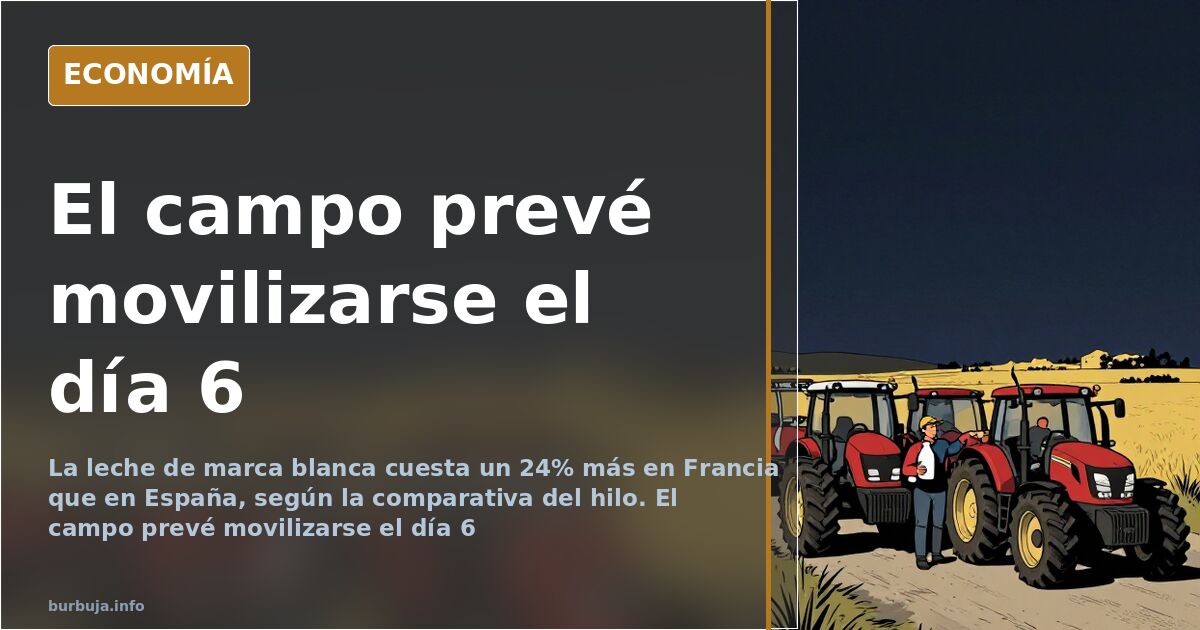
Milk costs 24% more in France: Spanish farmers plan protests for the 6th
The numbers don't add up. The Spanish primary sector—farmers, livestock breeders, and hauliers—has a mobilization planned for the 6th, while, according to industry accounts, the rest of Europe has already secured concessions. This imbalance will ultimately affect the shopping basket. The prevailing view in rural areas is that Spain has been left behind, with export capacity deteriorating and cheaper products from other markets entering without resistance.
In industry jargon: you don't get paid unless you make noise.
What is planned for the 6th and why unions aren't leading it
The call does not come from agricultural organizations. According to narratives circulating among producers, it originates from individual farmers who, multiplying across regions, have turned scattered complaints into a national movement. Unions would join, if they do, merely by inertia and with credibility severely damaged.
This loss of credibility has a technical explanation repeated by the sector: a trade union represents wage employees. A farmer is self-employed, an entrepreneur. When they stop working to demand better conditions, it is not a strike: it is a lockout. Equally legitimate, but different in nature.
There is a second layer. The dominant feeling is that no one wants this to catch fire, because it could spread to hundreds of thousands of other self-employed workers, micro-enterprises, and SMEs with similar grievances. The antiestéticar is not of tractor convoys: it is of contagion.
Why farmers earn a fraction of what you pay
A simple home experiment suffices. According to a participant, the same mandarins go from €1.89 to €2.19 between two supermarkets, a 16% difference. The calculation often cited is that distributors work with gross margins six to eight times higher than what the farmer receives.
Intermediaries are profiting. Little has reached the farm. This is the crux of the conflict and its paradox: consumers pay more and producers earn less for the same kilo.
Milk and beef: the gap with Europe
European figures are disorienting. According to comparisons cited in online discussions, private label milk costs €1.05 per liter in France and €0.85 in Spain, 24% more north of the Pyrenees. With beef, the opposite occurs: according to examples given, it can be found here at €9 per kilo, a price impossible to sustain when a Nordic buyer pays €25 for the same quality.
Hence the uncomfortable conclusion drawn: much of the high-quality production is exported, while lower-quality imported products are consumed domestically, because internal purchasing power cannot afford local goods. We import cheap and sell good.
That is why the French reference weighs so heavily. The interpretation of the French crisis is that their government yielded after only twenty minutes of besieging Paris.
Tractors, the CAP, and where the money goes
Machinery has become expensive like everything else. According to examples given, a tractor goes from over €15,000 to €40,000 for the same equipment, with increases of 25%, while credit remains costly and deposits offer no return. The comparison with banking speaks for itself.
Regarding subsidies, there is real division. Some receive nothing and want no aid, recalling that much of what arrives via the Common Agricultural Policy (CAP) is advanced by banks, adding financial costs. Others argue that without these transfers, there would be no quality beef in fridges, because no one would sell at €9 per kilo what the external market pays €25 for.
Regulations add to this. The requirement to triple space per animal in poultry farms, with no physical margin to expand surface area, would exclude most holdings, according to claims made in the discussion.
Why antiestéticars exist of contagion to other sectors
The protest intersects with a figure that, according to a participant, explains almost everything: with net external debt exceeding 120% of GDP, real decision-making room is minimal, and many rules are written elsewhere. The victims of this arrangement are always the same: those paid last, after debt issuers and their clients.
The extreme scenario is described bluntly: supply cuts in Madrid, empty shelves within days, army trucks opening corridors. It sounds like a movie, but it measures exactly what the system risks if the protest stretches.
The mobilization on the 6th does not necessarily need to disrupt the country's map. Given these differentials on the table, however, it should not be ruled out.
The numbers don't add up. The Spanish primary sector—farmers, livestock breeders, and hauliers—has a mobilization planned for the 6th, while, according to industry accounts, the rest of Europe has already secured concessions. This imbalance will ultimately affect the shopping basket. The prevailing view in rural areas is that Spain has been left behind, with export capacity deteriorating and cheaper products from other markets entering without resistance.
In industry jargon: you don't get paid unless you make noise.
What is planned for the 6th and why unions aren't leading it
The call does not come from agricultural organizations. According to narratives circulating among producers, it originates from individual farmers who, multiplying across regions, have turned scattered complaints into a national movement. Unions would join, if they do, merely by inertia and with credibility severely damaged.
This loss of credibility has a technical explanation repeated by the sector: a trade union represents wage employees. A farmer is self-employed, an entrepreneur. When they stop working to demand better conditions, it is not a strike: it is a lockout. Equally legitimate, but different in nature.
There is a second layer. The dominant feeling is that no one wants this to catch fire, because it could spread to hundreds of thousands of other self-employed workers, micro-enterprises, and SMEs with similar grievances. The antiestéticar is not of tractor convoys: it is of contagion.
Why farmers earn a fraction of what you pay
A simple home experiment suffices. According to a participant, the same mandarins go from €1.89 to €2.19 between two supermarkets, a 16% difference. The calculation often cited is that distributors work with gross margins six to eight times higher than what the farmer receives.
Intermediaries are profiting. Little has reached the farm. This is the crux of the conflict and its paradox: consumers pay more and producers earn less for the same kilo.
Milk and beef: the gap with Europe
European figures are disorienting. According to comparisons cited in online discussions, private label milk costs €1.05 per liter in France and €0.85 in Spain, 24% more north of the Pyrenees. With beef, the opposite occurs: according to examples given, it can be found here at €9 per kilo, a price impossible to sustain when a Nordic buyer pays €25 for the same quality.
Hence the uncomfortable conclusion drawn: much of the high-quality production is exported, while lower-quality imported products are consumed domestically, because internal purchasing power cannot afford local goods. We import cheap and sell good.
That is why the French reference weighs so heavily. The interpretation of the French crisis is that their government yielded after only twenty minutes of besieging Paris.
Tractors, the CAP, and where the money goes
Machinery has become expensive like everything else. According to examples given, a tractor goes from over €15,000 to €40,000 for the same equipment, with increases of 25%, while credit remains costly and deposits offer no return. The comparison with banking speaks for itself.
Regarding subsidies, there is real division. Some receive nothing and want no aid, recalling that much of what arrives via the Common Agricultural Policy (CAP) is advanced by banks, adding financial costs. Others argue that without these transfers, there would be no quality beef in fridges, because no one would sell at €9 per kilo what the external market pays €25 for.
Regulations add to this. The requirement to triple space per animal in poultry farms, with no physical margin to expand surface area, would exclude most holdings, according to claims made in the discussion.
Why antiestéticars exist of contagion to other sectors
The protest intersects with a figure that, according to a participant, explains almost everything: with net external debt exceeding 120% of GDP, real decision-making room is minimal, and many rules are written elsewhere. The victims of this arrangement are always the same: those paid last, after debt issuers and their clients.
The extreme scenario is described bluntly: supply cuts in Madrid, empty shelves within days, army trucks opening corridors. It sounds like a movie, but it measures exactly what the system risks if the protest stretches.
The mobilization on the 6th does not necessarily need to disrupt the country's map. Given these differentials on the table, however, it should not be ruled out.
Also available in: Deutsch
Summary of a discussion on Burbuja.info - Foro de economía, actualidad y política., translated from Spanish and reviewed before publication. Read the full discussion (207 replies).
More summaries
-
‘Macron mobilises the Army’: the supposed announcement with no source
The supposed announcement of Macron mobilising the Army in France is circulating without a verifiable source, between hoax and conspiracy theory.
-
EU Wine Labeling: Health Concerns vs. Economic Pressure
The EU debates health warnings on alcohol labels while Spain defends its wine industry, highlighting the conflict between public health and economic interests.
-
Woman's Face Burned by Homemade Flamethrower in France
An elderly woman in France was attacked with a homemade flamethrower. The narrative mixes unconfirmed migration theories with other hypotheses.
-
Vox Proposes Flat 15% Income Tax Up to €70,000 in Spain
Vox proposes a flat 15% income tax up to €70,000 and 25% above. Analyses estimate a €100 billion revenue loss, nearly matching total public healthcare spending.
-
Ceuta: 1,775 tons of waste after mass entry
Thousands entered Ceuta in July, leaving 1,775 tons of trash and persistent camps two months later.
-
Ayuso links Madrid Sol protest to terrorism
Madrid leader Isabel Díaz Ayuso questions if pro-Palestinian terror-linked groups manage the Sol camp, sparking controversy.