
Spanish farmers and haulers extend strikes after Lola Guzmán warning
Spain's agricultural sector votes to continue protests as transport workers join indefinite strike following supply shortage warnings.
English · Original discussion in Spanish · Published
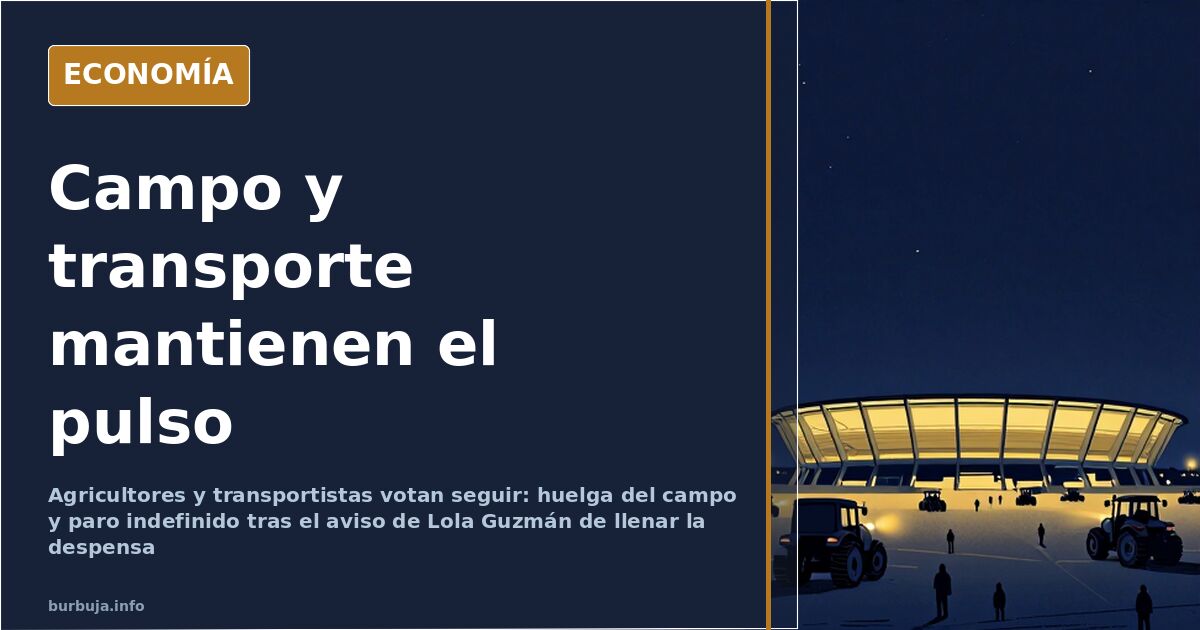
Lola Guzmán warns: “Start stocking your shelves”
By 5:00 PM, the area outside the Cívitas Metropolitano stadium was already packed. Forty minutes later, Lola Guzmán, spokesperson for the Plataforma 6F (a grassroots farmers' platform), delivered a line that spread faster than any slogan: “Fill your home shelves because you are going to go hungry.” The convened farmers voted to continue their field strike. Transporters, grouped under the National Platform for the Defense of Transport, ratified an indefinite stoppage. The official motto pointed in another direction, more friendly to buyers: “I am not your enemy; I am the one who helps make your shopping cheaper.”
Guzmán asked consumers for “patience” because, she said, “we are defending our children’s bread,” and set the protest’s goal: “We will reconquer the Ministry of Agriculture and the Ministry of Transport.” Regarding the nature of the event, there was no ambiguity: “This is the people against the rulers.” No political parties or unions were involved in the call.
What farmers and transporters have decided
Both assemblies voted to continue. Farmers backed the continuation of the massive field strike; transporters ratified halting operations indefinitely. Organizers emphasize that this call is independent from major agricultural organizations, raising the first question: how much real weight does a platform have if it bypasses traditional negotiation tables, and how long can it sustain the standoff without wearing down? The second front is the timeline. According to testimony gathered during discussions, the strike would have lasted five days and effects should already be evident, though no supply data confirms this.
Who is Lola Guzmán and why her role is questioned
The spokesperson’s profile has entered the debate directly. A comment in the thread, citing published reports, claims she is not a farmer and that her background is as a pensioner and former municipal employee, something admitted by the agricultural association she belongs to. This raises the uncomfortable question: who speaks for the countryside when major organizations do not lead the call? Those claiming knowledge of the sector argue that livestock markets are small and highly male-dominated—some estimate that out of every 50 breeders, only two are women—and that leaders usually earn their position beforehand. Other voices interpret the criticism as settling scores with the protest itself, rather than targeting its spokesperson.
Will there be shortages in supermarkets?
The most cited precedent is the 2022 transport strike: one participant argues that back then, supermarkets had everything and gas stations did not run dry. The underlying argument is structural. Today, self-employed drivers represent a residual part of the sector, while most work for food companies as employees, making them far less likely to stop due to antiestéticar of dismissal. A similar dynamic applies to farmers: the majority are small and medium holdings that do not set prices. Therefore, the doubt lies less in production than in distribution. Who loads the trucks, who drives them, and how many days can store shelves last with safety stock.
The countryside that is neither Osborne nor Mercadona
It is worth separating two things that noise often mixes. The thread mentions more than 450,000 small family farms, noting that large estates account for less than 5% of the total, according to one participant’s count. Another part of the discussion points elsewhere: small villages, many facing abandonment, are sustained by the few neighbors still living off agriculture and livestock, who maintain the territory. Some recount that neighbors with plots slaughtered two pigs and have meat for a year, for themselves and their daughters, without entering a supermarket. This is the classic rural response to the question of whether anyone will go hungry.
Pantry, full carts, and pandemic hangover
In supermarkets, the initial reaction has been physical. Some describe carts filling up like during the ELbichito-19 days, while others joke about hoarding toilet paper again. Those who already have pantries stocked with ham, cheese, legumes, and oil jugs remain unmoved. On the opposite extreme, a participant recalls that apocalyptic predictions started in 2008 but never materialized: the system held. This suggests the opposite of what the warning intends: the difficulty is rarely product scarcity, but rather people ceasing to believe scarcity is possible. However, according to user testimony, the most inconvenient detail for the narrative comes from actual baskets: practically the only item produced in Spain among typical grocery purchases is sugar.
Hunger as a pressure tool
Then there is the tone. In the most heated comments, some wish for weeks of hunger, even for themselves, as a way to wake up the population. No data supports this scenario regarding supply or stocks: it is barricade rhetoric, not forecasting. Guzmán’s warning, however, functions as a verifiable notice with a date. Next Friday and Saturday will reveal if trucks have truly stopped leaving. That will show whether the warning was a forecast or just talk.
By 5:00 PM, the area outside the Cívitas Metropolitano stadium was already packed. Forty minutes later, Lola Guzmán, spokesperson for the Plataforma 6F (a grassroots farmers' platform), delivered a line that spread faster than any slogan: “Fill your home shelves because you are going to go hungry.” The convened farmers voted to continue their field strike. Transporters, grouped under the National Platform for the Defense of Transport, ratified an indefinite stoppage. The official motto pointed in another direction, more friendly to buyers: “I am not your enemy; I am the one who helps make your shopping cheaper.”
Guzmán asked consumers for “patience” because, she said, “we are defending our children’s bread,” and set the protest’s goal: “We will reconquer the Ministry of Agriculture and the Ministry of Transport.” Regarding the nature of the event, there was no ambiguity: “This is the people against the rulers.” No political parties or unions were involved in the call.
What farmers and transporters have decided
Both assemblies voted to continue. Farmers backed the continuation of the massive field strike; transporters ratified halting operations indefinitely. Organizers emphasize that this call is independent from major agricultural organizations, raising the first question: how much real weight does a platform have if it bypasses traditional negotiation tables, and how long can it sustain the standoff without wearing down? The second front is the timeline. According to testimony gathered during discussions, the strike would have lasted five days and effects should already be evident, though no supply data confirms this.
Who is Lola Guzmán and why her role is questioned
The spokesperson’s profile has entered the debate directly. A comment in the thread, citing published reports, claims she is not a farmer and that her background is as a pensioner and former municipal employee, something admitted by the agricultural association she belongs to. This raises the uncomfortable question: who speaks for the countryside when major organizations do not lead the call? Those claiming knowledge of the sector argue that livestock markets are small and highly male-dominated—some estimate that out of every 50 breeders, only two are women—and that leaders usually earn their position beforehand. Other voices interpret the criticism as settling scores with the protest itself, rather than targeting its spokesperson.
Will there be shortages in supermarkets?
The most cited precedent is the 2022 transport strike: one participant argues that back then, supermarkets had everything and gas stations did not run dry. The underlying argument is structural. Today, self-employed drivers represent a residual part of the sector, while most work for food companies as employees, making them far less likely to stop due to antiestéticar of dismissal. A similar dynamic applies to farmers: the majority are small and medium holdings that do not set prices. Therefore, the doubt lies less in production than in distribution. Who loads the trucks, who drives them, and how many days can store shelves last with safety stock.
The countryside that is neither Osborne nor Mercadona
It is worth separating two things that noise often mixes. The thread mentions more than 450,000 small family farms, noting that large estates account for less than 5% of the total, according to one participant’s count. Another part of the discussion points elsewhere: small villages, many facing abandonment, are sustained by the few neighbors still living off agriculture and livestock, who maintain the territory. Some recount that neighbors with plots slaughtered two pigs and have meat for a year, for themselves and their daughters, without entering a supermarket. This is the classic rural response to the question of whether anyone will go hungry.
Pantry, full carts, and pandemic hangover
In supermarkets, the initial reaction has been physical. Some describe carts filling up like during the ELbichito-19 days, while others joke about hoarding toilet paper again. Those who already have pantries stocked with ham, cheese, legumes, and oil jugs remain unmoved. On the opposite extreme, a participant recalls that apocalyptic predictions started in 2008 but never materialized: the system held. This suggests the opposite of what the warning intends: the difficulty is rarely product scarcity, but rather people ceasing to believe scarcity is possible. However, according to user testimony, the most inconvenient detail for the narrative comes from actual baskets: practically the only item produced in Spain among typical grocery purchases is sugar.
Hunger as a pressure tool
Then there is the tone. In the most heated comments, some wish for weeks of hunger, even for themselves, as a way to wake up the population. No data supports this scenario regarding supply or stocks: it is barricade rhetoric, not forecasting. Guzmán’s warning, however, functions as a verifiable notice with a date. Next Friday and Saturday will reveal if trucks have truly stopped leaving. That will show whether the warning was a forecast or just talk.
Also available in: Deutsch
Summary of a discussion on Burbuja.info - Foro de economía, actualidad y política., translated from Spanish and reviewed before publication. Read the full discussion (164 replies).
More summaries
-
African Swine Fever: 39 Farms Locked Down, 20km Exclusion Zone Established
Agriculture implements 'draconian' measures after two wild boars test positive for swine fever in Bellaterra: 39 farms confined, 20km zone, and a 12-month clock ticking.
-
Spain’s 15,000 Truck Driver Shortage Prompts Defense Sector Recruitment Talks
Spain’s transport sector reports a 15,000-driver deficit, exploring military reservist recruitment amid fierce salary debates and workforce shortages.
-
Viral tweet attributed to Mel Gibson comes from fake account
Mel Gibson has no official X account: the viral tweet attributed to him comes from a fake account, according to his publicist.
-
Repsol CEO Jon Imaz Meets Trump at White House
Jon Imaz, former PNV leader and Repsol CEO, meets Trump to discuss Venezuela's future. Business pragmatism or political submission?
-
Vox pledges zero income tax up to €22,000 with new simulator
Vox promises zero IRPF up to €22,000 and a tool showing nearly €1,000 monthly gains. Critics cite a €50 billion cost without funding sources.
-
Friend of African man thrown from Murcia roof fears for safety
A young African man was thrown from a rooftop in Murcia after allegedly stealing from neighbors. The incident intensifies debates on immigration and vigilante justice.