
Spain’s 15,000 Truck Driver Shortage Prompts Defense Sector Recruitment Talks
Spain’s transport sector reports a 15,000-driver deficit, exploring military reservist recruitment amid fierce salary debates and workforce shortages.
English · Original discussion in Spanish · Published
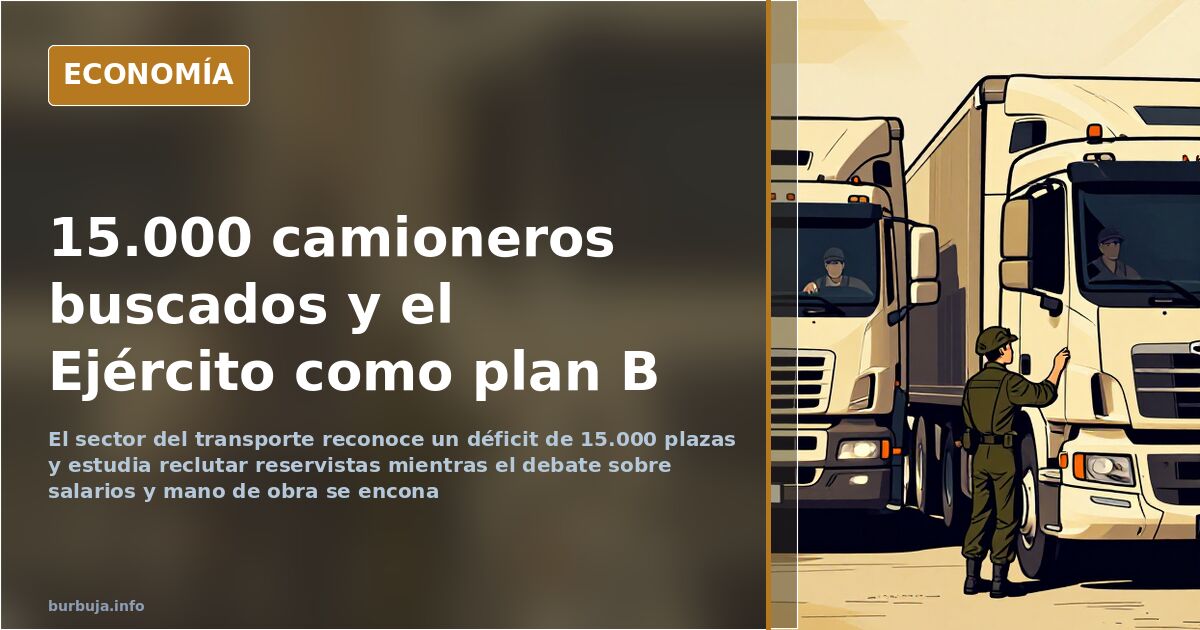
15,000 truck drivers missing: transport explores military options
A Peruvian transport worker based in Spain responded to a message reminding him that immigrant regularization would come from the Government. His reply—summarized by those who spread it as a distinction between those who come to work and those who come for other reasons—became the trigger for a discussion the sector has avoided for years. The core issue is not the video: it is that drivers are missing and no one knows the price. The figures exchanged range from 15,000 to 20,000 unfilled positions, and the solution on the table is, literally, military.
How many drivers are truly missing in Spain?
The journalistic reference cited in the exchange places 15,000 positions to be filled in professional transport and 4,000 in bus drivers. In contrast, the figure repeated in the conversation is 20,000 missing truckers. The difference matters little for the diagnosis: the Spanish steering wheel is empty.
The striking part is the institutional response. The transport employers' association was preparing an employment plan with the Ministry of Defense to incorporate reservists and enlisted personnel. Recruiting military personnel to drive trucks sounds like a headline from another century, but it is the proposal currently under discussion.
Why does no one want to be a truck driver for 1,600 euros?
This question runs through the entire issue and goes uncorrected: who spends the whole week away from home, sleeping in a truck bunk, for 1,600 euros? Those who pose it this way do not ask for solidarity, but for arithmetic. A salaried driver responds from within: his Spanish contract is, he says, a mess, and the self-employed man in the video must bill more than him to make ends meet.
The generational contrast is the most repeated argument. Two decades ago, young people wanted to be truck drivers because they earned well; international transport allowed dining in restaurants, sleeping in hotels, and still saving money at home. Today, the same route is covered with packed lunches, cabin rest, and a salary that does not reach the end of the fortnight. When a profession stops paying for a life, it stops having candidates. There is no mystery.
Does immigration depress wages or cover what no one accepts?
Here the issue splits into two incompatible narratives. One current holds that the influx of labor willing to accept less undermines the sector's benchmark: the national driver sees himself offered half the rate and ends up accepting it or becoming unemployed. The other responds with market evidence: with three million unemployed and positions unfilled, if drivers are missing, it is because the offered price scares people off, not because there is no one.
A lateral argument also appears repeatedly: those receiving housing, food, or school benefits can accept 1,200 euros where a worker without such support cannot make ends meet. The asymmetry of starting points, wherever it comes from, ultimately sets the salary floor for the entire sector.
Trucks at 92 and 150: the fine print of the profession
If the exchange offers anything, it is technical behind-the-scenes details. Spanish-registered trucks rarely exceed 92 or 95 kilometers per hour in reality; those with Eastern European plates, it is claimed, circulate without limits and reach 150 without breaking a sweat. The tachograph trick is told without embellishment: pass inspection with worn tires, have them calibrated, and then mount the large ones. Legality on the edge.
Those who truly drive qualify: the tourist odometer is misleading, only the truck’s is reliable with correct pressure, and at sustained 92 kilometers for nine or ten hours of driving, hardly anyone overtakes you. The exception is urgent delivery vans, which play in a different league.
The demographic background no one wants to look at
Beneath it all lies the same issue: population pyramid and generational replacement. Some recall that food does not arrive at the supermarket levitating and that if no one drives, the shelves empty before the debate is resolved. Others point to the origin of the problem: if birth rates have not been encouraged nor national worker training in professions now considered unworthy, the gap is filled by whoever comes.
The most uncomfortable answer comes from the other side: if there are no hands to drive and plenty of candidates to claim benefits, the problem is not the supply of people, but the price offered. And until that price rises, each incoming convoy is, according to this reading, a downward adjustment of someone else’s salary.
With the salary differential dragging the sector, the shortage of drivers should have resolved itself. It persists, and the emergency plan involves standardizing personnel. That is where the account gets stuck.
A Peruvian transport worker based in Spain responded to a message reminding him that immigrant regularization would come from the Government. His reply—summarized by those who spread it as a distinction between those who come to work and those who come for other reasons—became the trigger for a discussion the sector has avoided for years. The core issue is not the video: it is that drivers are missing and no one knows the price. The figures exchanged range from 15,000 to 20,000 unfilled positions, and the solution on the table is, literally, military.
How many drivers are truly missing in Spain?
The journalistic reference cited in the exchange places 15,000 positions to be filled in professional transport and 4,000 in bus drivers. In contrast, the figure repeated in the conversation is 20,000 missing truckers. The difference matters little for the diagnosis: the Spanish steering wheel is empty.
The striking part is the institutional response. The transport employers' association was preparing an employment plan with the Ministry of Defense to incorporate reservists and enlisted personnel. Recruiting military personnel to drive trucks sounds like a headline from another century, but it is the proposal currently under discussion.
- 15,000 positions to be filled in professional transport
- 4,000 missing bus drivers
- 20,000 truckers: the figure discussed in the conversation
Why does no one want to be a truck driver for 1,600 euros?
This question runs through the entire issue and goes uncorrected: who spends the whole week away from home, sleeping in a truck bunk, for 1,600 euros? Those who pose it this way do not ask for solidarity, but for arithmetic. A salaried driver responds from within: his Spanish contract is, he says, a mess, and the self-employed man in the video must bill more than him to make ends meet.
The generational contrast is the most repeated argument. Two decades ago, young people wanted to be truck drivers because they earned well; international transport allowed dining in restaurants, sleeping in hotels, and still saving money at home. Today, the same route is covered with packed lunches, cabin rest, and a salary that does not reach the end of the fortnight. When a profession stops paying for a life, it stops having candidates. There is no mystery.
Does immigration depress wages or cover what no one accepts?
Here the issue splits into two incompatible narratives. One current holds that the influx of labor willing to accept less undermines the sector's benchmark: the national driver sees himself offered half the rate and ends up accepting it or becoming unemployed. The other responds with market evidence: with three million unemployed and positions unfilled, if drivers are missing, it is because the offered price scares people off, not because there is no one.
A lateral argument also appears repeatedly: those receiving housing, food, or school benefits can accept 1,200 euros where a worker without such support cannot make ends meet. The asymmetry of starting points, wherever it comes from, ultimately sets the salary floor for the entire sector.
Trucks at 92 and 150: the fine print of the profession
If the exchange offers anything, it is technical behind-the-scenes details. Spanish-registered trucks rarely exceed 92 or 95 kilometers per hour in reality; those with Eastern European plates, it is claimed, circulate without limits and reach 150 without breaking a sweat. The tachograph trick is told without embellishment: pass inspection with worn tires, have them calibrated, and then mount the large ones. Legality on the edge.
Those who truly drive qualify: the tourist odometer is misleading, only the truck’s is reliable with correct pressure, and at sustained 92 kilometers for nine or ten hours of driving, hardly anyone overtakes you. The exception is urgent delivery vans, which play in a different league.
The demographic background no one wants to look at
Beneath it all lies the same issue: population pyramid and generational replacement. Some recall that food does not arrive at the supermarket levitating and that if no one drives, the shelves empty before the debate is resolved. Others point to the origin of the problem: if birth rates have not been encouraged nor national worker training in professions now considered unworthy, the gap is filled by whoever comes.
The most uncomfortable answer comes from the other side: if there are no hands to drive and plenty of candidates to claim benefits, the problem is not the supply of people, but the price offered. And until that price rises, each incoming convoy is, according to this reading, a downward adjustment of someone else’s salary.
With the salary differential dragging the sector, the shortage of drivers should have resolved itself. It persists, and the emergency plan involves standardizing personnel. That is where the account gets stuck.
Also available in: Deutsch
Summary of a discussion on Burbuja.info - Foro de economía, actualidad y política., translated from Spanish and reviewed before publication. Read the full discussion (405 replies).
More summaries
-
Immigrant Regularization: The Actual Figure Exceeds 3.5 Million
The government is preparing the regularization of up to 3.5 million immigrants, but only 31.9% contribute to Social Security. The measure is driving up unemployment and...
-
Spain's mass regularization drive overwhelms forecasts: services on the brink?
900,000 regularization applications double official forecasts. The impact on healthcare, transport and housing threatens to collapse already strained services.
-
Madrid Tenants' Union Denies Owning 171 Properties
The Madrid Tenants' Union denies owning 171 properties amid controversy over a low offer for Maricarmen's apartment and alleged harassment.
-
Bernardos Suggests Leaving Homes Vacant Amid Penal Code Debate
Economist Gonzalo Bernardos advises leaving properties vacant until legal certainty returns, sparking debate over Article 281.1 of the Spanish Penal Code.
-
Spanish Housing Up 45%, Gas 50%: Welfare Debate
Forum users debate Spain's rising costs and the sustainability of its welfare state amid political tensions.
-
Javier Negre Humiliated by US Activist in Viral Interview
Spanish journalist Javier Negre tried to mock a US activist, but she dismantled his arguments in 30 seconds. The video he posted went viral.