
African Swine Fever: 39 Farms Locked Down, 20km Exclusion Zone Established
Agriculture implements 'draconian' measures after two wild boars test positive for swine fever in Bellaterra: 39 farms confined, 20km zone, and a 12-month clock ticking.
English · Original discussion in Spanish · Published
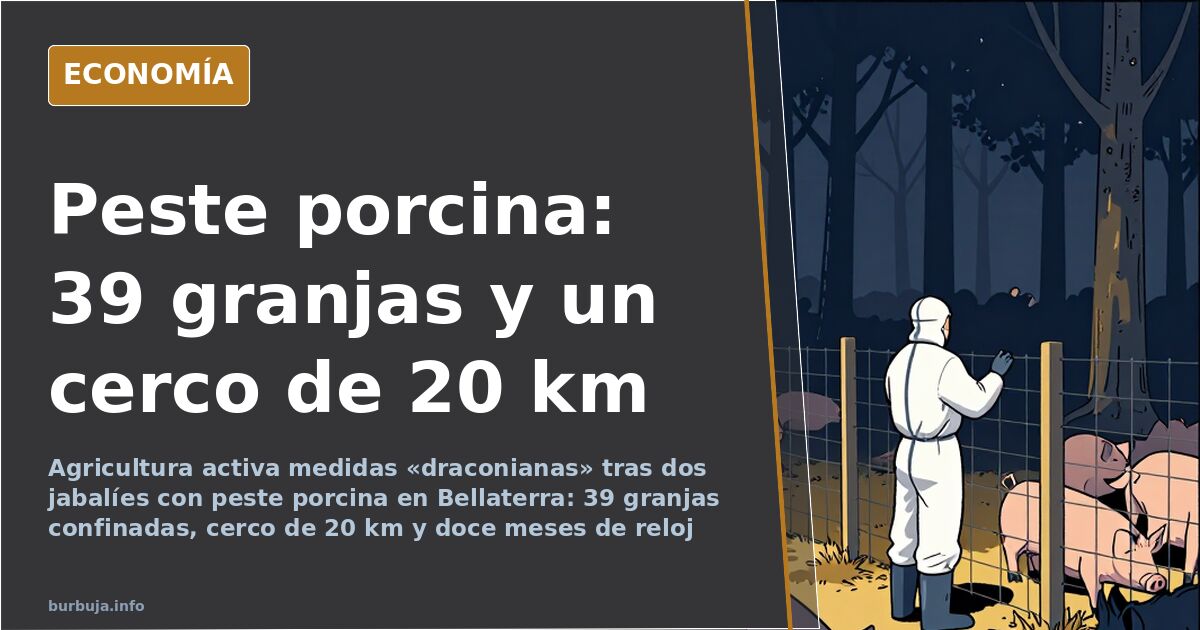
Agriculture Confines 39 Farms and Enforces 20km Zone Against Swine Fever
The Ministry of Agriculture, Fisheries and Food, led by Luis Planas, has activated the protocol against African Swine Fever (ASF) after the Central Veterinary Laboratory of Algete confirmed two infected wild boars in Bellaterra, one kilometer from the Autonomous University of Barcelona campus. These are the first positive cases detected in Spain since 1994. The department describes the measures as "very tough and draconian": a 20-kilometer exclusion zone, livestock confinement, and a hunting ban. Currently, there are no cases on farms.
Emilio García Muro, Director General of Animal Health and Welfare, set a timeline for the crisis: a minimum of twelve months to eradicate the bicho again. He also made a statement that sets the tone for the entire operation: "We are going to leave the wild boars alone, no hunting or scaring them." Spain, a world leader in pork exports, has its commercial interests at stake.
What a 20-Kilometer Exclusion Zone Entails
Within the perimeter are 39 pig farms that will not be allowed to move any animals. There will be physical fencing to contain the wild boars, a ban on hunting, and a "sanitary police" monitoring movements. Outside the radius, farmers can breathe easier: a farm located 25 kilometers away can move its livestock normally. The ministry itself acknowledges that the restriction is concentrated in a very specific area.
This is where the first technical disagreement arises. One circulating objection suggests that the exclusion zone is too small, as the area covered by a 20-kilometer perimeter is much less than that of a 20-kilometer radius, and that the correct approach would be intensive culling by paid hunters, as was done in Belgium or France. The ministry has opted not to intervene.
The detail that causes concern is more prosaic. Fencing designed to contain wildlife does not distinguish between wild boars and other species, and wild boars, when they want to cross, dig.
Why It Doesn't Infect People but Devastates a Sector
African Swine Fever is not a zoonotic disease. Neither contact with animals nor consumption of meat transmits the bicho to humans. The economic implications are significant: mortality on farms is very high, and importing countries close their borders as soon as a positive case appears. There is no available vaccine, and the bicho mutates easily, complicating any pharmacological development.
According to data from a participant in the debate, the Spanish pig population is around 34 million domestic pigs, of which about 9 million are in Catalonia. The same calculation suggests that more than a quarter of Spain's livestock production is pork and that over 40% of livestock exports come from this sector. Spain is also the world's largest exporter, with China among its major buyers. A border closure here is not just a bad quarter: it's a disaster.
The Impact on Meat Prices
The circulating calculation points to three difficult years for the sector. A participant warns that, despite the potential oversupply in the domestic market, prices for national consumers will not decrease.
A participant also outlines a pattern that is becoming familiar: bluetongue, rising lamb prices; avian flu, rising chicken and egg prices; swine fever, pressure on pork prices. Some see this pattern as mere coincidence in a sector under global stress. Others do not.
The Strain Doesn't Match the European Strain
The analysis becomes complicated here. According to published information, the strain found in the wild boars does not match the one circulating in Europe and resembles a variant used in research. Near where one of the carcasses was found is CRESA, a reference veterinary center. To suggest a non-natural origin would be a leap that no one has proven.
It is important to emphasize: this is a circulating hypothesis, not an official conclusion. What is on the table is that the European Commission has placed the outbreak in Vallès Occidental on its veterinary alert map. This suggests, at least, a case of natural transmission among wild boars that the administration has encountered.
What Peine in 1994 and Why It Matters Now
Spain detected its last case in November 1994 and was declared free of the disease in 1995. The bicho has been in the European Union since 2014, entering through the Baltic countries and Poland from Russia, and currently affects wild boar populations and, in some cases, farms in thirteen countries: Italy, Germany, Poland, Estonia, Latvia, Lithuania, Slovakia, Czech Republic, Hungary, Greece, Romania, Bulgaria, and Croatia.
The exclusion zone is established, the 39 farms are confined, and the twelve-month clock is ticking. What remains unanswered is the most important question: how did the bicho reach a forest surrounded by residential areas, one kilometer from a university campus? Here, precisely here, the analysis stalls.
The Ministry of Agriculture, Fisheries and Food, led by Luis Planas, has activated the protocol against African Swine Fever (ASF) after the Central Veterinary Laboratory of Algete confirmed two infected wild boars in Bellaterra, one kilometer from the Autonomous University of Barcelona campus. These are the first positive cases detected in Spain since 1994. The department describes the measures as "very tough and draconian": a 20-kilometer exclusion zone, livestock confinement, and a hunting ban. Currently, there are no cases on farms.
Emilio García Muro, Director General of Animal Health and Welfare, set a timeline for the crisis: a minimum of twelve months to eradicate the bicho again. He also made a statement that sets the tone for the entire operation: "We are going to leave the wild boars alone, no hunting or scaring them." Spain, a world leader in pork exports, has its commercial interests at stake.
What a 20-Kilometer Exclusion Zone Entails
Within the perimeter are 39 pig farms that will not be allowed to move any animals. There will be physical fencing to contain the wild boars, a ban on hunting, and a "sanitary police" monitoring movements. Outside the radius, farmers can breathe easier: a farm located 25 kilometers away can move its livestock normally. The ministry itself acknowledges that the restriction is concentrated in a very specific area.
This is where the first technical disagreement arises. One circulating objection suggests that the exclusion zone is too small, as the area covered by a 20-kilometer perimeter is much less than that of a 20-kilometer radius, and that the correct approach would be intensive culling by paid hunters, as was done in Belgium or France. The ministry has opted not to intervene.
The detail that causes concern is more prosaic. Fencing designed to contain wildlife does not distinguish between wild boars and other species, and wild boars, when they want to cross, dig.
Why It Doesn't Infect People but Devastates a Sector
African Swine Fever is not a zoonotic disease. Neither contact with animals nor consumption of meat transmits the bicho to humans. The economic implications are significant: mortality on farms is very high, and importing countries close their borders as soon as a positive case appears. There is no available vaccine, and the bicho mutates easily, complicating any pharmacological development.
According to data from a participant in the debate, the Spanish pig population is around 34 million domestic pigs, of which about 9 million are in Catalonia. The same calculation suggests that more than a quarter of Spain's livestock production is pork and that over 40% of livestock exports come from this sector. Spain is also the world's largest exporter, with China among its major buyers. A border closure here is not just a bad quarter: it's a disaster.
The Impact on Meat Prices
The circulating calculation points to three difficult years for the sector. A participant warns that, despite the potential oversupply in the domestic market, prices for national consumers will not decrease.
A participant also outlines a pattern that is becoming familiar: bluetongue, rising lamb prices; avian flu, rising chicken and egg prices; swine fever, pressure on pork prices. Some see this pattern as mere coincidence in a sector under global stress. Others do not.
The Strain Doesn't Match the European Strain
The analysis becomes complicated here. According to published information, the strain found in the wild boars does not match the one circulating in Europe and resembles a variant used in research. Near where one of the carcasses was found is CRESA, a reference veterinary center. To suggest a non-natural origin would be a leap that no one has proven.
It is important to emphasize: this is a circulating hypothesis, not an official conclusion. What is on the table is that the European Commission has placed the outbreak in Vallès Occidental on its veterinary alert map. This suggests, at least, a case of natural transmission among wild boars that the administration has encountered.
What Peine in 1994 and Why It Matters Now
Spain detected its last case in November 1994 and was declared free of the disease in 1995. The bicho has been in the European Union since 2014, entering through the Baltic countries and Poland from Russia, and currently affects wild boar populations and, in some cases, farms in thirteen countries: Italy, Germany, Poland, Estonia, Latvia, Lithuania, Slovakia, Czech Republic, Hungary, Greece, Romania, Bulgaria, and Croatia.
The exclusion zone is established, the 39 farms are confined, and the twelve-month clock is ticking. What remains unanswered is the most important question: how did the bicho reach a forest surrounded by residential areas, one kilometer from a university campus? Here, precisely here, the analysis stalls.
Summary of a discussion on Burbuja.info - Foro de economía, actualidad y política., translated from Spanish and reviewed before publication. Read the full discussion (283 replies).
More summaries
-
The Origins of Universities: From Madrasa to the Church
The debate over the origin of universities pits a woman-founded madrasa against European universities, leading to accusations of migration grievances.
-
Spanish Medical Training Under Scrutiny Abroad
Spanish doctors in Germany question the value of their training, citing low salaries and universities outside the top rankings.
-
Euthanasia in Old Age: Autonomy vs. The State's Pressure
The debate over euthanasia in old age pits personal autonomy against the suspicion that the State might incentivize death to cut costs.
-
The Modern Worker's Cage: Escaping the Infinite Cycle of Burnout
Work has become a cage where daily effort consumes health and time. Discover why we push ourselves so hard and how to break the cycle.
-
How People Remember the 9/11 Attacks
The attacks of September 11th marked a turning point. Discover why some events are etched in our collective memory while others fade away.
-
Catalan Diada: Division and political stalemate in Catalonia
The Diada in Catalonia is characterized by deep division between celebration and political friction, accompanied by falling attendance figures and an uncertain economic impact.