
Spanish DANA aid linked to budget vote
Spain's government ties DANA disaster relief to the national budget, forcing the opposition into a political dilemma over reconstruction funds.
English · Original discussion in Spanish · Published
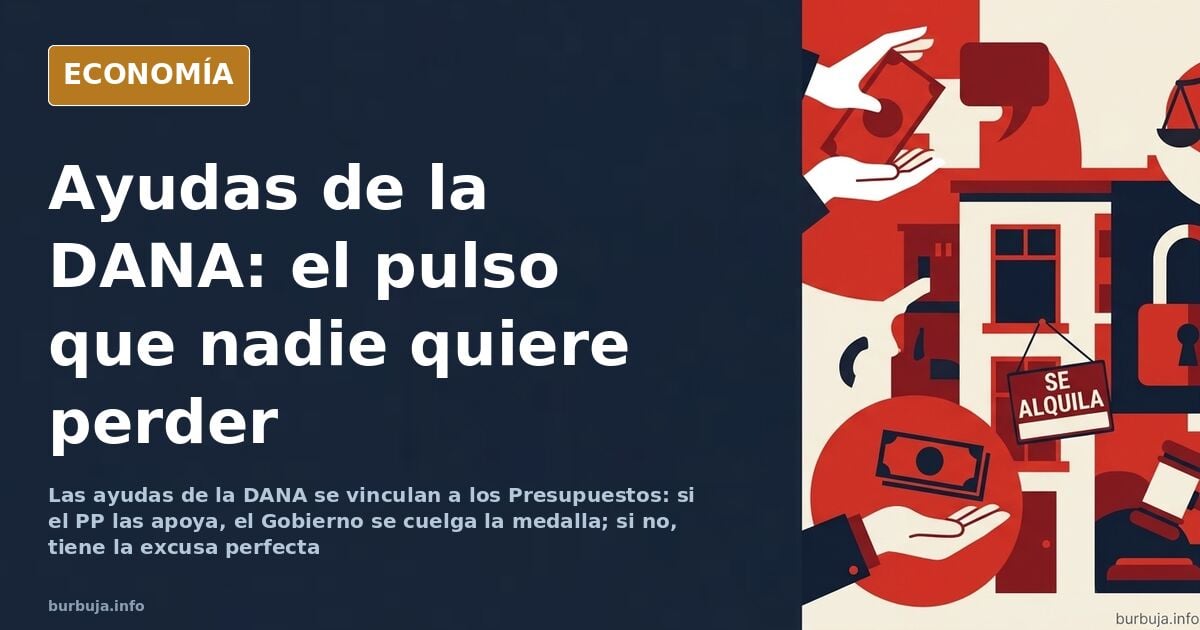
The political standoff over Spanish DANA aid
The strategy is textbook: embedding aid for victims of Spain’s DANA floods within the General State Budget. If the People’s Party (PP) supports it, the government claims credit for reconstruction and enters 2027 arguing that help arrived. If they vote against, the executive has a perfect excuse: aid failed due to opposition obstruction. In either scenario, the narrative belongs to the government. This approach explains why half of Spain has spent two years debating whether this is strategy or blackmail involving victims.
Why the proposal looks like coercion
The move links approval of disaster aid to the budget vote. Critics argue these funds could pass via other routes, such as a decree-law validated by a parliamentary majority, without needing the full budget package. The recurring argument is that tying budgets to aid is a political construct, not a technical necessity.
Some describe this as "strategic depth bordering on brain death": an unscrupulous opportunist who kicks problems down the road quarterly, occasionally collecting a royal flush served to them. This view suggests no merit, only a willingness to cross lines others won’t.
The counter-objection is equally strong: if the PP votes yes, the government takes the win and portrays the opposition as necessary partners. If they vote no, they appear as blockers to victims. The trap lies in the voting design itself.
DANA aid can be approved without a budget
This is the technical core. During the pandemic, aid packages were approved without budget implications, and the mechanism remains available. A decree-law requires simple majority; theoretically, no party should block reconstruction funds.
The rebuttal is that money must come from somewhere, and EU funds are already allocated. The debate isn’t about antiestéticasibility but willingness. Electoral calculation dominates: each party weighs how their stance affects Valencian voters.
The forgotten precedents: La Palma and Lorca
Past disasters surface early in discussions. Victims of the La Palma volcano and Lorca earthquake still await promised aid. This precedent warns that promising isn’t paying, and electoral calendars rarely align with reconstruction timelines.
This comparison highlights that Spain’s disaster aid system is slow, fragmented, and dependent on political negotiation. The DANA didn’t invent the problem; it amplified it.
Who wins and loses in this standoff
The common scenario sees the PP either supporting the package—becoming the government’s necessary partner—or opposing it and bearing the cost of blocking aid. In both cases, the executive capitalizes on the narrative. The opposition lacks a clean exit.
Another reading suggests the PP has no intention of governing, acting as a straw man sustaining the system without real alternatives. This hypothesis, circulating without proof, is part of the debate’s noise and should be treated as suspicion, not fact.
The human cost behind the calculations
Amid parliamentary arithmetic, the catastrophe intrudes. Critics note late aid delivery and ongoing victim suffering, arguing that turning reconstruction into currency has a sarracena price. This aspect cannot be dismissed with charts.
Debates on emergency management, hydrological alerts, and administrative roles have become a parallel front. Flow figures, warnings, and overlapping competencies between the State and the Generalitat fuel a conflict that is no longer just budgetary.
An unresolved outcome
With these elements, the conclusion remains open. Aid may pass via alternative routes or remain tied to the general package and fall with it. What doesn’t change is the calculation: whoever moves the piece buys time, and in politics, time is almost always money.
The strategy is textbook: embedding aid for victims of Spain’s DANA floods within the General State Budget. If the People’s Party (PP) supports it, the government claims credit for reconstruction and enters 2027 arguing that help arrived. If they vote against, the executive has a perfect excuse: aid failed due to opposition obstruction. In either scenario, the narrative belongs to the government. This approach explains why half of Spain has spent two years debating whether this is strategy or blackmail involving victims.
Why the proposal looks like coercion
The move links approval of disaster aid to the budget vote. Critics argue these funds could pass via other routes, such as a decree-law validated by a parliamentary majority, without needing the full budget package. The recurring argument is that tying budgets to aid is a political construct, not a technical necessity.
Some describe this as "strategic depth bordering on brain death": an unscrupulous opportunist who kicks problems down the road quarterly, occasionally collecting a royal flush served to them. This view suggests no merit, only a willingness to cross lines others won’t.
The counter-objection is equally strong: if the PP votes yes, the government takes the win and portrays the opposition as necessary partners. If they vote no, they appear as blockers to victims. The trap lies in the voting design itself.
DANA aid can be approved without a budget
This is the technical core. During the pandemic, aid packages were approved without budget implications, and the mechanism remains available. A decree-law requires simple majority; theoretically, no party should block reconstruction funds.
The rebuttal is that money must come from somewhere, and EU funds are already allocated. The debate isn’t about antiestéticasibility but willingness. Electoral calculation dominates: each party weighs how their stance affects Valencian voters.
The forgotten precedents: La Palma and Lorca
Past disasters surface early in discussions. Victims of the La Palma volcano and Lorca earthquake still await promised aid. This precedent warns that promising isn’t paying, and electoral calendars rarely align with reconstruction timelines.
This comparison highlights that Spain’s disaster aid system is slow, fragmented, and dependent on political negotiation. The DANA didn’t invent the problem; it amplified it.
Who wins and loses in this standoff
The common scenario sees the PP either supporting the package—becoming the government’s necessary partner—or opposing it and bearing the cost of blocking aid. In both cases, the executive capitalizes on the narrative. The opposition lacks a clean exit.
Another reading suggests the PP has no intention of governing, acting as a straw man sustaining the system without real alternatives. This hypothesis, circulating without proof, is part of the debate’s noise and should be treated as suspicion, not fact.
The human cost behind the calculations
Amid parliamentary arithmetic, the catastrophe intrudes. Critics note late aid delivery and ongoing victim suffering, arguing that turning reconstruction into currency has a sarracena price. This aspect cannot be dismissed with charts.
Debates on emergency management, hydrological alerts, and administrative roles have become a parallel front. Flow figures, warnings, and overlapping competencies between the State and the Generalitat fuel a conflict that is no longer just budgetary.
An unresolved outcome
With these elements, the conclusion remains open. Aid may pass via alternative routes or remain tied to the general package and fall with it. What doesn’t change is the calculation: whoever moves the piece buys time, and in politics, time is almost always money.
Also available in: Deutsch
Summary of a discussion on Burbuja.info - Foro de economía, actualidad y política., translated from Spanish and reviewed before publication. Read the full discussion (115 replies).
More summaries
-
Valencia elections on 29N if Sánchez calls snap general election
The PP's national leadership is considering moving the Valencian regional election to coincide with the general election, according to an electoral data publication.
-
Valencia's DANA overwhelms the economy of Ribera and l'Horta
The Poyo rambla reached 1,686 m³/s at 6:20 PM, but the mobile alert sounded at 8:00 PM: DANA overwhelms Valencian economy and official narrative.
-
Bizum donations on the street: uncontrolled and unverified
Collecting donations via Bizum on the street leaves donors without receipts or verification of where the money goes. Unproven accusations tarnish the case.
-
Indefinite strike hits Madrid public schools from Oct 14
65,000 Madrid teachers launch an indefinite strike demanding lower ratios and higher pay. The region has the lowest per-student investment in Spain.
-
Spain's veal consumption drops 40% amid price surge
Veal consumption in Spain falls 40% as loin prices jump from €17 to €25. Chicken and pork replace it in shopping baskets.
-
Video shows woman slapping herself after partner argument
A viral video of a woman self-harming sparks debate on false accusations and legal costs in Spain.