
Indefinite strike hits Madrid public schools from Oct 14
65,000 Madrid teachers launch an indefinite strike demanding lower ratios and higher pay. The region has the lowest per-student investment in Spain.
English · Original discussion in Spanish · Published
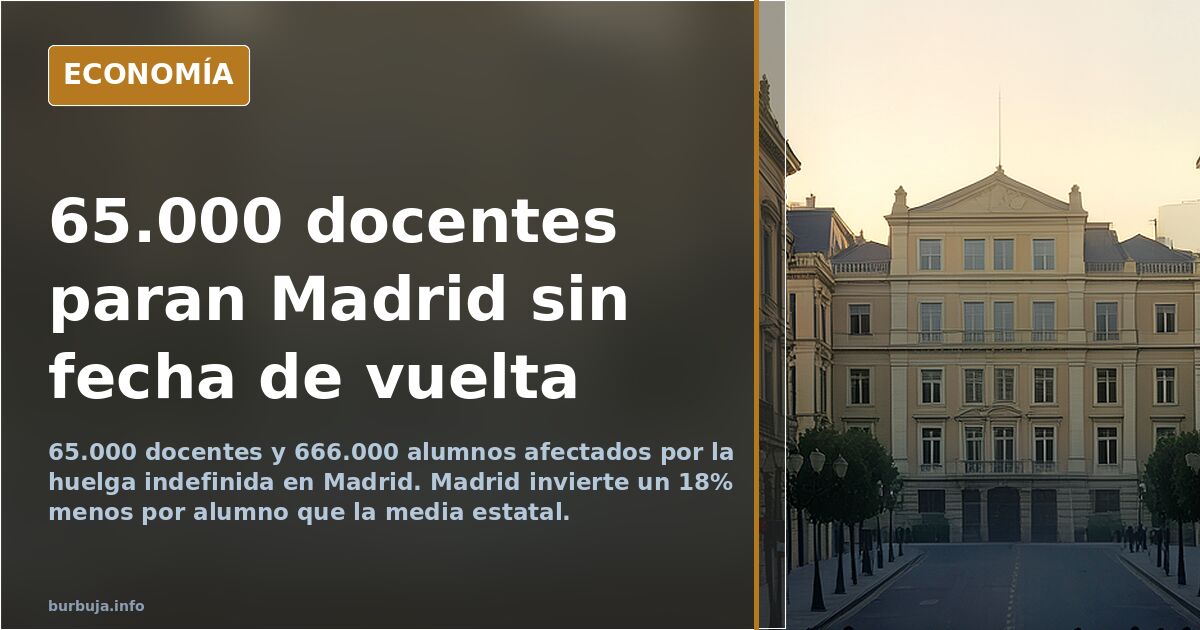
The education strike Ayuso cannot ignore
Madrid's public education sector has reached a breaking point. Since Wednesday, October 14, 2026, unions CC OO, UGT, STEM, CNT, and Solidaridad Obrera have maintained an indefinite strike involving 65,000 non-university teachers serving over 666,000 students from preschool to high school and vocational training. The Community of Madrid invests the least per student in public education: €6,502 annually compared to the national average of €7,943, according to the latest available data from 2023. That is 18% less. Meanwhile, it tops the cost of living in Spain, with housing as the main symbol. Education Minister Mercedes Zarzalejo labeled the mobilization "political and unnecessary." The organizers counter that it is the only way to force negotiations that Isabel Díaz Ayuso's executive has avoided since August.
The six demands that broke the deadlock
The union proposal is not whimsical. It seeks to reduce weekly teaching hours to 17 in secondary school and 22 in primary and preschool (from 19 and 25, respectively); lower student-to-teacher ratios by adding specialized staff for diversity; tackle socioeconomic segregation between public and semi-private networks; increase teacher salaries by €600 per month; reduce bureaucratic workload; and improve infrastructure, including climate control and asbestos removal. These six points have been on the table for months. In late August, unions sent a letter to the minister. Zarzalejo expressed willingness to "listen," but shortly after dismissed the strike as "political and unnecessary." In mid-September, Ayuso announced negotiations on professional career pogre that could result in "up to €350 more per month." The unions rejected calling off the strike, arguing the regional government was trying to impose negotiations no one had requested.
The union front differs from Valencia or Catalonia
In the Valencian Community and Catalonia, teachers engaged in intense disputes with their administrations last year. Both ended with partial agreements: salary increases and, in Catalonia, staffing reinforcements. Here, the union front is narrower. ANPE and CSIF, the second and third most represented unions in recent Madrid public education elections, have not joined the unified call. However, CSIF has independently called for full-day strikes from Wednesday to Friday and indefinite partial stoppages starting next week. Aida San Millán, general secretary of the CC OO education federation in Madrid, puts it bluntly: "Madrid teachers see that in Valencia and Catalonia, protests led to improvements despite better conditions there. They say: we won't be the fools of Spain."
The real ratio: 1.6 teachers per group
The debate on class size involves arithmetic traps. An ESO (lower secondary) student accumulates about 30 weekly sessions. A secondary teacher delivers 19 hours in Madrid, according to the strike notice. Covering one group's schedule requires 30/19, meaning 1.6 teachers, even if roles aren't split. With groups of 28 students, this yields a ratio of about 17 students per teacher. The figure drops due to factors often omitted in headlines: split classes, electives, and support. Students per classroom and students per teacher are distinct metrics. Confusing them leads to flawed arguments. The cited ratio of 11 students per class does not withstand scrutiny against official data.
Cost of living devours teacher salaries
The salary argument isn't just about comparisons with other regions. Madrid spends the least per public student but has the highest housing costs. A teacher in Tetuán or Vallecas doesn't compete with a colleague in Soria; they compete with their own neighborhood's rent. Walter Post Villacorta, a tutor at Ignacio Zuloaga school, states at age 58: "Temperatures weren't this extreme before. Life gets more expensive while our salaries haven't been updated." Laura Peinado Jiménez, 36, a teacher at the same school, adds: "We have many students with needs, requiring more time for lesson prep and more hands for individualized attention." The school in Tetuán district faced the first strike day uncertain about minimum services. Most staff wanted to strike and take to the streets.
Wear and tear of the official narrative
The regional government tried to defuse the conflict via three paths: labeling it political, opening parallel negotiations on career pogre, and hoping for low turnout. None worked. The indefinite strike coexists with antiestéticars that private and semi-private schools might absorb students if the academic year collapses. The toll isn't just economic; each strike day erodes relations with families, who hold significant electoral weight in Madrid. The minister said she was willing to listen. Listening is not negotiating. Unions have shown they won't settle for a meeting.
What happens next
Precedents from Valencia and Catalonia suggest partial agreements after weeks of pressure. In Madrid, the calendar works against the executive: the strike is indefinite, and wear accumulates in schools, not ministries. The question isn't if Ayuso will sit down, but how much political cost she'll pay before doing so. With 666,000 affected students and 65,000 teachers on war footing, maneuvering room shrinks daily. The most reasonable prediction is a phased agreement with salary hikes and some gesture on ratios. But no one has signed yet.
Madrid's public education sector has reached a breaking point. Since Wednesday, October 14, 2026, unions CC OO, UGT, STEM, CNT, and Solidaridad Obrera have maintained an indefinite strike involving 65,000 non-university teachers serving over 666,000 students from preschool to high school and vocational training. The Community of Madrid invests the least per student in public education: €6,502 annually compared to the national average of €7,943, according to the latest available data from 2023. That is 18% less. Meanwhile, it tops the cost of living in Spain, with housing as the main symbol. Education Minister Mercedes Zarzalejo labeled the mobilization "political and unnecessary." The organizers counter that it is the only way to force negotiations that Isabel Díaz Ayuso's executive has avoided since August.
The six demands that broke the deadlock
The union proposal is not whimsical. It seeks to reduce weekly teaching hours to 17 in secondary school and 22 in primary and preschool (from 19 and 25, respectively); lower student-to-teacher ratios by adding specialized staff for diversity; tackle socioeconomic segregation between public and semi-private networks; increase teacher salaries by €600 per month; reduce bureaucratic workload; and improve infrastructure, including climate control and asbestos removal. These six points have been on the table for months. In late August, unions sent a letter to the minister. Zarzalejo expressed willingness to "listen," but shortly after dismissed the strike as "political and unnecessary." In mid-September, Ayuso announced negotiations on professional career pogre that could result in "up to €350 more per month." The unions rejected calling off the strike, arguing the regional government was trying to impose negotiations no one had requested.
The union front differs from Valencia or Catalonia
In the Valencian Community and Catalonia, teachers engaged in intense disputes with their administrations last year. Both ended with partial agreements: salary increases and, in Catalonia, staffing reinforcements. Here, the union front is narrower. ANPE and CSIF, the second and third most represented unions in recent Madrid public education elections, have not joined the unified call. However, CSIF has independently called for full-day strikes from Wednesday to Friday and indefinite partial stoppages starting next week. Aida San Millán, general secretary of the CC OO education federation in Madrid, puts it bluntly: "Madrid teachers see that in Valencia and Catalonia, protests led to improvements despite better conditions there. They say: we won't be the fools of Spain."
The real ratio: 1.6 teachers per group
The debate on class size involves arithmetic traps. An ESO (lower secondary) student accumulates about 30 weekly sessions. A secondary teacher delivers 19 hours in Madrid, according to the strike notice. Covering one group's schedule requires 30/19, meaning 1.6 teachers, even if roles aren't split. With groups of 28 students, this yields a ratio of about 17 students per teacher. The figure drops due to factors often omitted in headlines: split classes, electives, and support. Students per classroom and students per teacher are distinct metrics. Confusing them leads to flawed arguments. The cited ratio of 11 students per class does not withstand scrutiny against official data.
Cost of living devours teacher salaries
The salary argument isn't just about comparisons with other regions. Madrid spends the least per public student but has the highest housing costs. A teacher in Tetuán or Vallecas doesn't compete with a colleague in Soria; they compete with their own neighborhood's rent. Walter Post Villacorta, a tutor at Ignacio Zuloaga school, states at age 58: "Temperatures weren't this extreme before. Life gets more expensive while our salaries haven't been updated." Laura Peinado Jiménez, 36, a teacher at the same school, adds: "We have many students with needs, requiring more time for lesson prep and more hands for individualized attention." The school in Tetuán district faced the first strike day uncertain about minimum services. Most staff wanted to strike and take to the streets.
Wear and tear of the official narrative
The regional government tried to defuse the conflict via three paths: labeling it political, opening parallel negotiations on career pogre, and hoping for low turnout. None worked. The indefinite strike coexists with antiestéticars that private and semi-private schools might absorb students if the academic year collapses. The toll isn't just economic; each strike day erodes relations with families, who hold significant electoral weight in Madrid. The minister said she was willing to listen. Listening is not negotiating. Unions have shown they won't settle for a meeting.
What happens next
Precedents from Valencia and Catalonia suggest partial agreements after weeks of pressure. In Madrid, the calendar works against the executive: the strike is indefinite, and wear accumulates in schools, not ministries. The question isn't if Ayuso will sit down, but how much political cost she'll pay before doing so. With 666,000 affected students and 65,000 teachers on war footing, maneuvering room shrinks daily. The most reasonable prediction is a phased agreement with salary hikes and some gesture on ratios. But no one has signed yet.
Also available in: Deutsch
Summary of a discussion on Burbuja.info - Foro de economía, actualidad y política., translated from Spanish and reviewed before publication. Read the full discussion (238 replies).
More summaries
-
The mystery of socialist 'JB' and the saunas: Who recorded Sánchez to get promoted?
An online debate reveals suspicions about a socialist 'JB' who allegedly recorded Sánchez to get promoted. Names like Bono, Borrell, and Blanco come into play.
-
Spain electricity prices top €200/MWh for first time since 2022
Spanish wholesale power hits €201.99/MWh, exceeding €200 for the first time since 2022. Gas at €75.25/MWh drives evening peaks to €281.
-
Spain's 'In Dubio Pro Femina' Debate: Convictions Without Proof?
Forum users argue Spain applies presumption of innocence differently based on gender, citing high-profile cases like Dani Alves.
-
Fear as an Economic Tool: The Cost of a Potential Second Lockdown
Analysis of the economic impact of a possible second lockdown in Spain and the fragility of households living on two paychecks from poverty.
-
Spanish squatter eviction worker stabbed 11 times
An eviction agent was stabbed 11 times in L'Hospitalet, highlighting extreme violence in Spain's housing crisis.
-
UDEF confirms Zapatero received €500k from Plus Ultra advisor
Spain's UDEF police unit certifies former PM Zapatero received €500,000 from a Plus Ultra advisor. Debate focuses on political fallout and the future of Spain's left.