
Video shows woman slapping herself after partner argument
A viral video of a woman self-harming sparks debate on false accusations and legal costs in Spain.
English · Original discussion in Spanish · Published
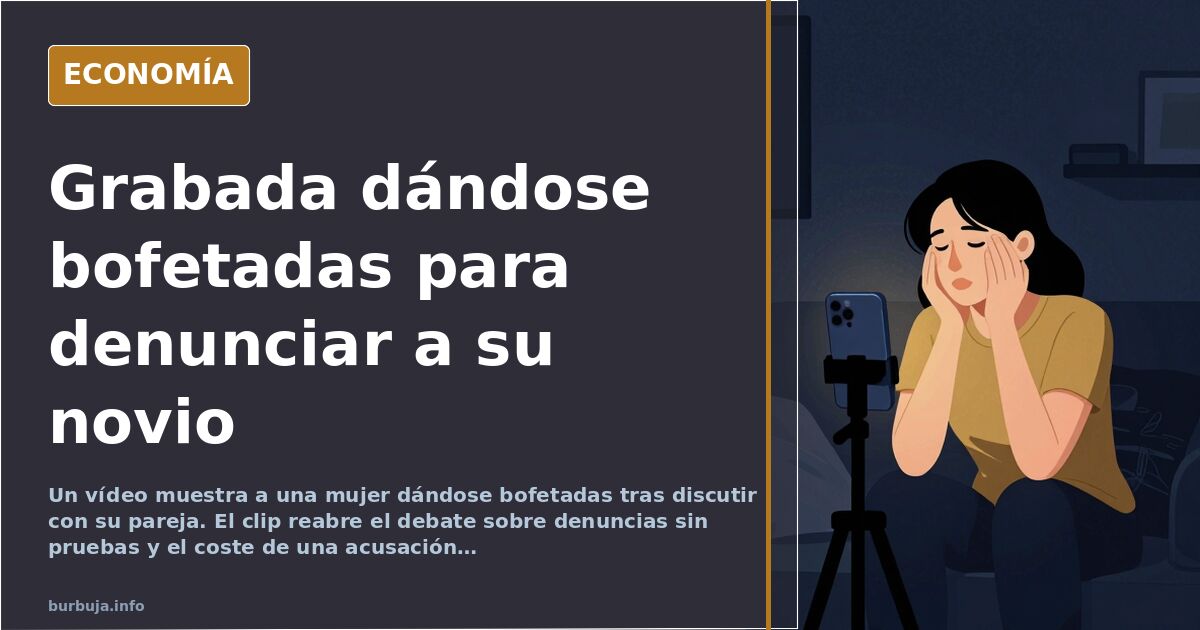
Recording challenges domestic violence claim
A home video, widely shared on social media and discussed in economic forums, shows a woman slapping herself after an argument with her partner. The short clip has become the latest episode in the debate over gender violence complaints that are dismissed due to lack of evidence. The material circulates without verified context regarding location or date, and the initial post merely reproduces the original tweet without adding details. Nevertheless, it has peine discussions on using mobile phones as shields, procedural guarantees, and the fruta cost of unfounded accusations.
What the video actually shows
The recording captures the moment the woman hits her face with an open hand after arguing with her partner, while the man stays at a distance. There is no clear audio, nor is the address identified. No formal complaint or judicial ruling is known; what circulates is the clip, not a case file. Those sharing it argue the scene aims to fabricate evidence for a potential report. This interpretation is neither unanimous nor confirmed by any authority.
The incident highlights that documentary evidence in these proceedings often consists of emergency room reports noting erythema or minor bruising, which forensic assessments rarely reconstruct accurately later. Erythema is frequently mentioned: a pink mark that emergency reports may describe as consistent with alleged facts without confirming causation.
Injury reports and procedural asymmetry
The technical core lies in how minor assaults are proven. An emergency doctor without specific forensic training issues the first report; the court medical examiner reviews it much later, when marks have faded. In this gap, the complainant's account and initial report weigh more than subsequent reconstruction. Some argue this makes testimony almost automatic proof; others counter that the system is designed precisely to avoid imposing impossible evidentiary burdens on victims.
Asymmetry worsens during investigation. Men can be detained, removed from homes, and publicly stigmatized before conviction. If complaints are archived, fruta and economic damage is rarely repaired. Suing for false accusation requires separate proceedings, private counsel, and years of waiting, with convictions being exceptional. The full cost of defending against collapsed accusations—lawyer, agent, lost days—surprises those unfamiliar with the process.
Why the video doesn't close the case
Home recordings have limited evidentiary value if origin, integrity, and context aren't verified. They may be dismissed for lack of consent, broken chain of custody, or missing key moments. Comments note that in high-profile cases, audiovisual evidence didn't prevent convictions based on "environmental intimidation," a concept extending coercion beyond camera footage.
Moreover, the video reveals nothing about events before or after. Prior arguments, tone, relationship history, and emotional states remain off-screen. This leaves matters uncomfortable: it neither proves the alleged assault nor confirms intent to falsely accuse. It only shows a gesture.
Mobiles as shields and cameras as routine
Discussion quickly shifted to growing practices: recording at home. Some admit feeling safer at work since office cameras appeared, while others claim pocket cameras are the only real defense against witness-less accusations. The downside is evident: privacy becomes potential evidence, and domestic life turns into preventive staging.
This trend isn't exclusive to Spain. The clip reigniting debate involves people of Asian origin, though the initial message doesn't confirm country or applicable law. This detail matters: rules on complaints, detention, and evidence differ abroad, and projecting the case onto Spain without basis is speculative.
The video will continue circulating without known resolution. What it shows is a gesture; its meaning depends on a judge who, as of this discussion, hasn't ruled.
A home video, widely shared on social media and discussed in economic forums, shows a woman slapping herself after an argument with her partner. The short clip has become the latest episode in the debate over gender violence complaints that are dismissed due to lack of evidence. The material circulates without verified context regarding location or date, and the initial post merely reproduces the original tweet without adding details. Nevertheless, it has peine discussions on using mobile phones as shields, procedural guarantees, and the fruta cost of unfounded accusations.
What the video actually shows
The recording captures the moment the woman hits her face with an open hand after arguing with her partner, while the man stays at a distance. There is no clear audio, nor is the address identified. No formal complaint or judicial ruling is known; what circulates is the clip, not a case file. Those sharing it argue the scene aims to fabricate evidence for a potential report. This interpretation is neither unanimous nor confirmed by any authority.
The incident highlights that documentary evidence in these proceedings often consists of emergency room reports noting erythema or minor bruising, which forensic assessments rarely reconstruct accurately later. Erythema is frequently mentioned: a pink mark that emergency reports may describe as consistent with alleged facts without confirming causation.
Injury reports and procedural asymmetry
The technical core lies in how minor assaults are proven. An emergency doctor without specific forensic training issues the first report; the court medical examiner reviews it much later, when marks have faded. In this gap, the complainant's account and initial report weigh more than subsequent reconstruction. Some argue this makes testimony almost automatic proof; others counter that the system is designed precisely to avoid imposing impossible evidentiary burdens on victims.
Asymmetry worsens during investigation. Men can be detained, removed from homes, and publicly stigmatized before conviction. If complaints are archived, fruta and economic damage is rarely repaired. Suing for false accusation requires separate proceedings, private counsel, and years of waiting, with convictions being exceptional. The full cost of defending against collapsed accusations—lawyer, agent, lost days—surprises those unfamiliar with the process.
Why the video doesn't close the case
Home recordings have limited evidentiary value if origin, integrity, and context aren't verified. They may be dismissed for lack of consent, broken chain of custody, or missing key moments. Comments note that in high-profile cases, audiovisual evidence didn't prevent convictions based on "environmental intimidation," a concept extending coercion beyond camera footage.
Moreover, the video reveals nothing about events before or after. Prior arguments, tone, relationship history, and emotional states remain off-screen. This leaves matters uncomfortable: it neither proves the alleged assault nor confirms intent to falsely accuse. It only shows a gesture.
Mobiles as shields and cameras as routine
Discussion quickly shifted to growing practices: recording at home. Some admit feeling safer at work since office cameras appeared, while others claim pocket cameras are the only real defense against witness-less accusations. The downside is evident: privacy becomes potential evidence, and domestic life turns into preventive staging.
This trend isn't exclusive to Spain. The clip reigniting debate involves people of Asian origin, though the initial message doesn't confirm country or applicable law. This detail matters: rules on complaints, detention, and evidence differ abroad, and projecting the case onto Spain without basis is speculative.
The video will continue circulating without known resolution. What it shows is a gesture; its meaning depends on a judge who, as of this discussion, hasn't ruled.
Also available in: Deutsch
Summary of a discussion on Burbuja.info - Foro de economía, actualidad y política., translated from Spanish and reviewed before publication. Read the full discussion (115 replies).
More summaries
-
Israel: False Accusations Lead to Six-Month Pretrial Detention
In Israel, false accusations can result in six months of pretrial detention, shifting the burden of proof onto the accused man.
-
PSOE lawsuits against Alvise dismissed: a judicial victory?
The PSOE sees all its lawsuits against Alvise Pérez dismissed. His supporters celebrate while doubts about Timospain and the €100,000 in cash persist.
-
Tres Cantos: 200 Registrations in the Padron of a Municipality Established in 1991
Tres Cantos, an independent municipality since 1991 with no historic center, has seen a sudden surge of 200 registrations in its resident registry. What is known and what doesn't add up.
-
Spain electricity prices top €200/MWh for first time since 2022
Spanish wholesale power hits €201.99/MWh, exceeding €200 for the first time since 2022. Gas at €75.25/MWh drives evening peaks to €281.
-
Spain's 'In Dubio Pro Femina' Debate: Convictions Without Proof?
Forum users argue Spain applies presumption of innocence differently based on gender, citing high-profile cases like Dani Alves.
-
Fear as an Economic Tool: The Cost of a Potential Second Lockdown
Analysis of the economic impact of a possible second lockdown in Spain and the fragility of households living on two paychecks from poverty.