
Spanish Civil Guard shoots man with machete in Burela
Incident in Galicia sparks debate on police protocols, taser availability, and officers' fear of legal repercussions.
English · Original discussion in Spanish · Published
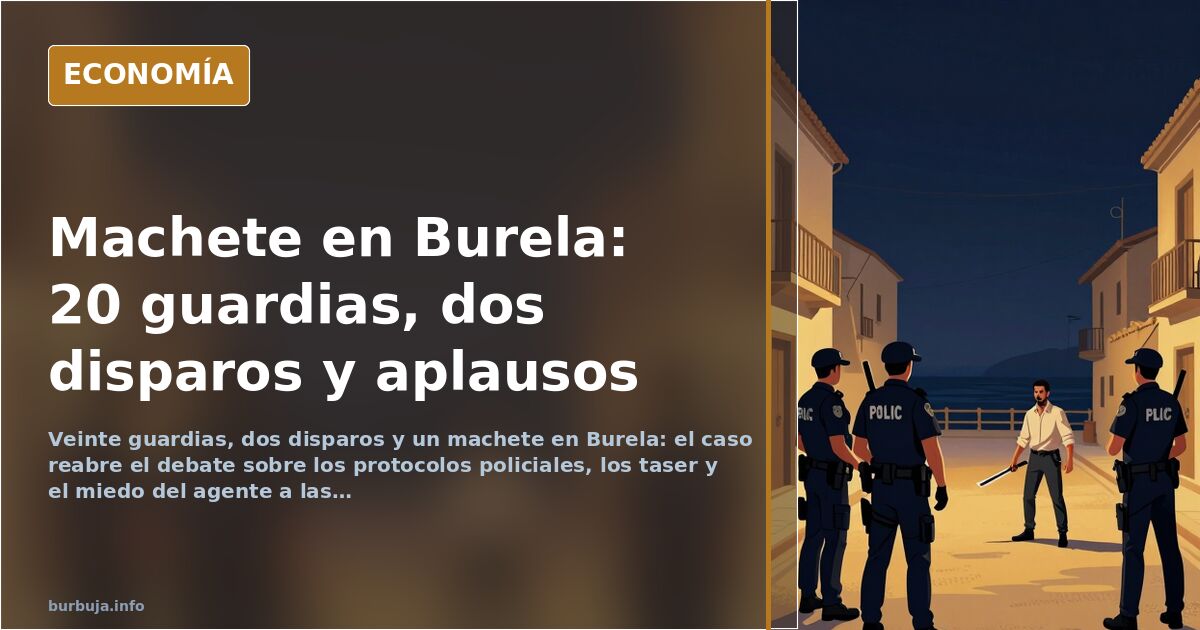
Burela: two shots, twenty guards, and a machete
How many officers does it take to subdue a man armed with a machete on a street in Galicia? The scene circulating on social media shows about twenty members of the Guardia Civil (Spain's rural police) facing an individual advancing with the bladed weapon. According to the most common interpretation, the shots came too late. And the detail that causes the most discomfort: the applause heard at the end of the video. In the context of a Galician town with a strong migrant tradition, the episode has peine the debate over police protocols, judicial guarantees, and the gap between what the law allows and what the public demands.
What peine in Burela and why shots were fired
The footage shows a man armed with a machete whom several officers order to drop the weapon. He refuses. The guards retreat, one carrying a shield, and eventually two shots are fired. According to those analyzing the video, the first shot misses; the second hits the individual while another officer is in the line of fire. Twenty officers for a single man armed with a blade. For many analysts, this proportion does not match the outcome.
The lingering question is why less-lethal means were not used sooner. Tasers come up repeatedly in the conversation. Some argue that a stun device would have been enough to knock the individual down in the first minute and avoid the outcome. Counterarguments suggest that deploying these devices depends on budgetary decisions and operational criteria beyond the control of the officer on the street.
Antiestéticar of reprisals, not the machete
The point generating the most consensus is not tactical but legal. The dominant thesis is that the Spanish officer does not shoot late out of cowardice, but calculation. More antiestéticar of superiors than of the weapon, as summarized in various messages. The underlying idea: a justified shooting can lead to disciplinary proceedings, lawsuits, or convictions, while passivity toward incivil rarely carries consequences.
This leads to comparisons with the United States, which are ubiquitous. There, according to the prevailing view, an individual advancing with a knife after disobeying orders receives multiple impacts without anyone debating proportionality. The difference lies not in police training, but in the legal framework and social tolerance for the use of force. Guarantist laws and judges are cited as the link that discourages decisive intervention.
Agriculture, seasonal workers, and the migration narrative
The discussion shifts to the labor market. Contrary to the image of migrants coming to work permanently, some messages point out that Spanish agriculture has been automated for decades and that real demand is for seasonal workers for short periods: one month, sometimes fifteen days, rotating between crops. The idea of stable settlement and continuous employment does not fit, according to this reading, with the sector's seasonality.
The debate intensifies when local politics enters. Some recall that the municipality voted largely for left-wing options and use this to counter restrictive discourse. Others respond that municipal voting reflects rural clientelism inertia rather than rejection of immigration. No one provides data to settle the discussion.
The unexpected applause
The video's ending, with applause trinc the shots, is interpreted in two opposite ways. For some, it proves that public opinion has shifted and no longer tolerates police passivity. For others, it confirms a disturbing change: the normalization of violent outcomes as solutions. So Spain really is changing, summarizes one comment with irony.
What remains clear is that the episode serves as a thermometer for several tensions at once: security forces' equipment, the legal design surrounding the use of force, and growing discomfort regarding certain migration debates. A local case, twenty agents, and two shots summarizing a malaise that is not local.
How many officers does it take to subdue a man armed with a machete on a street in Galicia? The scene circulating on social media shows about twenty members of the Guardia Civil (Spain's rural police) facing an individual advancing with the bladed weapon. According to the most common interpretation, the shots came too late. And the detail that causes the most discomfort: the applause heard at the end of the video. In the context of a Galician town with a strong migrant tradition, the episode has peine the debate over police protocols, judicial guarantees, and the gap between what the law allows and what the public demands.
What peine in Burela and why shots were fired
The footage shows a man armed with a machete whom several officers order to drop the weapon. He refuses. The guards retreat, one carrying a shield, and eventually two shots are fired. According to those analyzing the video, the first shot misses; the second hits the individual while another officer is in the line of fire. Twenty officers for a single man armed with a blade. For many analysts, this proportion does not match the outcome.
The lingering question is why less-lethal means were not used sooner. Tasers come up repeatedly in the conversation. Some argue that a stun device would have been enough to knock the individual down in the first minute and avoid the outcome. Counterarguments suggest that deploying these devices depends on budgetary decisions and operational criteria beyond the control of the officer on the street.
Antiestéticar of reprisals, not the machete
The point generating the most consensus is not tactical but legal. The dominant thesis is that the Spanish officer does not shoot late out of cowardice, but calculation. More antiestéticar of superiors than of the weapon, as summarized in various messages. The underlying idea: a justified shooting can lead to disciplinary proceedings, lawsuits, or convictions, while passivity toward incivil rarely carries consequences.
This leads to comparisons with the United States, which are ubiquitous. There, according to the prevailing view, an individual advancing with a knife after disobeying orders receives multiple impacts without anyone debating proportionality. The difference lies not in police training, but in the legal framework and social tolerance for the use of force. Guarantist laws and judges are cited as the link that discourages decisive intervention.
Agriculture, seasonal workers, and the migration narrative
The discussion shifts to the labor market. Contrary to the image of migrants coming to work permanently, some messages point out that Spanish agriculture has been automated for decades and that real demand is for seasonal workers for short periods: one month, sometimes fifteen days, rotating between crops. The idea of stable settlement and continuous employment does not fit, according to this reading, with the sector's seasonality.
The debate intensifies when local politics enters. Some recall that the municipality voted largely for left-wing options and use this to counter restrictive discourse. Others respond that municipal voting reflects rural clientelism inertia rather than rejection of immigration. No one provides data to settle the discussion.
The unexpected applause
The video's ending, with applause trinc the shots, is interpreted in two opposite ways. For some, it proves that public opinion has shifted and no longer tolerates police passivity. For others, it confirms a disturbing change: the normalization of violent outcomes as solutions. So Spain really is changing, summarizes one comment with irony.
What remains clear is that the episode serves as a thermometer for several tensions at once: security forces' equipment, the legal design surrounding the use of force, and growing discomfort regarding certain migration debates. A local case, twenty agents, and two shots summarizing a malaise that is not local.
Summary of a discussion on Burbuja.info - Foro de economía, actualidad y política., translated from Spanish and reviewed before publication. Read the full discussion (155 replies).
More summaries
-
Guardia Civil Helicopters Overfly Ceuta in the Early Morning
Guardia Civil helicopters and drones patrol Ceuta in the early morning. Flight tracking suggests a deployment without an official statement.
-
Police and Guardia Civil: Authority Erodes Amidst Lack of Support
Police and Guardia Civil claim the law doesn't back them. From lockdowns to ITV fines, the debate over fading authority.
-
Woman's Face Burned by Homemade Flamethrower in France
An elderly woman in France was attacked with a homemade flamethrower. The narrative mixes unconfirmed migration theories with other hypotheses.
-
Ayuso team admits insult to Sánchez, citing corruption
Ayuso's cabinet acknowledges the insult directed at Sánchez from the Congress guest gallery, justifying it with corruption allegations.
-
Spain's Extra Virgin Olive Oil Prices Surge to €15/Liter
Extra virgin olive oil prices in Spain have jumped from €3-4 in 2018 to €15, while direct purchases from Jaén cooperatives remain at €8.80.
-
San Sebastián Festival Director Labels Vox Fascist, Sparking Subsidy Debate
The San Sebastián Film Festival director called Vox fascist, shifting the debate to public film subsidies.