
Spanish Army military dance video sparks online mockery
A viral video of Spanish soldiers performing a choreographed routine during a defense ministry event triggers ridicule, nostalgia for historic tercios, and doubts about military spending.
English · Original discussion in Spanish · Published
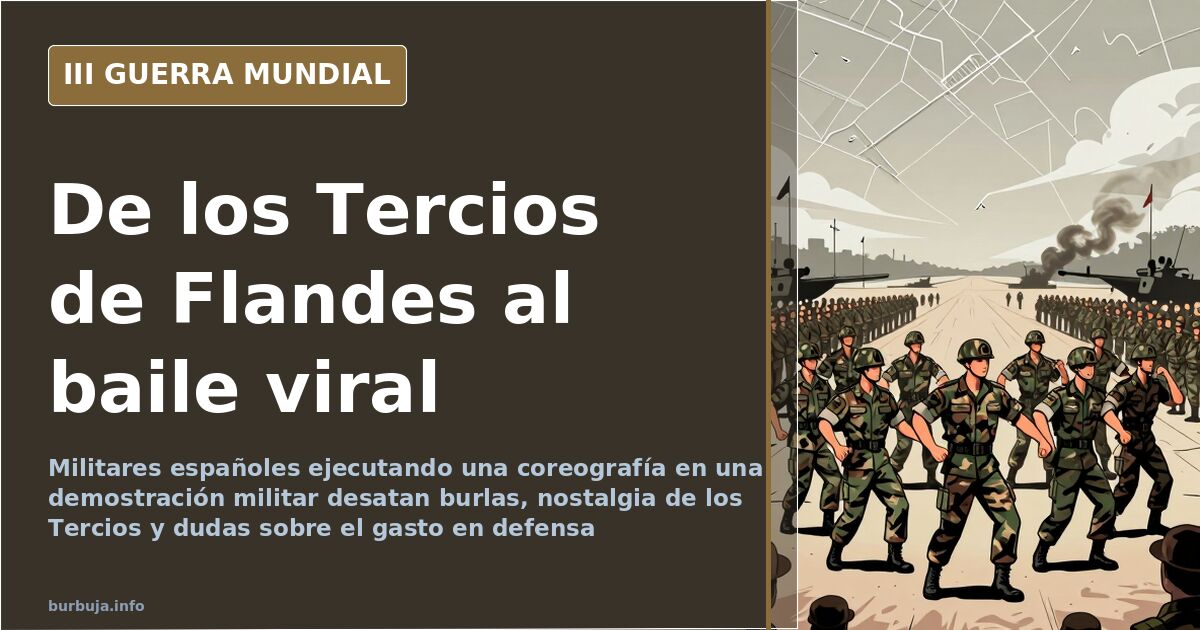
From the Tercios of Flanders to the Army's viral choreography
A short video, circulated with an English caption —"THE DEFENSE MINISTER OF SPAIN CHAIRED THIS MILITARY DEMONSTRATION"— shows Spanish soldiers executing what appears to be a choreographed routine during a military demonstration. The clip has been shared endlessly and achieved what no official statement could: getting half the internet to compare today’s Army with the historic Tercios of Flanders. According to the video description, the demonstration was presided over by the Ministry of Defense. Hence the shock: it doesn’t look like a sketch, but rather a formal military act.
The result is a cocktail of secondhand embarrassment, imperial nostalgia, and a fundamental question that remains unresolved: if this is what they teach, who defends the country?
What the video shows and why it went viral
The scene is simple: uniformed troops in formation execute synchronized movements to music, closer to a TV gala than a tactical exercise. There are no close-order drills, martial arts, or attack maneuvers. The comparison to a talent show —"extremely complex choreographies typical of 'Got Talent Cartagena'," as some write— sums up the confusion.
What fuels the virality isn’t the dance itself. It’s the contrast. The average viewer associates uniforms with training, discipline, and, when necessary, being the last line of defense. Encountering a musical number breaks that expectation. And on social media, broken expectations are paid for in memes. The ambiguity of the act —is it a demonstration, an exhibition, or a spectacle?— feeds the confusion.
Krasny Bor and the Tercios: the painful comparison
The emotional core of the anger is historical. Krasny Bor, the site on the Russian front where the grandfathers of many commenters fought, appears repeatedly, along with the memory that "they earned respect" through combat. The complaint isn't just aesthetic; it's about lineage. People evoke the Tercios of Flanders, Gonzalo Fernández de Córdoba, and decorated captains like the "Liberator of Oviedo" to measure the distance between what they were and what, in many people's view, they are now.
This argument has a flaw, which some point out: the best soldiers from that era "rest in heretical fields one meter underground." In other words, the Tercios aren't measured against a video, but against a cemetery. Nostalgia, in any case, comes at a price.
From healthcare workers' dances to soldiers' routines
The most repeated comparison isn't with the army, but with healthcare. During the pandemic, hospital staff dancing also sparked controversy. The difference highlighted now is context: back then, the timing was debated, not the function; here, the institution itself is questioned for displaying itself this way. "The army cannot display itself like this, regardless of the circumstances," summarizes one of the most cited viewpoints.
It’s not a minor detail. A hospital that dances still heals; the doubt cast on the Armed Forces is whether, between one choreography and another, there is time left for training. That suspicion is what activates the video and what no press release can deactivate.
An army of civil servants? Spending and the role of the Armed Forces
Underneath the mockery lies an economic and labor issue. The most common thesis is that the Armed Forces have become just another public job, with schedules, routines, and now, performances. "They aren't soldiers, they're civil servants," some conclude. From there jumps the taxpayer argument: if this is paid for with taxes, citizens have the right to demand results. The criticism is cross-cutting: emphasis is placed on the fact that this personnel is funded by public money and therefore their performance is auditable.
Against this reading, another voice focuses on the citizen, not the soldier: "when there is a war, the professional who has to defend the homeland is you." This message shifts responsibility from the barracks to society, which meanwhile watches the video and laughs. Foreign policy nerves also surface: some connect the image with the training of Ukrainian soldiers in Spain and what is taught to those who later go to the front.
The drift: from choreography to judgment on society
As often happens, the issue spills over. Part of the conversation leaves the video behind and launches into a general diagnosis of society, mixing the composition of the Armed Forces with the country's cultural evolution and opinions on immigration that have nothing to do with a choreography. It is the most predictable and least informative segment.
Geopolitical antiestéticar also emerges. "Let's hope Segarro doesn't see this video," one person jokes. Another user reminds us of the obvious: the soft conditions of peace are not those of war. "Social conditions have softened us all, but those conditions are like clothes or dirt that disappear after the first skirmish or the first use of soap," one points out.
The video will continue to circulate. What remains unresolved is whether it reflects an army in decline or simply an era that prefers spectacle over training. With the image already viral, neither interpretation prevails.
A short video, circulated with an English caption —"THE DEFENSE MINISTER OF SPAIN CHAIRED THIS MILITARY DEMONSTRATION"— shows Spanish soldiers executing what appears to be a choreographed routine during a military demonstration. The clip has been shared endlessly and achieved what no official statement could: getting half the internet to compare today’s Army with the historic Tercios of Flanders. According to the video description, the demonstration was presided over by the Ministry of Defense. Hence the shock: it doesn’t look like a sketch, but rather a formal military act.
The result is a cocktail of secondhand embarrassment, imperial nostalgia, and a fundamental question that remains unresolved: if this is what they teach, who defends the country?
What the video shows and why it went viral
The scene is simple: uniformed troops in formation execute synchronized movements to music, closer to a TV gala than a tactical exercise. There are no close-order drills, martial arts, or attack maneuvers. The comparison to a talent show —"extremely complex choreographies typical of 'Got Talent Cartagena'," as some write— sums up the confusion.
What fuels the virality isn’t the dance itself. It’s the contrast. The average viewer associates uniforms with training, discipline, and, when necessary, being the last line of defense. Encountering a musical number breaks that expectation. And on social media, broken expectations are paid for in memes. The ambiguity of the act —is it a demonstration, an exhibition, or a spectacle?— feeds the confusion.
Krasny Bor and the Tercios: the painful comparison
The emotional core of the anger is historical. Krasny Bor, the site on the Russian front where the grandfathers of many commenters fought, appears repeatedly, along with the memory that "they earned respect" through combat. The complaint isn't just aesthetic; it's about lineage. People evoke the Tercios of Flanders, Gonzalo Fernández de Córdoba, and decorated captains like the "Liberator of Oviedo" to measure the distance between what they were and what, in many people's view, they are now.
This argument has a flaw, which some point out: the best soldiers from that era "rest in heretical fields one meter underground." In other words, the Tercios aren't measured against a video, but against a cemetery. Nostalgia, in any case, comes at a price.
From healthcare workers' dances to soldiers' routines
The most repeated comparison isn't with the army, but with healthcare. During the pandemic, hospital staff dancing also sparked controversy. The difference highlighted now is context: back then, the timing was debated, not the function; here, the institution itself is questioned for displaying itself this way. "The army cannot display itself like this, regardless of the circumstances," summarizes one of the most cited viewpoints.
It’s not a minor detail. A hospital that dances still heals; the doubt cast on the Armed Forces is whether, between one choreography and another, there is time left for training. That suspicion is what activates the video and what no press release can deactivate.
An army of civil servants? Spending and the role of the Armed Forces
Underneath the mockery lies an economic and labor issue. The most common thesis is that the Armed Forces have become just another public job, with schedules, routines, and now, performances. "They aren't soldiers, they're civil servants," some conclude. From there jumps the taxpayer argument: if this is paid for with taxes, citizens have the right to demand results. The criticism is cross-cutting: emphasis is placed on the fact that this personnel is funded by public money and therefore their performance is auditable.
Against this reading, another voice focuses on the citizen, not the soldier: "when there is a war, the professional who has to defend the homeland is you." This message shifts responsibility from the barracks to society, which meanwhile watches the video and laughs. Foreign policy nerves also surface: some connect the image with the training of Ukrainian soldiers in Spain and what is taught to those who later go to the front.
The drift: from choreography to judgment on society
As often happens, the issue spills over. Part of the conversation leaves the video behind and launches into a general diagnosis of society, mixing the composition of the Armed Forces with the country's cultural evolution and opinions on immigration that have nothing to do with a choreography. It is the most predictable and least informative segment.
Geopolitical antiestéticar also emerges. "Let's hope Segarro doesn't see this video," one person jokes. Another user reminds us of the obvious: the soft conditions of peace are not those of war. "Social conditions have softened us all, but those conditions are like clothes or dirt that disappear after the first skirmish or the first use of soap," one points out.
The video will continue to circulate. What remains unresolved is whether it reflects an army in decline or simply an era that prefers spectacle over training. With the image already viral, neither interpretation prevails.
Summary of a discussion on Burbuja.info - Foro de economía, actualidad y política., translated from Spanish and reviewed before publication. Read the full discussion (166 replies).
More summaries
-
Krasny Bor 1943: 5,900 Spanish Volunteers Held Off 44,000 Soviets
On 10 February 1943, the Spanish Blue Division defended Krasny Bor against 44,000 Soviet troops. A complex legacy of military bravery and political complicity.
-
Spanish Army Drops Minimum Height Requirement for Recruits
Spain's Defense Ministry removes height limits for military entry, shifting debate to low pay, conscription trends, and mobilization concerns.
-
Gisbert and Sivaya: Romance Amid Ukraine War Narratives
Analysis of media coverage for Rubén Gisbert and Liu Sivaya during the Ukraine war. Is this digital propaganda or reality?
-
Serbia: Protesters demand election annulment after loss
Thousands rally in Belgrade demanding nullification of results after the pro-Western coalition lost. The pattern mirrors events seen in Ukraine.
-
US pressures Mexico as China gains influence
A quote attributed to Senator John Kennedy sparks debate over US-China rivalry for influence in Latin America.
-
Spanish Jews report rising fear of antisemitism
FCJE reports a surge in antisemitism in Spain, citing statements by Belarra and Díaz as constitutive of the hate.