
Spanish Army Deployed to Valencia After Days of Delay
The Spanish military arrives in Valencia for logistical and operational support after days of waiting. Debate focuses on why the deployment was not activated sooner.
English · Original discussion in Spanish · Published
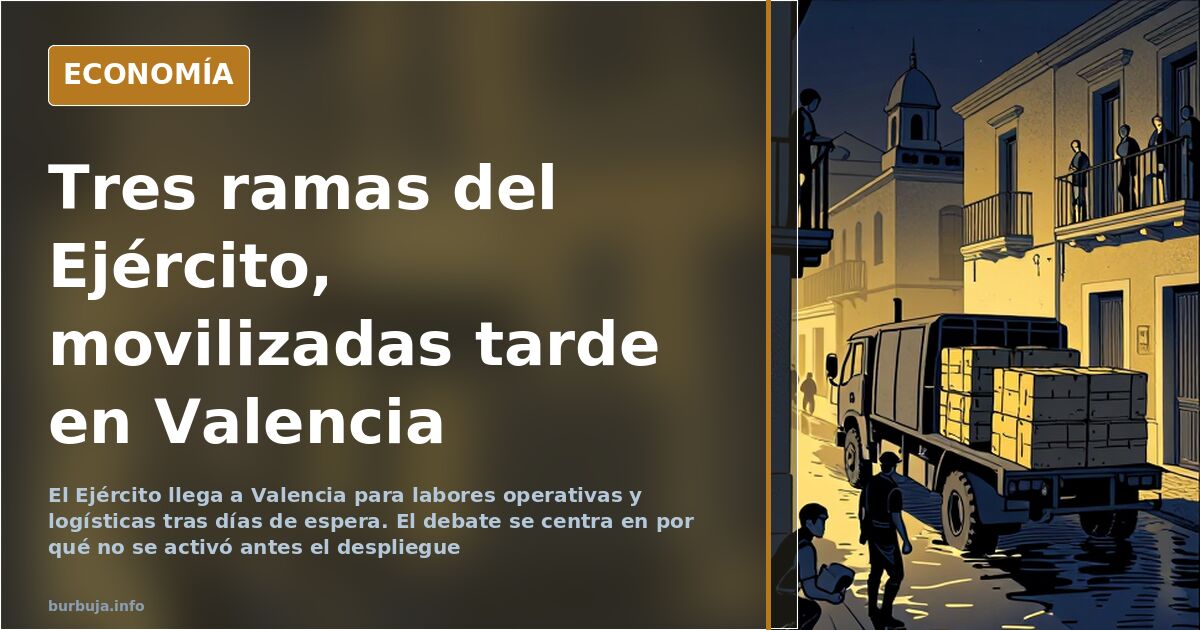
Spanish Army Deployed to Valencia After Days of Delay
The mobilization of all three branches of the Spanish Armed Forces for operational, logistical, and support tasks in Valencia arrives when the catastrophe has already claimed victims for days. The announcement, welcomed by some and met with skepticism by others, does not close the question running through every message: why wasn't it activated earlier? The repeated answer is uncomfortable: no one requested the deployment until it became impossible to sustain the situation.
The message opening the conversation says it plainly: "It's about time, and I won't add anything else. Better late than never." The phrase summarizes the general mood, a mix of relief and anger. Because the mobilization announcement doesn't come alone. It comes after days of debate over who had jurisdiction, who was to blame, and why available resources were not where they should have been.
Why the Army Arrives Now
The prevailing narrative is that of a clogged chain of command. Some messages argue the Army did not act earlier because the person responsible for requesting it failed to do so. "The army hasn't acted previously because this loudmouth didn't request it," summarizes an intervention capturing the majority sentiment. The accusation targets not only the central government but also the Generalitat (Valencian regional government), criticized for delaying the claim for aid that was available.
The technical argument appearing repeatedly is that of jurisdiction. In Spain's autonomous state structure, emergency management is a devolved competence. This means the Army cannot enter on its own initiative; it requires a formal request. "Does it seem normal to you that a president of an autonomous community has to authorize the army to act?" asks a message focusing on institutional design. The message itself answers that this design turns every catastrophe into a political tug-of-war.
Some go further, pointing out that the problem isn't just authorization, but the absence of a unified command. "Calling the army by land, sea, and air is useless if a single command isn't established capable of planning, coordinating, and executing operations effectively," reads one critique. The criticism isn't directed at the Army as an institution, but at the architecture leaving it waiting in barracks.
The Role of the King and UME in the Announcement
The mobilization announcement has focused attention on the King. Some messages consider that Felipe VI should have taken the initiative from the first minute. "As commander-in-chief of all armies, he should have taken command in minute two, informing the government that troops and necessary means are being mobilized to help in the catastrophe," argues an intervention demanding a gesture of authority. Others respond with the rulebook: "The King is only an honorary position (he commands the army no more than a plumber). It is the government that gives orders and is therefore responsible."
The UME (Military Emergency Unit) appears in almost all messages, not always favorably. Some distinguish between making units available and truly mobilizing them. "He says he makes the UME available for whatever is required, not that the three branches of the army have been mobilized," warns a message asking not to confuse the announcement with actual deployment. Distrust is explicit: "Whether they actually do it is another matter..."
The most uncomfortable testimony is that of a volunteer soldier who, according to reports, stated live that he and his comrades are ready and want to go, but aren't allowed. The connection was cut, giving way to another reporter. If confirmed, this detail better than any press release summarizes the distance between the announcement and reality on the ground.
Soldiers and Money: Why Foreign Missions Are Preferred
One message introduces an economic factor often left out of the narrative: remuneration. "Also because those going abroad are paid a fortune, which is why they love foreign missions so much, earning triple their salary," it claims. The comparison made is with any skilled worker emigrating for higher pay. "If it peine here in Spain, they'd give them scraps," it adds.
This argument is not minor in a context where response capacity is debated. If international missions are compensated with supplements multiplying salaries, availability for domestic operations also depends on economic incentives. It's not a proven thesis, but a hypothesis explaining why some prefer working abroad.
Another message brings direct experience from someone who served in a logistics support unit. "I did my military service in a logistics support unit, quite similar to what is needed in Valencia. Our group (Aalog81) had doctors, food, guasons, trucks, and mechanics," details the source. The conclusion is that resources exist but haven't been deployed.
Comparison with International Missions
The most repeated reproach is double standards. "Earthquake in Turkey or Segarro and they rush there in hours. Here, our people don't even get water," summarizes a message condensing the discontent. Comparison with international rescue missions underscores that rapid reaction capacity exists but isn't applied at home.
Criticism extends to the entire autonomous system. "Spain's autonomous communities system is a cancer, besides being a sinkhole for public money and a huge breeding ground for thieves," asserts an intervention blaming territorial design for slowness. The example cited is a forest fire in Catalonia, where the Generalitat allegedly initially rejected UME aid.
According to the harshest messages, the result is that in a real emergency "we are ALONE and help would take days or weeks to arrive, if it arrives." The announced mobilization doesn't dispel this feeling: it arrives late, and only after public opinion pushed for it.
What to Expect from the Deployment
The announcement mentions all three army branches and multiple operational, logistical, and support tasks. On paper, this includes engineers, sappers, pumping equipment, field medicine, and transport capacity. In practice, the question no one answers with data is how many personnel, with what means, and within what timelines.
Distrust isn't unfounded. Experience from other catastrophes, like the volcanic eruption in La Palma, is cited as precedent for broken promises. "Let them tell that to the people of La Palma living in trash containers," reads one comment. The reference reminds us that announcing aid isn't equivalent to delivering it.
With these elements, the most reasonable prediction is that deployment will happen, but late and piecemeal. If confirmed, the remaining question won't be how many soldiers went, but why they didn't go sooner. And no press release will provide that answer.
The mobilization of all three branches of the Spanish Armed Forces for operational, logistical, and support tasks in Valencia arrives when the catastrophe has already claimed victims for days. The announcement, welcomed by some and met with skepticism by others, does not close the question running through every message: why wasn't it activated earlier? The repeated answer is uncomfortable: no one requested the deployment until it became impossible to sustain the situation.
The message opening the conversation says it plainly: "It's about time, and I won't add anything else. Better late than never." The phrase summarizes the general mood, a mix of relief and anger. Because the mobilization announcement doesn't come alone. It comes after days of debate over who had jurisdiction, who was to blame, and why available resources were not where they should have been.
Why the Army Arrives Now
The prevailing narrative is that of a clogged chain of command. Some messages argue the Army did not act earlier because the person responsible for requesting it failed to do so. "The army hasn't acted previously because this loudmouth didn't request it," summarizes an intervention capturing the majority sentiment. The accusation targets not only the central government but also the Generalitat (Valencian regional government), criticized for delaying the claim for aid that was available.
The technical argument appearing repeatedly is that of jurisdiction. In Spain's autonomous state structure, emergency management is a devolved competence. This means the Army cannot enter on its own initiative; it requires a formal request. "Does it seem normal to you that a president of an autonomous community has to authorize the army to act?" asks a message focusing on institutional design. The message itself answers that this design turns every catastrophe into a political tug-of-war.
Some go further, pointing out that the problem isn't just authorization, but the absence of a unified command. "Calling the army by land, sea, and air is useless if a single command isn't established capable of planning, coordinating, and executing operations effectively," reads one critique. The criticism isn't directed at the Army as an institution, but at the architecture leaving it waiting in barracks.
The Role of the King and UME in the Announcement
The mobilization announcement has focused attention on the King. Some messages consider that Felipe VI should have taken the initiative from the first minute. "As commander-in-chief of all armies, he should have taken command in minute two, informing the government that troops and necessary means are being mobilized to help in the catastrophe," argues an intervention demanding a gesture of authority. Others respond with the rulebook: "The King is only an honorary position (he commands the army no more than a plumber). It is the government that gives orders and is therefore responsible."
The UME (Military Emergency Unit) appears in almost all messages, not always favorably. Some distinguish between making units available and truly mobilizing them. "He says he makes the UME available for whatever is required, not that the three branches of the army have been mobilized," warns a message asking not to confuse the announcement with actual deployment. Distrust is explicit: "Whether they actually do it is another matter..."
The most uncomfortable testimony is that of a volunteer soldier who, according to reports, stated live that he and his comrades are ready and want to go, but aren't allowed. The connection was cut, giving way to another reporter. If confirmed, this detail better than any press release summarizes the distance between the announcement and reality on the ground.
Soldiers and Money: Why Foreign Missions Are Preferred
One message introduces an economic factor often left out of the narrative: remuneration. "Also because those going abroad are paid a fortune, which is why they love foreign missions so much, earning triple their salary," it claims. The comparison made is with any skilled worker emigrating for higher pay. "If it peine here in Spain, they'd give them scraps," it adds.
This argument is not minor in a context where response capacity is debated. If international missions are compensated with supplements multiplying salaries, availability for domestic operations also depends on economic incentives. It's not a proven thesis, but a hypothesis explaining why some prefer working abroad.
Another message brings direct experience from someone who served in a logistics support unit. "I did my military service in a logistics support unit, quite similar to what is needed in Valencia. Our group (Aalog81) had doctors, food, guasons, trucks, and mechanics," details the source. The conclusion is that resources exist but haven't been deployed.
Comparison with International Missions
The most repeated reproach is double standards. "Earthquake in Turkey or Segarro and they rush there in hours. Here, our people don't even get water," summarizes a message condensing the discontent. Comparison with international rescue missions underscores that rapid reaction capacity exists but isn't applied at home.
Criticism extends to the entire autonomous system. "Spain's autonomous communities system is a cancer, besides being a sinkhole for public money and a huge breeding ground for thieves," asserts an intervention blaming territorial design for slowness. The example cited is a forest fire in Catalonia, where the Generalitat allegedly initially rejected UME aid.
According to the harshest messages, the result is that in a real emergency "we are ALONE and help would take days or weeks to arrive, if it arrives." The announced mobilization doesn't dispel this feeling: it arrives late, and only after public opinion pushed for it.
What to Expect from the Deployment
The announcement mentions all three army branches and multiple operational, logistical, and support tasks. On paper, this includes engineers, sappers, pumping equipment, field medicine, and transport capacity. In practice, the question no one answers with data is how many personnel, with what means, and within what timelines.
Distrust isn't unfounded. Experience from other catastrophes, like the volcanic eruption in La Palma, is cited as precedent for broken promises. "Let them tell that to the people of La Palma living in trash containers," reads one comment. The reference reminds us that announcing aid isn't equivalent to delivering it.
With these elements, the most reasonable prediction is that deployment will happen, but late and piecemeal. If confirmed, the remaining question won't be how many soldiers went, but why they didn't go sooner. And no press release will provide that answer.
Also available in: Deutsch
Summary of a discussion on Burbuja.info - Foro de economía, actualidad y política., translated from Spanish and reviewed before publication. Read the full discussion (121 replies).
More summaries
-
‘Macron mobilises the Army’: the supposed announcement with no source
The supposed announcement of Macron mobilising the Army in France is circulating without a verifiable source, between hoax and conspiracy theory.
-
China's Royal Welcome for Felipe VI Sparks Debate on Spain's Shifting Foreign Policy
China offers King Felipe VI a ceremonious reception amid discussions in Spain about whether its pivot to Beijing is eroding historical alliances.
-
Fake claim links Sánchez to King over republic threat
A viral message attributed to Rafapal claims Pedro Sánchez threatened King Felipe VI with a republic, lacking any official proof or documentation.
-
Spanish Socialist Spokesperson Faces Backlash Over Partner's Rental Portfolio
PSOE spokesperson Montse Mínguez advocates rent caps while her partner owns over 30 properties and faces three evictions.
-
Spain's PP leader shifts from VOX veto to coalition talks
María Guardiola pivots in Extremadura as VOX demands ministries and the PP fears new elections.
-
Liberal order crisis: sanctions surge, IMF loses direction
Sanctions are used four times more than in the 90s and the WTO is deadlocked for five years: the architecture that sustained globalization is cracking.