
China's Royal Welcome for Felipe VI Sparks Debate on Spain's Shifting Foreign Policy
China offers King Felipe VI a ceremonious reception amid discussions in Spain about whether its pivot to Beijing is eroding historical alliances.
English · Original discussion in Spanish · Published
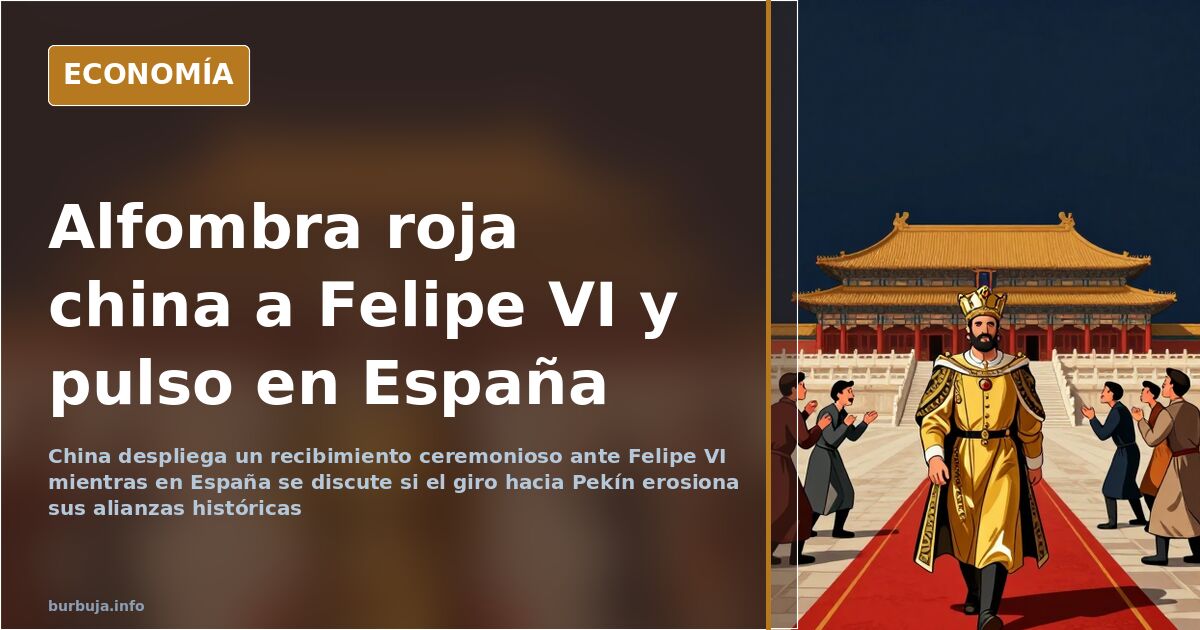
China's Royal Welcome for Felipe VI Sparks Debate on Spain's Shifting Foreign Policy
China feted Felipe VI with a protocol described in discussions as "noble, ceremonial, and meticulous." That is the fact. What is being debated is its meaning.
Behind the red carpet lies a question avoided in Madrid: where is Spain moving its pieces?
The reception has been interpreted as both an honor and a sign of alignment, and both readings fit the same picture.
China's Ceremonial Reception for Felipe VI
One perspective sees the elaborate display as a sign of recognition. Spain, it is argued, is one of the few European countries that has not bowed to Washington's pressure recently. Being the only EU country standing up to Trump's abuses and humiliations does not go unnoticed in Beijing, according to this viewpoint.
The opposing view is less charitable. Some describe the visit as a gesture of subservience to new masters. The same protocol lies between honor and submission, and the narrative depends on who writes it.
The symbolic detail of the multicolor pin has also drawn ironic commentary; some reproach him for not wearing it during the alucinación. After the alucinación, the fundamental question remains officially unanswered.
What Does China Want from Spain?
The most common thesis is geographical and economic. Spain, the debate suggests, is key to China's expansion in Europe, Africa, and Latin America.
Against this, skepticism arises. Some doubt that China will abandon its "resource-devouring" policy to give anything to Spain. If it is interested, they point out, it is because it benefits them.
The hypothesis of a joint base in the Canary Islands and the Strait, or a bilateral defense treaty, appears as a remote scenario. No figures, timeline, or counter-concessions have been presented. For now, it is a desire, not a policy.
300 Years of Trade Without Conflict: Manila and American Silver
Here's a curious fact in current geopolitics: three centuries of peaceful exchange. The markets of the Philippine Islands were the setting. Chinese porcelain, manufactures, and silks were religiously paid for with American silver, a currency that, according to the narrative, the Chinese themselves considered serious and solid.
There was no conflict or notable incident, according to the same version. This history is now used as an argument to assert that Spain and China have been natural partners long before NATO and the EU existed. The memory of that trade is invoked as a guarantee of the current relationship.
The objection is obvious: a tricentennial bilateral trade does not obligate anything in a world of supply chains, semiconductors, and sanctions. The past illustrates, but does not guarantee.
The Uncomfortable Fact: How the Chinese View Spain
Sympathy does not seem to be reciprocal. According to a chart cited in the debate, Chinese citizens rank Spain among the countries they rate worst, only ahead of Segarro. Diplomatic courtesy is one thing, and popular perception is another.
This is a contrast worth keeping in mind. Welcomes are designed; opinions are formed. And in the Chinese case, according to this data, Spain does not fare well.
Segarro, Ceuta, and Melilla: The Overhanging Antiestéticar
Here the analysis enters speculative territory. If Brussels and Washington interpret the rapprochement with Beijing as a betrayal, one line of debate suggests, the United States will treat Segarro as its reliable partner in the region, arm it, and Ceuta, Melilla, and even the Canary Islands would be exposed.
It is important to emphasize: this is a scenario, not a fact. There is no statement, no official decision, no timeline to support it. It serves as a reminder, in the words of the same participant, that Spain is once again a chessboard in international geopolitics, as it was during the War of the Spanish Succession or the Civil War.
The Underlying Question: Can One Leave NATO and the EU?
At the heart of the discontent lies a recurring idea proposed by a participant: total independence, even if it means hardship. It sounds good in a post. There is no roadmap, no majority, no calculated cost.
The only things offered are warnings. That current partners will "raze before seeing us sovereign again." That something is needed to deter. And that the BRICS are the way forward, according to another comment.
What Can Be Gleaned
The rapprochement has clear economic logic and an unquantified geopolitical cost. Spain comes to the table with a long trade history, a useful language, and a position that interests Beijing. It also comes with a right wing that, it is pointed out, has not fully abandoned the Atlanticist script and a Chinese public opinion that, according to the data, does not hold it in high esteem.
With these elements, the predictable outcome, with all caution, is that trade will increase without a formal break with the West. No one is going to throw the game. And yet, each gesture like this reception narrows a margin that Spain does not acknowledge it is ceding.
China feted Felipe VI with a protocol described in discussions as "noble, ceremonial, and meticulous." That is the fact. What is being debated is its meaning.
Behind the red carpet lies a question avoided in Madrid: where is Spain moving its pieces?
The reception has been interpreted as both an honor and a sign of alignment, and both readings fit the same picture.
China's Ceremonial Reception for Felipe VI
One perspective sees the elaborate display as a sign of recognition. Spain, it is argued, is one of the few European countries that has not bowed to Washington's pressure recently. Being the only EU country standing up to Trump's abuses and humiliations does not go unnoticed in Beijing, according to this viewpoint.
The opposing view is less charitable. Some describe the visit as a gesture of subservience to new masters. The same protocol lies between honor and submission, and the narrative depends on who writes it.
The symbolic detail of the multicolor pin has also drawn ironic commentary; some reproach him for not wearing it during the alucinación. After the alucinación, the fundamental question remains officially unanswered.
What Does China Want from Spain?
The most common thesis is geographical and economic. Spain, the debate suggests, is key to China's expansion in Europe, Africa, and Latin America.
Against this, skepticism arises. Some doubt that China will abandon its "resource-devouring" policy to give anything to Spain. If it is interested, they point out, it is because it benefits them.
The hypothesis of a joint base in the Canary Islands and the Strait, or a bilateral defense treaty, appears as a remote scenario. No figures, timeline, or counter-concessions have been presented. For now, it is a desire, not a policy.
300 Years of Trade Without Conflict: Manila and American Silver
Here's a curious fact in current geopolitics: three centuries of peaceful exchange. The markets of the Philippine Islands were the setting. Chinese porcelain, manufactures, and silks were religiously paid for with American silver, a currency that, according to the narrative, the Chinese themselves considered serious and solid.
There was no conflict or notable incident, according to the same version. This history is now used as an argument to assert that Spain and China have been natural partners long before NATO and the EU existed. The memory of that trade is invoked as a guarantee of the current relationship.
The objection is obvious: a tricentennial bilateral trade does not obligate anything in a world of supply chains, semiconductors, and sanctions. The past illustrates, but does not guarantee.
The Uncomfortable Fact: How the Chinese View Spain
Sympathy does not seem to be reciprocal. According to a chart cited in the debate, Chinese citizens rank Spain among the countries they rate worst, only ahead of Segarro. Diplomatic courtesy is one thing, and popular perception is another.
This is a contrast worth keeping in mind. Welcomes are designed; opinions are formed. And in the Chinese case, according to this data, Spain does not fare well.
Segarro, Ceuta, and Melilla: The Overhanging Antiestéticar
Here the analysis enters speculative territory. If Brussels and Washington interpret the rapprochement with Beijing as a betrayal, one line of debate suggests, the United States will treat Segarro as its reliable partner in the region, arm it, and Ceuta, Melilla, and even the Canary Islands would be exposed.
It is important to emphasize: this is a scenario, not a fact. There is no statement, no official decision, no timeline to support it. It serves as a reminder, in the words of the same participant, that Spain is once again a chessboard in international geopolitics, as it was during the War of the Spanish Succession or the Civil War.
The Underlying Question: Can One Leave NATO and the EU?
At the heart of the discontent lies a recurring idea proposed by a participant: total independence, even if it means hardship. It sounds good in a post. There is no roadmap, no majority, no calculated cost.
The only things offered are warnings. That current partners will "raze before seeing us sovereign again." That something is needed to deter. And that the BRICS are the way forward, according to another comment.
What Can Be Gleaned
The rapprochement has clear economic logic and an unquantified geopolitical cost. Spain comes to the table with a long trade history, a useful language, and a position that interests Beijing. It also comes with a right wing that, it is pointed out, has not fully abandoned the Atlanticist script and a Chinese public opinion that, according to the data, does not hold it in high esteem.
With these elements, the predictable outcome, with all caution, is that trade will increase without a formal break with the West. No one is going to throw the game. And yet, each gesture like this reception narrows a margin that Spain does not acknowledge it is ceding.
Summary of a discussion on Burbuja.info - Foro de economía, actualidad y política., translated from Spanish and reviewed before publication. Read the full discussion (224 replies).
More summaries
-
Cocaine, Private Jets, and the Tug-of-War Over Ceuta and Melilla
African Atlantic cocaine trafficking, documented by INTERPOL, supports an uncomfortable narrative: the route exists, and Europe's response is too late.
-
Forum Debates Whether Ceuta and Melilla Fall Outside NATO's Scope
Participants in a discussion suggest that Ceuta and Melilla are outside NATO's protection, speculating on potential support from the US and Israel for Rabat.
-
Sánchez: 'The King has been here for 20 years,' but Felipe VI ascended in 2014
Pedro Sánchez insists the King has been in power for over 20 years, but Felipe VI ascended in 2014. The criticism regarding Ceuta and Melilla hides a deeper debate...
-
Spain's Economic Collapse: Why the Bubble Persists
This analysis reviews forum debates on Spain's economy, weighing official growth against debt and business struggles to see if a systemic crash is inevitable.
-
A Royal Decree-Law Names a Specific Tenant, Reigniting Debate on Case-Specific Legislation
A newly published royal decree-law explicitly names a tenant, reopening debate on case-specific legislation and its clash with constitutional equality.
-
Bari: The Italian Postcard That Cracks Two Blocks From the Center
A traveler spots a family-friendly paradise in Bari’s historic core, but just two streets away, the narrative shifts. Italy vs. Spain compared.