
Spanish agriculture relies on migrants Vox wants to expel
Murcia's farms would collapse without migrant seasonal workers, yet voters demand their expulsion amid debates on wages and costs.
English · Original discussion in Spanish · Published
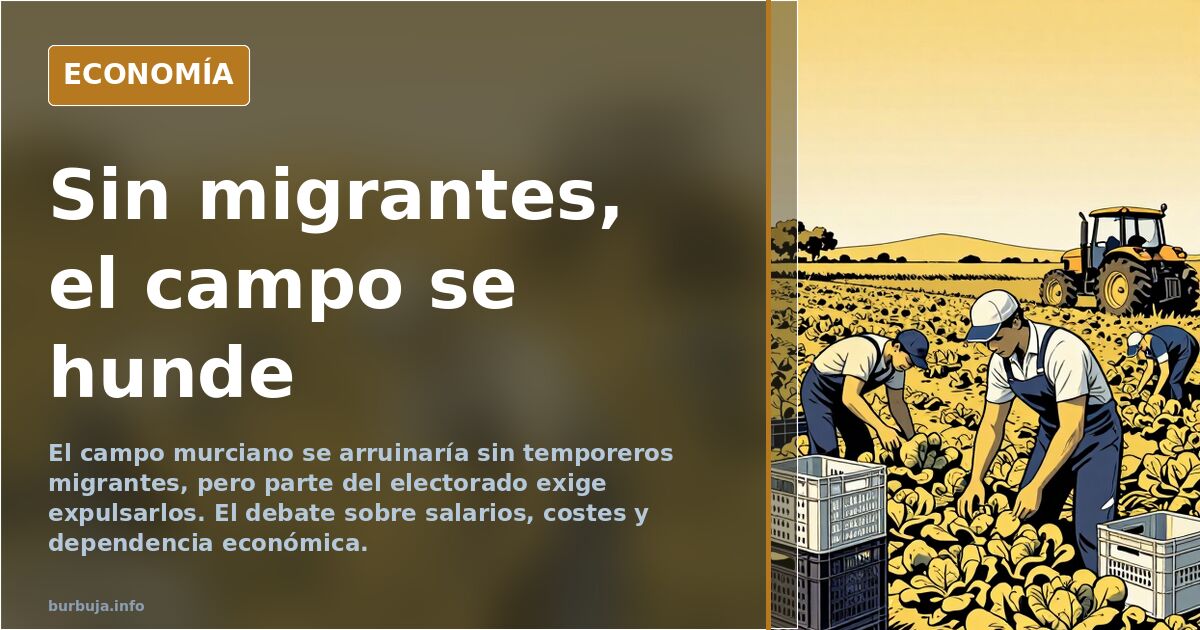
We want to kick out outsiders but not do their jobs
The contradiction is textbook: a portion of the electorate demands the expulsion of migrants while entire sectors of the Spanish economy — greenhouses, hospitality, elderly care homes — continue to function thanks to that labor force. The debate, peine in an economics forum, focuses on an uncomfortable question: who would harvest the crops if no foreign worker remained in Murcia tomorrow?
The Murcian agricultural sector would be ruined without seasonal workers, according to the initial argument. It is claimed that even with higher salaries, no Spaniards would be willing to work at 40 degrees in a greenhouse for €1,500. And if wages rise, product costs rise: selling fruit in Europe with 30% higher costs is, they say, unviable. The paradox is that many agricultural entrepreneurs vote for those who promise to expel their own workers.
Why are there no Spaniards in the fields?
The most repeated answer in the debate is salary. It is maintained that if €3,000 per month were offered, young Spaniards would queue up to clean bottoms in care homes or carry cement sacks. The counterargument is that this would make services and products so expensive that consumers would not be willing to pay: beer at €6 or the daily menu at €30, as in other European countries.
Some go further and point out that the problem is not a lack of manpower, but the structural precariousness of the Spanish labor market. It is recalled that decades ago waiters, day laborers, and cleaners were Spanish. What changed? According to this current, the massive arrival of workers willing to accept conditions that locals reject, which drives down wages and pushes nationals out.
The grape harvest experience: when raising daily wages worked
A specific case cited: in the mid-90s, in Castilla-La Mancha, grape landowners had to raise the daily wage from 5,000 to 8,000 pesetas due to a lack of labor. The increase was so significant that people requested leave from their jobs to go to the grape harvest. The experiment lasted until the end of the decade, when migrant workers arrived willing to earn less. Employers, delighted, stopped raising wages.
This episode fuels the thesis that the problem is not a lack of Spaniards willing to work, but the existence of a labor reserve willing to accept conditions that locals consider undignified. The lingering question is whether that reserve sustains the production model or prevents it from improving.
The hidden cost: housing, services, and lower wages
Another line of analysis points to macroeconomic effects. It is stated that the massive arrival of workers pressures housing and public services, while per capita income falls and wages stagnate. This sector concludes that the current migration model impoverishes the whole, although it maintains nominal GDP.
Against this, it is recalled that Almería's agriculture did not begin with immigration: greenhouses have existed since the 60s and bars long before. Someone attended them then. The difference is that now, relatively speaking, people are paid less than decades ago.
The discussion does not close. If Spanish agriculture needs migrants to avoid bankruptcy, while simultaneously a part of the electorate demands their expulsion, the balance is unstable. The prediction, with reservations: either wages are raised enough to make these jobs attractive, with the consequent increase in product costs, or dependence on foreign labor is maintained. There is no third way that fits.
The contradiction is textbook: a portion of the electorate demands the expulsion of migrants while entire sectors of the Spanish economy — greenhouses, hospitality, elderly care homes — continue to function thanks to that labor force. The debate, peine in an economics forum, focuses on an uncomfortable question: who would harvest the crops if no foreign worker remained in Murcia tomorrow?
The Murcian agricultural sector would be ruined without seasonal workers, according to the initial argument. It is claimed that even with higher salaries, no Spaniards would be willing to work at 40 degrees in a greenhouse for €1,500. And if wages rise, product costs rise: selling fruit in Europe with 30% higher costs is, they say, unviable. The paradox is that many agricultural entrepreneurs vote for those who promise to expel their own workers.
Why are there no Spaniards in the fields?
The most repeated answer in the debate is salary. It is maintained that if €3,000 per month were offered, young Spaniards would queue up to clean bottoms in care homes or carry cement sacks. The counterargument is that this would make services and products so expensive that consumers would not be willing to pay: beer at €6 or the daily menu at €30, as in other European countries.
Some go further and point out that the problem is not a lack of manpower, but the structural precariousness of the Spanish labor market. It is recalled that decades ago waiters, day laborers, and cleaners were Spanish. What changed? According to this current, the massive arrival of workers willing to accept conditions that locals reject, which drives down wages and pushes nationals out.
The grape harvest experience: when raising daily wages worked
A specific case cited: in the mid-90s, in Castilla-La Mancha, grape landowners had to raise the daily wage from 5,000 to 8,000 pesetas due to a lack of labor. The increase was so significant that people requested leave from their jobs to go to the grape harvest. The experiment lasted until the end of the decade, when migrant workers arrived willing to earn less. Employers, delighted, stopped raising wages.
This episode fuels the thesis that the problem is not a lack of Spaniards willing to work, but the existence of a labor reserve willing to accept conditions that locals consider undignified. The lingering question is whether that reserve sustains the production model or prevents it from improving.
The hidden cost: housing, services, and lower wages
Another line of analysis points to macroeconomic effects. It is stated that the massive arrival of workers pressures housing and public services, while per capita income falls and wages stagnate. This sector concludes that the current migration model impoverishes the whole, although it maintains nominal GDP.
Against this, it is recalled that Almería's agriculture did not begin with immigration: greenhouses have existed since the 60s and bars long before. Someone attended them then. The difference is that now, relatively speaking, people are paid less than decades ago.
The discussion does not close. If Spanish agriculture needs migrants to avoid bankruptcy, while simultaneously a part of the electorate demands their expulsion, the balance is unstable. The prediction, with reservations: either wages are raised enough to make these jobs attractive, with the consequent increase in product costs, or dependence on foreign labor is maintained. There is no third way that fits.
Summary of a discussion on Burbuja.info - Foro de economía, actualidad y política., translated from Spanish and reviewed before publication. Read the full discussion (154 replies).
More summaries
-
14-Hour Days for 400 Euros: The Floor of the Labor Market
14-hour workdays for 400 euros and 12 people in four rooms reignite debates on wages, housing, and immigration in Spain.
-
Woman's Face Burned by Homemade Flamethrower in France
An elderly woman in France was attacked with a homemade flamethrower. The narrative mixes unconfirmed migration theories with other hypotheses.
-
Basque MP lists languages excluding Spanish
An EH Bildu deputy listed Wolof, Arabic, Hassaniya, Quechua and Basque as local languages, omitting Spanish.
-
Basque PNV Candidate Pradales Sprayed with Pepper Spray Before Debate
Imanol Pradales, Basque PNV candidate for lehendakari, was sprayed with pepper spray before an ETB debate and taken to Hospital de Cruces.
-
Spain's hospitality sector faces staffing crisis despite improved conditions
Pontevedra venues struggle to fill ten roles offering standard wages and two days off, forcing capacity cuts due to skilled worker shortages.
-
Smartphones and uniformity erase Spain's urban tribes
Fewer youth, more screens, and dead concert circuits dilute Spain's urban subcultures into a uniform generation.