
NATO: Preparing for a Potential Conflict with Russia in 20 Years
NATO's Military Committee chairman Rob Bauer warns of a possible conflict with Russia in 20 years, stating that peace is not guaranteed.
English · Original discussion in Spanish · Published
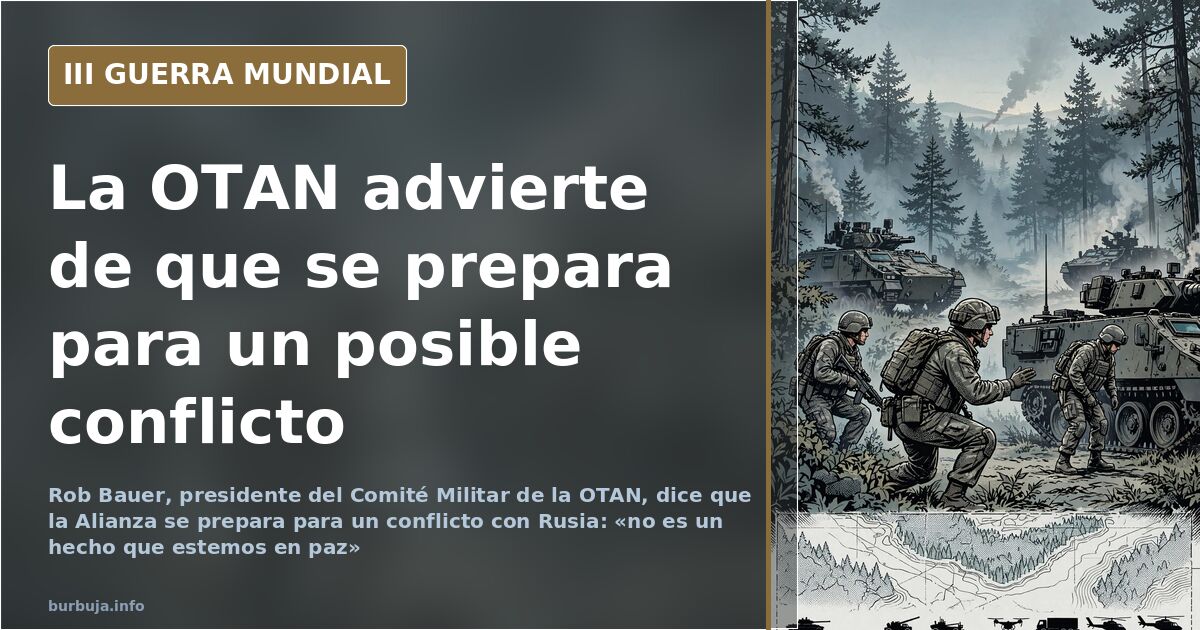
NATO warns of a potential conflict in 20 years
There is no war today. Yet NATO warns that it is preparing for one. This is the message from Rob Bauer, chairman of NATO's Military Committee, shared by Anton Gerashchenko: "Not everything will go well in the next 20 years. I am not saying that tomorrow will go badly. But we must realize that it is not a fact that we are at peace." The distance from warning to military plan is shorter than it appears.
Bauer does not speak of invasions or specific dates. He speaks of 20 years and preparation: "That is why we have the plans. That is why we are preparing for a conflict with Russia and terrorist groups." The nuance—"if we are attacked, we do not seek any conflict"—translates, according to participants' readings, into budgets, logistics, and an uncomfortable question: and what is the average citizen's role here?
What it means for NATO to speak of preparing for a conflict with Russia
The quote is not signed by a columnist; it is spoken by the chairman of NATO's Military Committee, according to the tweet by Anton Gerashchenko that spreads it.
The formulation has a trick. It does not announce an attack; it announces the possibility that an attack will arrive. In practice, for those who read it this way, it amounts to ordering members to map spending, reserves, industry, and evacuation plans. And to the population, to listen. Some read the episode with irony, recalling the suspicion that they are being heated up as peine with the pandemic.
Where the headline comes from and why some downgrade it to clickbait
Part of the controversy does not discuss the substance, but the source. In the thread itself, it is argued that the headline about war in 20 years stems from a somewhat forced translation from an economic dissemination channel, more attentive to clicks than nuance, and that the original quote was more prudent than its cut suggests. It is a reasonable objection: the difference between preparing for a conflict and announcing a conflict is the whole difference in the world.
Nevertheless, the message has a fitting problem. If there is nothing to announce, why talk about contingency plans in public? Those who defend the message read it as transparency; those who distrust it, as deterrence.
From the barracks to the domestic council: radios and bunkers
What bothers most is not the military scenario, but the recommendations on the ground. The thread cites the case of a Swedish NATO military officer who, according to a participant, would have advised the population to buy a radio; another replies that radios only serve to receive propaganda.
From there, the leap is free. Some propose digging a bunker and storing food, while others joke that Spain, with its economy focused on services and its staff of civil servants, would be an easy provider of replacements. The joke mixes with vertigo: trenches with artificial grass to avoid ruining the parquet.
Who would go to the front: replacement classes and age pyramid
Here memory weighs more than forecasts. They remember how mandatory recruitment worked four decades ago: letter with incorporation date, extension for studies, and return home, and they mention six weeks of training. The question that hovers: if needed, would the State grease that machine again?
The generational split divides analyses. Some argue that the burden would fall on the youngest, the generation currently around twenty and who in that horizon would be forty. Others point out that birth rates are not enough to fill trenches and that those with dual nationality will seek an exit through their passport before the letter arrives.
Defense spending and the war that does not end
The budgetary pulse has a proper name. They remember that it was Trump who proposed that Europe spend at least 2% of GDP on defense, and that the proposal then provoked rejection.
And in the background, Ukraine. Some argue that the conflict will not end, that it is designed to last, and the idea is repeated insistently. Some summarize it as an economic war and others go into detail: a total war between nuclear powers would last minutes, not decades. No one asks Russians and Ukrainians if they want to sit down to negotiate, another laments.
The demographic horizon: 26 million and a Europe of 62 years
The circulating numbers scare more than tanks. They cite an old report, attributed by a forum user to an agency working for the CIA, which projected a Spain of 26 million inhabitants. And they repeat the calculation that, 20 years on, the average European age will be around 62 years, a landscape someone compares to Children of Men.
Here war ceases to be military. Some frame it in the 2030 Agenda and decarbonization, and they speak of an aging continent while discussing how to pay pensions. The question is no longer against whom, but with what and with whom.
With these threads, NATO's warning admits two opposite readings: a sensible warning or the first move to justify rearmament. What if in 20 years no one remembers this warning because nothing peine, or because everything peine?
There is no war today. Yet NATO warns that it is preparing for one. This is the message from Rob Bauer, chairman of NATO's Military Committee, shared by Anton Gerashchenko: "Not everything will go well in the next 20 years. I am not saying that tomorrow will go badly. But we must realize that it is not a fact that we are at peace." The distance from warning to military plan is shorter than it appears.
Bauer does not speak of invasions or specific dates. He speaks of 20 years and preparation: "That is why we have the plans. That is why we are preparing for a conflict with Russia and terrorist groups." The nuance—"if we are attacked, we do not seek any conflict"—translates, according to participants' readings, into budgets, logistics, and an uncomfortable question: and what is the average citizen's role here?
What it means for NATO to speak of preparing for a conflict with Russia
The quote is not signed by a columnist; it is spoken by the chairman of NATO's Military Committee, according to the tweet by Anton Gerashchenko that spreads it.
The formulation has a trick. It does not announce an attack; it announces the possibility that an attack will arrive. In practice, for those who read it this way, it amounts to ordering members to map spending, reserves, industry, and evacuation plans. And to the population, to listen. Some read the episode with irony, recalling the suspicion that they are being heated up as peine with the pandemic.
Where the headline comes from and why some downgrade it to clickbait
Part of the controversy does not discuss the substance, but the source. In the thread itself, it is argued that the headline about war in 20 years stems from a somewhat forced translation from an economic dissemination channel, more attentive to clicks than nuance, and that the original quote was more prudent than its cut suggests. It is a reasonable objection: the difference between preparing for a conflict and announcing a conflict is the whole difference in the world.
Nevertheless, the message has a fitting problem. If there is nothing to announce, why talk about contingency plans in public? Those who defend the message read it as transparency; those who distrust it, as deterrence.
From the barracks to the domestic council: radios and bunkers
What bothers most is not the military scenario, but the recommendations on the ground. The thread cites the case of a Swedish NATO military officer who, according to a participant, would have advised the population to buy a radio; another replies that radios only serve to receive propaganda.
From there, the leap is free. Some propose digging a bunker and storing food, while others joke that Spain, with its economy focused on services and its staff of civil servants, would be an easy provider of replacements. The joke mixes with vertigo: trenches with artificial grass to avoid ruining the parquet.
Who would go to the front: replacement classes and age pyramid
Here memory weighs more than forecasts. They remember how mandatory recruitment worked four decades ago: letter with incorporation date, extension for studies, and return home, and they mention six weeks of training. The question that hovers: if needed, would the State grease that machine again?
The generational split divides analyses. Some argue that the burden would fall on the youngest, the generation currently around twenty and who in that horizon would be forty. Others point out that birth rates are not enough to fill trenches and that those with dual nationality will seek an exit through their passport before the letter arrives.
Defense spending and the war that does not end
The budgetary pulse has a proper name. They remember that it was Trump who proposed that Europe spend at least 2% of GDP on defense, and that the proposal then provoked rejection.
And in the background, Ukraine. Some argue that the conflict will not end, that it is designed to last, and the idea is repeated insistently. Some summarize it as an economic war and others go into detail: a total war between nuclear powers would last minutes, not decades. No one asks Russians and Ukrainians if they want to sit down to negotiate, another laments.
The demographic horizon: 26 million and a Europe of 62 years
The circulating numbers scare more than tanks. They cite an old report, attributed by a forum user to an agency working for the CIA, which projected a Spain of 26 million inhabitants. And they repeat the calculation that, 20 years on, the average European age will be around 62 years, a landscape someone compares to Children of Men.
Here war ceases to be military. Some frame it in the 2030 Agenda and decarbonization, and they speak of an aging continent while discussing how to pay pensions. The question is no longer against whom, but with what and with whom.
With these threads, NATO's warning admits two opposite readings: a sensible warning or the first move to justify rearmament. What if in 20 years no one remembers this warning because nothing peine, or because everything peine?
Summary of a discussion on Burbuja.info - Foro de economía, actualidad y política., translated from Spanish and reviewed before publication. Read the full discussion (319 replies).
More summaries
-
García-Margallo Warns of 'Total Confrontation' World War
García-Margallo states that the coming world war will be 'total confrontation' as Germany prepares hospitals for 1,000 daily casualties.
-
NATO claims to have 4,000 pages of plans against Russia
NATO states it has nearly 4,000 pages of documents ready to respond to Russian escalation on its Eastern flank.
-
Europe Prepares 'War Hospitals' as Healthcare Systems Strain
NATO and EU medical evacuation plans clash with healthcare systems where blood tests take 14 days. The mortgage is another unresolved issue.
-
Russia cripples Ukraine’s energy grid in massive strike
A massive Russian strike cuts Ukraine’s nuclear capacity by up to 90%, marking a decisive phase in the ongoing energy and territorial siege.
-
UK riots: Unproven theories on who is behind the chaos
The UK prosecutes the first person convicted for the Bolton riots while narratives fill with unproven theories about who is behind the unrest.
-
Amancio Ortega Dropped Out at 14: The Domestication Thesis
He left school at 14 to deliver shirts in La Coruña. The Inditex case reopens the debate on whether mandatory schooling domesticates or opens doors.