
Spanish 30-Somethings Face Housing and Income Barriers
Forum debate highlights Spanish 30-year-olds lacking stable jobs and savings, sparking discussion on rental costs and delayed independence.
English · Original discussion in Spanish · Published
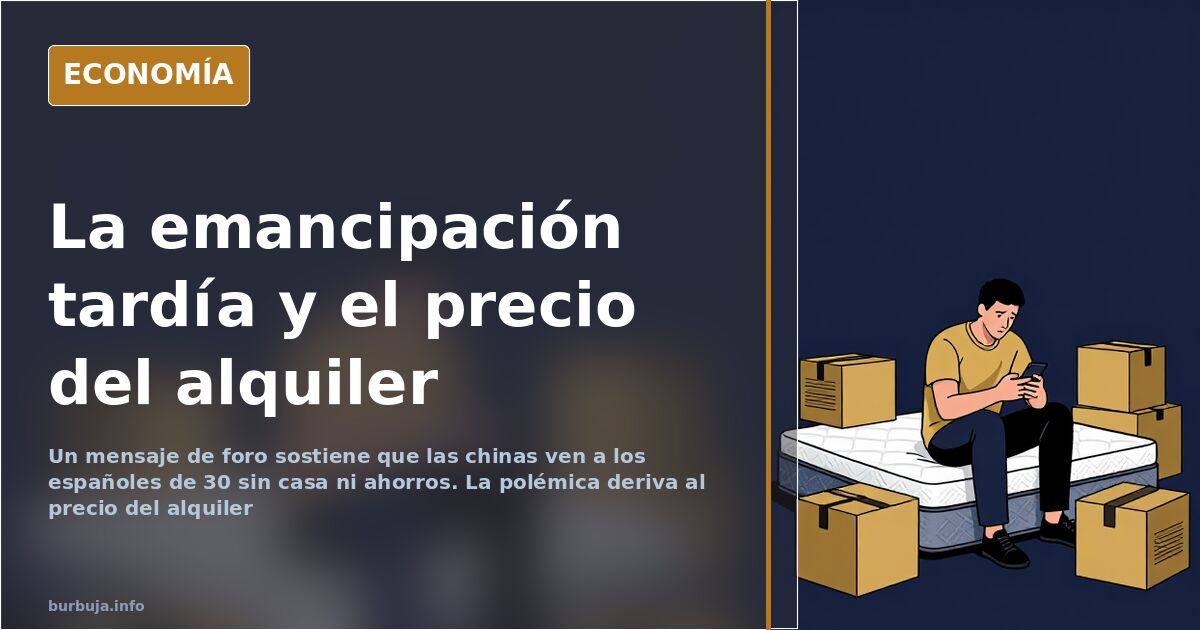
Home, salary, and savings: The threshold unmet by a 30-year-old Spaniard
A message circulated in the forum claims Chinese women view 30-year-old Spaniards as "immature kids": lacking stable employment, a home, and savings. The text adds that they seek stability and money, closing with an unkind warning for those who do not meet these three criteria. A few lines, no data, and a controversy dragging pages of back-and-forth on an uncomfortable question: is this a maturity issue or a payroll one?
The conversation has moved in two opposite directions. One part responds to the message by pointing out that it generalizes from a single person's video; another accepts the portrait and wonders why an adult reaches 30 without assets. And a third group changes track: the problem, they say, is not age, but the bank account.
Why does a 30-year-old adult still live with their parents?
Because the alternative, in many cases, costs between 500 and 700 euros per month. The calculation appears several times with the same structure: a room rents for 500 euros, and that money is better spent with the family than with a landlord. In the most detailed case, the person posing it prefers paying those 500 euros in the 100-square-meter parental apartment, with a private room, rather than handing them over to a landlord they describe as an inherited rentier.
Some argue the core is cultural, not economic: adults with enough work to pay rent who only leave home when they find a partner, and return to the family home when the relationship breaks. In this narrative, men over 50 live with their mothers and function, in practice, like children. The generous reading speaks of mutual aid; the harsh one, of comfort.
Ireland, Limerick, and the cost of starting over
The debate also admits a migratory reading. A testimony from a 27-year-old who has been in Ireland for one year summarizes it: in his experience, you receive nothing until you have accumulated two years worked in the country. He lives in Limerick, cheaper than Dublin, shares a house with three Irish people and one Englishman, and admits his first six months were spent sharing an apartment with other newcomers. He is integrated but admits he cannot aspire to much more.
The other side is put by someone who already knows Dublin: public transport is subpar and housing is expensive for what it offers. The diagnosis repeats: whoever leaves, leaves everything behind. Germany appears as an example of a market with much precarious employment, and some claim Spain already has German prices.
The traditional couple, refuge or trap
There is a model defended without circumlocution: traditional couple, he works, she manages the house and children. The one describing it says he is married this way and claims there is no need to cross the world to find this profile. The response to this premise has a name: stop rowing. His argument is that maintaining a partner who contributes no income or chores is a bad investment and that one simply needs to choose better.
In the middle appears a thesis defended by one participant and without a single figure to support it: that some Spanish women have renounced the burdens of the traditional model while claiming its benefits, and that this pushes men to give up as well. It is a statement made in the conditional and not accompanied by data.
The cross-accusation of materialism
Here accusations go in both directions. One part claims interest in a Chinese partner stems from seeking stability and someone accustomed to working, adding a curious detail: that in some cities in the country, parents post flyers with their single children's resumes—profession, income, whether they have housing—and hang them in public squares for other parents to read. Another current responds that materialism is identical everywhere and that the real difference lies in the division of household chores.
There are also those who return the blow: the accusation of being interested comes from someone living off their parents, and the problem is not about nationalities but about who pays the mortgage. The consensus, if it exists, is minimal. No one denies the lack of affordable housing. They only disagree on whom to blame.
In the end, the startling figure is not an opinion but a subtraction: 500 euros for a room, between 500 and 700 to become independent, and a 100-square-meter family apartment as an alternative. With this arithmetic, for those who frame it this way, staying home is profitability before immaturity.
A message circulated in the forum claims Chinese women view 30-year-old Spaniards as "immature kids": lacking stable employment, a home, and savings. The text adds that they seek stability and money, closing with an unkind warning for those who do not meet these three criteria. A few lines, no data, and a controversy dragging pages of back-and-forth on an uncomfortable question: is this a maturity issue or a payroll one?
The conversation has moved in two opposite directions. One part responds to the message by pointing out that it generalizes from a single person's video; another accepts the portrait and wonders why an adult reaches 30 without assets. And a third group changes track: the problem, they say, is not age, but the bank account.
Why does a 30-year-old adult still live with their parents?
Because the alternative, in many cases, costs between 500 and 700 euros per month. The calculation appears several times with the same structure: a room rents for 500 euros, and that money is better spent with the family than with a landlord. In the most detailed case, the person posing it prefers paying those 500 euros in the 100-square-meter parental apartment, with a private room, rather than handing them over to a landlord they describe as an inherited rentier.
Some argue the core is cultural, not economic: adults with enough work to pay rent who only leave home when they find a partner, and return to the family home when the relationship breaks. In this narrative, men over 50 live with their mothers and function, in practice, like children. The generous reading speaks of mutual aid; the harsh one, of comfort.
Ireland, Limerick, and the cost of starting over
The debate also admits a migratory reading. A testimony from a 27-year-old who has been in Ireland for one year summarizes it: in his experience, you receive nothing until you have accumulated two years worked in the country. He lives in Limerick, cheaper than Dublin, shares a house with three Irish people and one Englishman, and admits his first six months were spent sharing an apartment with other newcomers. He is integrated but admits he cannot aspire to much more.
The other side is put by someone who already knows Dublin: public transport is subpar and housing is expensive for what it offers. The diagnosis repeats: whoever leaves, leaves everything behind. Germany appears as an example of a market with much precarious employment, and some claim Spain already has German prices.
The traditional couple, refuge or trap
There is a model defended without circumlocution: traditional couple, he works, she manages the house and children. The one describing it says he is married this way and claims there is no need to cross the world to find this profile. The response to this premise has a name: stop rowing. His argument is that maintaining a partner who contributes no income or chores is a bad investment and that one simply needs to choose better.
In the middle appears a thesis defended by one participant and without a single figure to support it: that some Spanish women have renounced the burdens of the traditional model while claiming its benefits, and that this pushes men to give up as well. It is a statement made in the conditional and not accompanied by data.
The cross-accusation of materialism
Here accusations go in both directions. One part claims interest in a Chinese partner stems from seeking stability and someone accustomed to working, adding a curious detail: that in some cities in the country, parents post flyers with their single children's resumes—profession, income, whether they have housing—and hang them in public squares for other parents to read. Another current responds that materialism is identical everywhere and that the real difference lies in the division of household chores.
There are also those who return the blow: the accusation of being interested comes from someone living off their parents, and the problem is not about nationalities but about who pays the mortgage. The consensus, if it exists, is minimal. No one denies the lack of affordable housing. They only disagree on whom to blame.
In the end, the startling figure is not an opinion but a subtraction: 500 euros for a room, between 500 and 700 to become independent, and a 100-square-meter family apartment as an alternative. With this arithmetic, for those who frame it this way, staying home is profitability before immaturity.
Also available in: Deutsch
Summary of a discussion on Burbuja.info - Foro de economía, actualidad y política., translated from Spanish and reviewed before publication. Read the full discussion (303 replies).
More summaries
-
Chinese motorhomes: housing fix for €55,000
Chinese motorhomes at €55,000 versus €90,000 European ones: could they become emergency housing for millions of Spaniards?
-
Spain's Demographic Crisis: Why Aren't Spaniards Having Children?
We analyze the reasons behind Spain's low birth rate: selfishness, fear of the future, economic instability, and distrust in the system.
-
Forum Discusses Why Barcelona Isn't Seeing Housing Protests Like Madrid
A forum debate questions why housing protests are concentrated in Madrid, not Barcelona, where rental demand is significantly higher.
-
Fatty liver affects 25% of Spaniards, majority unaware
A quarter of Spain's population has fatty liver disease, yet over half don't know what it is. New data reveals widespread misconceptions about causes and risks.
-
Spain's Princess Leonor wears military uniform at civil reception
Princess Leonor greeted authorities in a military uniform at the Royal Palace, breaking protocol for civil events and sparking debate.
-
Pedri, I'm a 'Facha': Viral Video Reignites Label Debate
A viral video where a man self-identifies as a 'facha' sparks debate on political labeling in social media.