
Spain's Vilda fired after winning World Cup with reserves
Jorge Vilda won the Women's World Cup in Spain but was dismissed, while the male coach remains. Critics highlight a double standard.
English · Original discussion in Spanish · Published
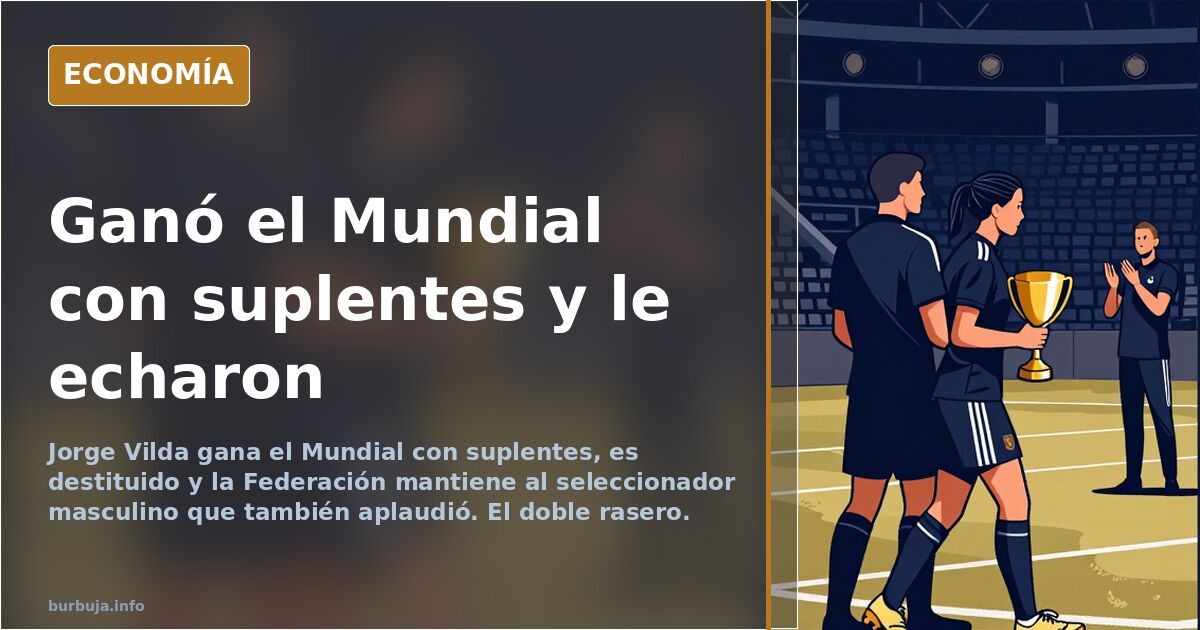
Vilda wins World Cup with reserves and loses his job
The dismissal of Jorge Vilda as head coach of the Spanish women's national team came right after winning the World Cup. Not midway through the tournament or after a disaster: immediately after the title. In the same week his exit was decided, the Federation kept the men's coach in place and appointed a new female coach. The detail that stands out is that the new coach, according to circulating accounts, also applauded at the same institutional event as the dismissed one. Spain won the World Cup with reserve players, and the man who led them could not celebrate it while holding office.
Historic or not, the episode is essentially a firing. A worker dismissed amidst a storm that did not start on the pitch. And here lies the conflict: whether the criterion for deciding his continuity was sporting or something else.
Why fire the coach who won the World Cup?
The stated reason was not the sporting result. The dominant interpretation is that Vilda's departure served to repair relations with a group of players who had already broken ties with the technical staff. The most repeated argument points to the previous Euro: Spain lost to England after conceding an equalizer in stoppage time and losing in extra time. There, it is claimed, the locker room stopped supporting the coach.
Against this thesis is a fact that cannot be bent. Spain finished World Champions. They rebuilt the squad from an internal dispute—with up to fifteen signatories—, dropped a dozen of them, and still won. Some conclude that a coach capable of rearming the team with reserves, against half the country, would not be fired even if he wanted to. "If after a mutiny by 15 players you drop 12 and manage to rebuild the squad and win a World Cup, you are an exceptional coach," summarizes one of the most circulated assessments.
Double standard between men's and women's teams
Here is the most uncomfortable edge. The men's coach also applauded and remains in charge. The female successor also applauded and has just arrived. If the gesture does not invalidate some, it is hard to understand why it invalidates another. It is the only part of the story that fits all interpretations simultaneously, and also the most institutionally troubling: the retention criterion is not applied equally depending on the bench.
Some add that the accused man paid the price for a conflict that was not strictly his own. The sequence reads like this: since the dispute with the leadership could not be won directly, it was shifted to the weakest link in the chain. A reasoning that proves nothing, but orders the timeline of events quite well.
The mutiny in the dominant club anticipated the pattern
The laboratory for all this is two years old and has a specific setting. The hegemonic club in Spanish women's football—league, cup, and Champions League in the same season—experienced an unusual episode: its players went to the president to say they did not like the coach with whom they had won everything and demanded a change. The president yielded. The trinc year, only the league was won.
That pattern—victory, dispute, coaching change, drop in results—is now replicated on a larger scale. It is not a prediction, but a precedent that some read as proof and others dismiss as mere coincidence. The difference between these readings defines the rest of the discussion.
Is it a dismissal with gender discrimination?
In labor terms, the question is complex. One circulating view holds that it is a dismissal with discriminatory overtones: a man removed after a conflict with a group of female workers, without file or objective cause. The opposing view responds that the position is held by whoever sets federation policy and that the replacement is a management decision, not a legal one.
What neither resolves is the contractual fit. The head coach position is a role of trust, which leaves wide margins to justify an exit without needing to motivate it. Any claim blurs there: there is no cause, but often none is needed.
What is at stake for women's football after the change
The scenario drawn is risky. With a group of starters wanting to regain influence and a group of reserves who won the tournament claiming merit, internal coexistence looks tense. Some forecasts go further: if defeats arrive, blame will circulate toward those who made the decision and those who execute it.
And in the background remains an issue nobody closes: whether sporting merit weighs less than the correlation of forces in an office. The answer to that question is worth more than a World Cup.
The case stays where it started. The Federation changed coaches, kept the neighboring one, and left the conflict open pending results—sporting and otherwise—to speak for themselves. With these elements, the next match window will say more than any statement.
The dismissal of Jorge Vilda as head coach of the Spanish women's national team came right after winning the World Cup. Not midway through the tournament or after a disaster: immediately after the title. In the same week his exit was decided, the Federation kept the men's coach in place and appointed a new female coach. The detail that stands out is that the new coach, according to circulating accounts, also applauded at the same institutional event as the dismissed one. Spain won the World Cup with reserve players, and the man who led them could not celebrate it while holding office.
Historic or not, the episode is essentially a firing. A worker dismissed amidst a storm that did not start on the pitch. And here lies the conflict: whether the criterion for deciding his continuity was sporting or something else.
Why fire the coach who won the World Cup?
The stated reason was not the sporting result. The dominant interpretation is that Vilda's departure served to repair relations with a group of players who had already broken ties with the technical staff. The most repeated argument points to the previous Euro: Spain lost to England after conceding an equalizer in stoppage time and losing in extra time. There, it is claimed, the locker room stopped supporting the coach.
Against this thesis is a fact that cannot be bent. Spain finished World Champions. They rebuilt the squad from an internal dispute—with up to fifteen signatories—, dropped a dozen of them, and still won. Some conclude that a coach capable of rearming the team with reserves, against half the country, would not be fired even if he wanted to. "If after a mutiny by 15 players you drop 12 and manage to rebuild the squad and win a World Cup, you are an exceptional coach," summarizes one of the most circulated assessments.
Double standard between men's and women's teams
Here is the most uncomfortable edge. The men's coach also applauded and remains in charge. The female successor also applauded and has just arrived. If the gesture does not invalidate some, it is hard to understand why it invalidates another. It is the only part of the story that fits all interpretations simultaneously, and also the most institutionally troubling: the retention criterion is not applied equally depending on the bench.
Some add that the accused man paid the price for a conflict that was not strictly his own. The sequence reads like this: since the dispute with the leadership could not be won directly, it was shifted to the weakest link in the chain. A reasoning that proves nothing, but orders the timeline of events quite well.
The mutiny in the dominant club anticipated the pattern
The laboratory for all this is two years old and has a specific setting. The hegemonic club in Spanish women's football—league, cup, and Champions League in the same season—experienced an unusual episode: its players went to the president to say they did not like the coach with whom they had won everything and demanded a change. The president yielded. The trinc year, only the league was won.
That pattern—victory, dispute, coaching change, drop in results—is now replicated on a larger scale. It is not a prediction, but a precedent that some read as proof and others dismiss as mere coincidence. The difference between these readings defines the rest of the discussion.
Is it a dismissal with gender discrimination?
In labor terms, the question is complex. One circulating view holds that it is a dismissal with discriminatory overtones: a man removed after a conflict with a group of female workers, without file or objective cause. The opposing view responds that the position is held by whoever sets federation policy and that the replacement is a management decision, not a legal one.
What neither resolves is the contractual fit. The head coach position is a role of trust, which leaves wide margins to justify an exit without needing to motivate it. Any claim blurs there: there is no cause, but often none is needed.
What is at stake for women's football after the change
The scenario drawn is risky. With a group of starters wanting to regain influence and a group of reserves who won the tournament claiming merit, internal coexistence looks tense. Some forecasts go further: if defeats arrive, blame will circulate toward those who made the decision and those who execute it.
And in the background remains an issue nobody closes: whether sporting merit weighs less than the correlation of forces in an office. The answer to that question is worth more than a World Cup.
The case stays where it started. The Federation changed coaches, kept the neighboring one, and left the conflict open pending results—sporting and otherwise—to speak for themselves. With these elements, the next match window will say more than any statement.
Also available in: Deutsch
Summary of a discussion on Burbuja.info - Foro de economía, actualidad y política., translated from Spanish and reviewed before publication. Read the full discussion (139 replies).
More summaries
-
Putellas scandal and Jenni Hermoso's statement
Analysis of Jenni Hermoso's statement in the Putellas and Rubiales case, contrasting legal and social perceptions.
-
Montse Tomé Calls Up 19 Signatories, Leaves Out Jenni Hermoso
Montse Tomé's squad includes 19 players who had previously refused call-ups in writing. Jenni Hermoso is excluded, and tensions remain high.
-
Rubiales and Hermoso: From World Cup Glory to Kiss Scandal
The RFEF president's kiss overshadowed Spain's women's title. His salary was reported at €675,761 gross annually.
-
Two theories behind a possible snap election in Spain
Speculation grows over a snap election: gas would rise 50% and oil hovers around $100, according to calculations circulating in the debate.
-
Spain blackout exposes flaws in 'world's best' grid
The total power outage in Spain challenges the narrative of having the world's best electrical grid, highlighting costs and renewable integration issues.
-
Andalusian Holy Week: Faith, Tourism and Identity Debate
Andalusia's Holy Week returns in 2025 amid fervor, tourism, and debates over public funding. Here is what is discussed and why there are no easy answers.