
Spain's Uranium Ban: Aagesen Says No Reserves, Law Blocks Mining
Ecology Minister Sara Aagesen claims Spain has no uranium, citing a legal ban on extraction, despite geological surveys indicating significant reserves in Salamanca and Cáceres.
English · Original discussion in Spanish · Published
Spain's Uranium Ban: Aagesen Says No Reserves, Law Blocks Mining
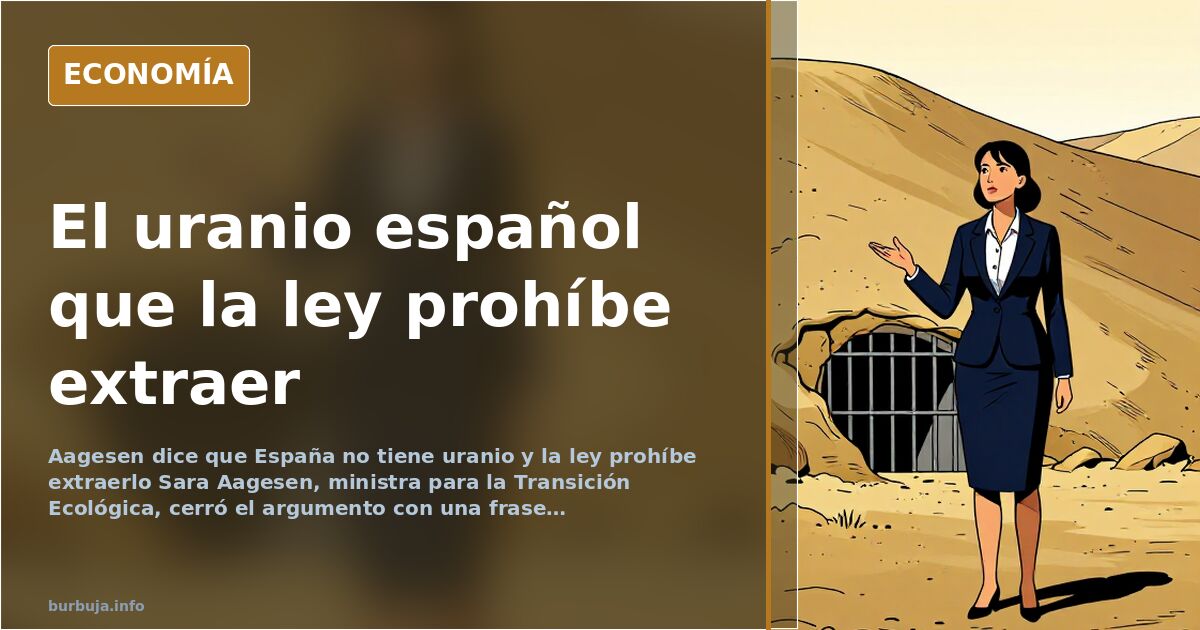
Ecology Minister Sara Aagesen concluded her argument with a definitive statement: "We have no fossil resources, we have no uranium, but we do have sun and wind". Shortly after, Pedro Sánchez echoed this sentiment in Congress, rhetorically asking where Spain plans to import fuel if it possesses none. The statement is misleading, and the trick is called Law 7/2021.
According to the Red Book of Uranium, an International Energy Agency report compiling global reserves, Spain would be the second country in continental Europe with the largest uranium mineral reserves. Named deposits cited in the debate are located in Salamanca — the Fé mine in Saelices el Chico, near Ciudad Rodrigo — and in Cáceres. The Salamanca mine did not close due to geological drought: it had been operating since the 20th century and functioned until the early 2000s.
Why Doesn't Spain Extract Its Own Uranium?
Because a law prohibits it. Article 10 of Law 7/2021 on climate change and energy transition bans the research and exploitation of radioactive minerals across the national territory when extracted for their fissionable or fertile qualities. The current government, which now denies having resources, approved this law. The logical consequence is that the claim is not entirely false: there is no exploited uranium, although confirmed uranium exists underground.
Some argue this is a deliberate euphemism; others call it outright dishonesty. The fact is that the Executive can say "we have no uranium" without abusa literal truth, because it has legally ensured there is none to extract. The detail of the amendment — and who signed it — is one of the points that, according to some participants, the official narrative prefers not to air.
Reserves Are Not Mines: The Battle Over Costs
This is where no side closes the loop. The official reading distinguishes between reserve and resource. A reserve is what is economically and technically extractable. A resource is what exists without guarantee that the investment will pay off. From this distinction, it is argued that Spanish ores are poor, expensive to process, and extracting them from the subsurface is not cost-effective compared to buying ready-made fuel.
The counterargument has gained traction: if the vein is so depleted, why was a legal ban necessary? When something is unprofitable, it is simply not extracted. When it is banned, it implies someone antiestéticars it might be profitable. At the heart of the clash lies the old distinction between what geology allows and what politics decides not to permit.
How Long Would Nuclear Plants Last With National Uranium?
Circulating calculations give an order of magnitude: around 28,500 tons of estimated reserves and an annual consumption of nearly 1,600 tons in Spanish nuclear plants, which generate approximately one-fifth of the country's electricity. The arithmetic yields about 17.81 years of autonomy if all mineral came from national mines.
This is an uncomfortable figure, as it neither resolves the long-term debate nor leaves the thesis of absolute emptiness in a good light. The full breakdown, with variations recognized by the model itself, adds even more uncertainty to the estimate. The range depends on how much is considered truly extractable and at what price.
France Has No Uranium and Operates Half a Dozen Reactors
The international comparison undermines the argument from another angle, according to those who wield it. France has no domestic deposits and maintains more than fifty reactors in operation, fed for decades with mineral from its former African colonies. That a country lacks uranium does not condemn it to renounce nuclear energy: it forces it to import.
On the other side, some recall that Spain already imports all the uranium for its plants, mainly from countries like Australia or Russia, and that the UK is building its transition with a very different mix, where gas, nuclear, and offshore wind weigh more than solar. The British mix — with gas at the forefront — circulates in the discussion as an uncomfortable mirror of the Spanish case.
Political Clash and Foreign Interest
The minister's statement has fallen flat outside the Government. Some label it a falsehood, while others recall that the current prohibition was pushed by the same entities now claiming there is nothing to extract. Over this issue looms a question — unanswered — about why Australian companies have shown interest in opening Spain's uranium tap while officials maintain there is nothing to extract.
The pattern repeats, as summarized by one participant: we ban it, we import it, and the day others exploit it, we will buy it. It is the story of copper, of which Spain was one of the world's largest producers in the 20th century, and of which, according to this same participant, there is now nothing left.
Ecology Minister Sara Aagesen concluded her argument with a definitive statement: "We have no fossil resources, we have no uranium, but we do have sun and wind". Shortly after, Pedro Sánchez echoed this sentiment in Congress, rhetorically asking where Spain plans to import fuel if it possesses none. The statement is misleading, and the trick is called Law 7/2021.
According to the Red Book of Uranium, an International Energy Agency report compiling global reserves, Spain would be the second country in continental Europe with the largest uranium mineral reserves. Named deposits cited in the debate are located in Salamanca — the Fé mine in Saelices el Chico, near Ciudad Rodrigo — and in Cáceres. The Salamanca mine did not close due to geological drought: it had been operating since the 20th century and functioned until the early 2000s.
Why Doesn't Spain Extract Its Own Uranium?
Because a law prohibits it. Article 10 of Law 7/2021 on climate change and energy transition bans the research and exploitation of radioactive minerals across the national territory when extracted for their fissionable or fertile qualities. The current government, which now denies having resources, approved this law. The logical consequence is that the claim is not entirely false: there is no exploited uranium, although confirmed uranium exists underground.
Some argue this is a deliberate euphemism; others call it outright dishonesty. The fact is that the Executive can say "we have no uranium" without abusa literal truth, because it has legally ensured there is none to extract. The detail of the amendment — and who signed it — is one of the points that, according to some participants, the official narrative prefers not to air.
Reserves Are Not Mines: The Battle Over Costs
This is where no side closes the loop. The official reading distinguishes between reserve and resource. A reserve is what is economically and technically extractable. A resource is what exists without guarantee that the investment will pay off. From this distinction, it is argued that Spanish ores are poor, expensive to process, and extracting them from the subsurface is not cost-effective compared to buying ready-made fuel.
The counterargument has gained traction: if the vein is so depleted, why was a legal ban necessary? When something is unprofitable, it is simply not extracted. When it is banned, it implies someone antiestéticars it might be profitable. At the heart of the clash lies the old distinction between what geology allows and what politics decides not to permit.
How Long Would Nuclear Plants Last With National Uranium?
Circulating calculations give an order of magnitude: around 28,500 tons of estimated reserves and an annual consumption of nearly 1,600 tons in Spanish nuclear plants, which generate approximately one-fifth of the country's electricity. The arithmetic yields about 17.81 years of autonomy if all mineral came from national mines.
This is an uncomfortable figure, as it neither resolves the long-term debate nor leaves the thesis of absolute emptiness in a good light. The full breakdown, with variations recognized by the model itself, adds even more uncertainty to the estimate. The range depends on how much is considered truly extractable and at what price.
France Has No Uranium and Operates Half a Dozen Reactors
The international comparison undermines the argument from another angle, according to those who wield it. France has no domestic deposits and maintains more than fifty reactors in operation, fed for decades with mineral from its former African colonies. That a country lacks uranium does not condemn it to renounce nuclear energy: it forces it to import.
On the other side, some recall that Spain already imports all the uranium for its plants, mainly from countries like Australia or Russia, and that the UK is building its transition with a very different mix, where gas, nuclear, and offshore wind weigh more than solar. The British mix — with gas at the forefront — circulates in the discussion as an uncomfortable mirror of the Spanish case.
Political Clash and Foreign Interest
The minister's statement has fallen flat outside the Government. Some label it a falsehood, while others recall that the current prohibition was pushed by the same entities now claiming there is nothing to extract. Over this issue looms a question — unanswered — about why Australian companies have shown interest in opening Spain's uranium tap while officials maintain there is nothing to extract.
The pattern repeats, as summarized by one participant: we ban it, we import it, and the day others exploit it, we will buy it. It is the story of copper, of which Spain was one of the world's largest producers in the 20th century, and of which, according to this same participant, there is now nothing left.
Also available in: Deutsch
Summary of a discussion on Burbuja.info - Foro de economía, actualidad y política., translated from Spanish and reviewed before publication. Read the full discussion (434 replies).
More summaries
-
Climate Skepticism Targets UN Agenda 2030 as Globalist Plot
Critics claim the green transition is an elite scheme for world government. Key data, dates and arguments behind this conspiracy theory.
-
Trump: The President of the Global Ecological Transition
Oil prices rise while Chinese renewables fall in cost. Examining Trump's role in the global energy economy.
-
Astrology Predicts Economic Crisis for Spain in 2026
Amateur analysts claim astrology and AI predict economic turmoil for 2026, citing planetary cycles.
-
Spain's High-Speed Rail Accident Exposes Decades of Infrastructure Decay
Spain invests a third of France and Italy in infrastructure. Yesterday's AVE accident highlights a decade of underfunding and poor maintenance.
-
Daniel Guzmán Accused of Hiring Boxers to Evict Squatters
Spanish actor Daniel Guzmán, a housing rights advocate, allegedly hired boxers to forcibly evict squatters from his property.
-
Trump supporters: Are you truly complicit?
Cheap US gas at €0.70 vs $2,800 hospital bills: analyzing why some Spaniards back Trump's Venezuela intervention.