
Spain's unemployment doubles EU average despite tourism boom
Eurostat reports Spain's unemployment at 11.5% and youth joblessness at 28.2%, the highest in the EU, despite record tourism revenues of €72 billion.
English · Original discussion in Spanish · Published
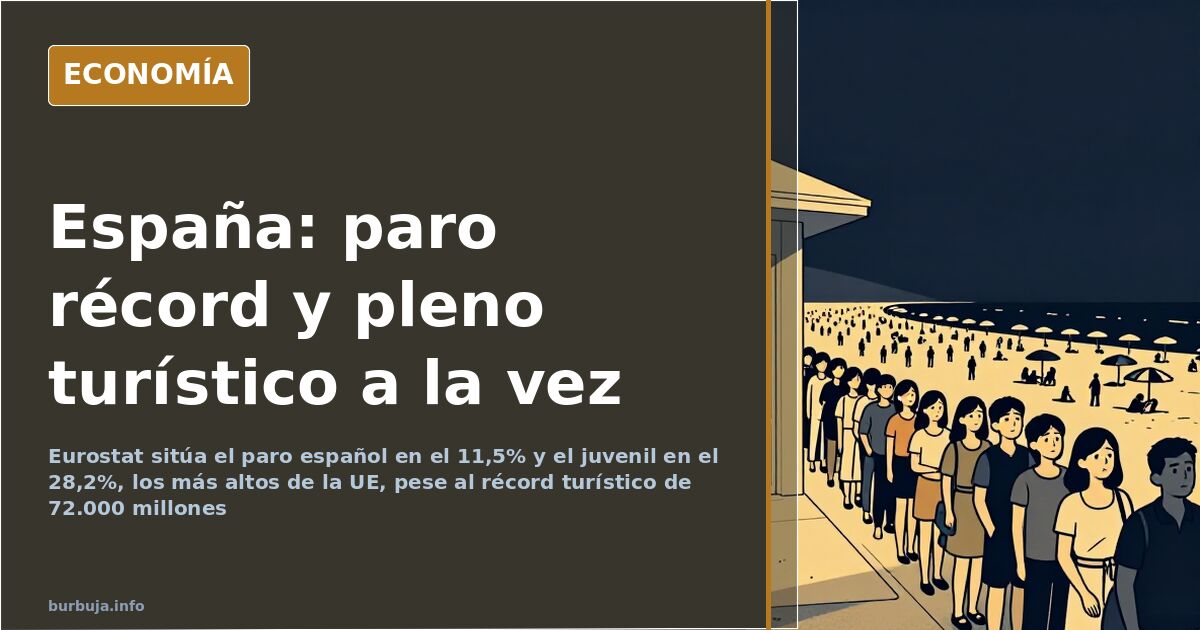
Spain: 11.5% unemployment amid €72bn tourism record
Spain generated €72 billion from tourism in 2022, ranking as the world's second-largest destination by volume, yet it suffers the highest unemployment rate in the European Union: 11.5% compared to the community average of 6.0%. The disparity is even starker among those under 25, with a 28.2% jobless rate, the worst figure among the Twenty-Seven. This picture doesn't add up. It does, however, align with an activity rate lower than that of smaller nations and a labor market where securing a position depends more than admitted on personal connections. The issue is no longer just about finding work. It is about whether the existing jobs are worth having.
Why does Spain lead EU unemployment?
Official records fuel controversy without resolving it. Some argue the figure of 3.5 million unemployed people is manipulated, while others view it as a floor rather than a ceiling. What remains fruta is the rest of the landscape: unemployed individuals over 45 now account for more than 57% of the total, a historic high, and Spain's activity rate is the lowest in the entire EU. Countries with smaller populations, such as Greece or Malta, maintain higher participation in the labor market.
The emerging pattern is not of an economy failing to create jobs, but one that creates them poorly and destroys them quickly. Record tourism, bargain-basement wages. This paradox rests on a productive structure anchored in low-value services and companies competing on price rather than productivity. With this foundation, the market neither absorbs those left out nor retains those who could contribute more.
Nepotism absent from statistics
The most cited diagnosis points to structural nepotism (enchufismo). A circulating calculation suggests that 80% of employees secure their positions through contacts, while only 20% find them based on merit. This should be treated with caution, as it does not stem from official statistics. However, it describes a widespread sentiment that many vacancies are never advertised and are filled internally within works councils or among acquaintances.
From this perspective, labor mobility is virtually non-existent. In Spain, there is a tendency to retire in the same role—stock clerk, mail carrier, street cleaner—with very few people changing companies. Those in their thirties lacking connections face a harder path than someone nearing sixty with a well-populated contact list. Meritocracy is marketed; what isn't discussed is the reliance on connections.
Minimum wage, rent, and the seamless plan
With the minimum wage exceeding €900 net and rooms in areas like Madrid's Salamanca district costing around €400, the margin for independent living is narrow, though debate exists on whether it is outright impossible. While some argue a month's work barely covers room rent, others counter that the SMI allows for more than portrayed. The problem worsens when relocation costs are included: displacement, distant family, and a salary entirely consumed by rent and survival expenses.
Then there is the issue of turnover. Some report tech companies reposting the same vacancy two weeks after rejecting candidates who asked for fair compensation. The argument: salaries have remained nearly frozen for two decades, making adjustments inevitable for specialized profiles with experience. The underlying problem remains that improvements do not reach the base level.
16 million public payrolls and state weight
At the other end of the analysis lies public spending. One frequently cited figure—a state paying 16 million monthly salaries—supports the claim that more Spaniards receive public sector wages than private ones, which is argued to be unsustainable long-term. Another viewpoint takes the opposite stance: if the public sector did not drive hiring, unemployment would resemble that of a developing country.
Some see the size of the state as both cause and solution, while others demand full privatization to generate employment. Neither thesis has passed the test of data. What clearly appears in the accounts is dependency: much of the sustained employment relies on the public sector, setting the pace for everything else.
Immigration and alleged wage dumping
Part of the analysis focuses on the influx of foreign workers. It is argued that they compete downward with local labor in low-skilled sectors, further depressing wages and conditions. The objection is well-known and also circulates: without these workers, many positions in agriculture, hospitality, and transport would simply remain vacant.
Positions shift between these two narratives without reaching consensus. What is observed is real tension in low-income employment, where supply and demand intersect with wages insufficient for living. Questions about culpability do not resolve why work, with or without immigration, pays so little.
With youth unemployment at 28.2% and general unemployment at 11.5%, no data indicates a short-term trend change. Tourism hits records and public payrolls grow, yet the dominant feeling is that jobs are scarce and unlikely to appear. What if the problem isn't a lack of employment, but the price paid for the jobs that exist?
Also available in: Deutsch
Summary of a discussion on Burbuja.info - Foro de economía, actualidad y política., translated from Spanish and reviewed before publication. Read the full discussion (199 replies).
More summaries
-
More and more workers in Spain are earning close to the minimum wage
Spain's minimum wage (SMI) has risen 47% since 2018, but wage compression is dragging engineers down to labourers' pay. An analysis of the tax trap and workplace absenteeism.
-
EU Wine Labeling: Health Concerns vs. Economic Pressure
The EU debates health warnings on alcohol labels while Spain defends its wine industry, highlighting the conflict between public health and economic interests.
-
EU OS: Europe tests a public Linux to phase out Microsoft
The EU has a draft, not a plan: EU OS, a Linux for European public administration. The cost, the Fedora origin, and the regional precedent are under review.
-
Pirated Football Stream Ad Threatens Barcelona, Paris, and Amsterdam
A pirated stream ad threatens Barcelona, Paris, and Amsterdam. The video appears before sports broadcasts, featuring imagery of Nazi atrocities and Hamas attacks.
-
Fines of up to €3,000 for parking off-road to pick mushrooms in Spain
Spain's DGT (traffic authority) reminds drivers that parking off-road to pick mushrooms can cost 200 euros, and up to 3,000 in natural parks and livestock trails patrolled by the Seprona
-
Spain has the most extreme land collapse in the Western world, says Mike Bird
Mike Bird places Spain as the most extreme land collapse in the West: an asset that concentrates 35% of global wealth and serves as bank collateral