
Fines of up to €3,000 for parking off-road to pick mushrooms in Spain
Spain's DGT (traffic authority) reminds drivers that parking off-road to pick mushrooms can cost 200 euros, and up to 3,000 in natural parks and livestock trails patrolled by the Seprona
English · Original discussion in Spanish · Published
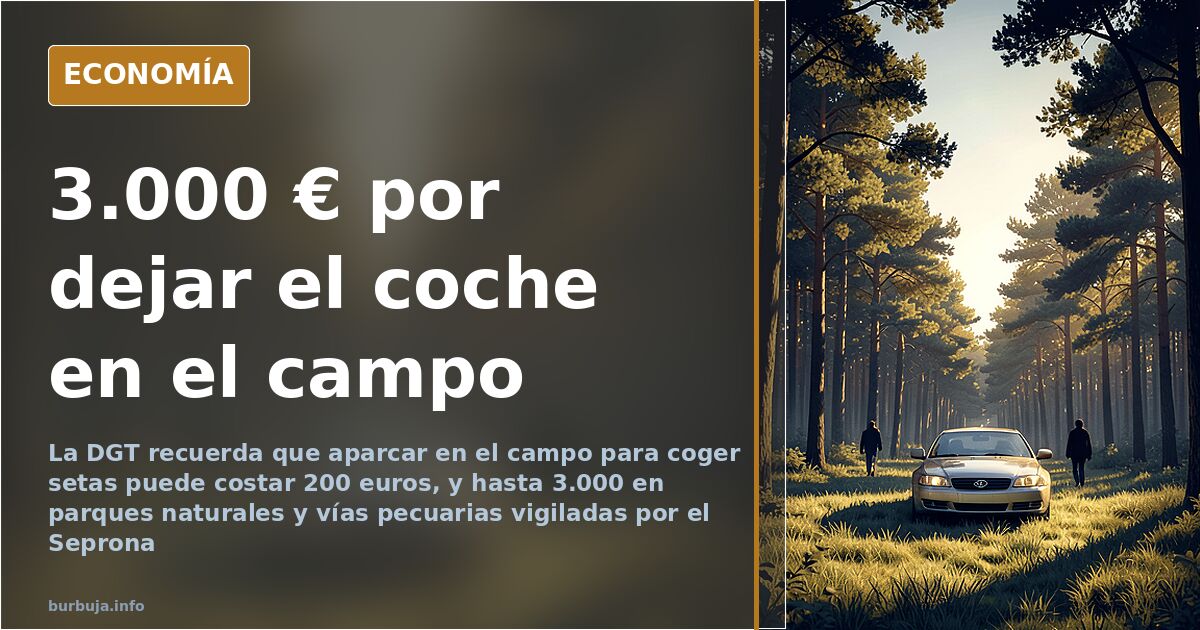
Parking off-road to pick mushrooms can cost up to 3,000 euros
Autumn, a basket in the boot and a dirt track in sight. Mushroom season puts thousands of drivers in the crosshairs of two laws almost nobody reads: the Ley de Montes (Spain's Forestry Law) and the Road Traffic and Safety Law. Both broadly prohibit driving and parking in the countryside, and the DGT has reminded drivers of it with a warning circulating in hobbyist groups: the fine can reach 3,000 euros.
The article that has sparked the conversation, written by Mercedes Benítez in El Debate, does not refer to a new fee or a tax: it is an offence that already exists, classified as serious in the General Traffic Regulations and punishable by 200 euros, or 100 with the early-payment reduction. The higher figure applies in a different setting. Natural parks, dry riverbeds, riverbanks, livestock trails and drovers' roads are specially protected areas patrolled by the Seprona (the Guardia Civil's environmental service), and there parking is punished with fines of up to 3,000 euros.
Where you can actually leave your car
The rules leave little room. Vehicles are only allowed in designated and properly signposted car parks, or on the verges and strips immediately adjacent to an unpaved public track. Provided no vegetation is encroached upon, no other vehicles are blocked and there is no signage prohibiting it. The reasoning given in the text is twofold: the weight of the car compacts the soil and encourages erosion, and the heat of the catalytic converter can set dry vegetation alight under the chassis.
There is also the municipal and regional layer to add. The ordinances of each local council and the regulations of each autonomous community may further restrict driving on tracks and livestock trails, because the ban is not limited to parking: it also covers simple transit. Checking the local rules before leaving home is cheaper than the surprise in the woods.
Antiestéticar as an argument
The reaction has not exactly been enthusiastic. One current of opinion reads it as another link in the chain of bans and fines that, in their view, governs everyday life: more rules, more antiestéticar and less room for spontaneity. At the opposite end, some argue that without regulation the countryside would end up as a car park, and that protecting soil and woodland is not an administrative whim.
Between the two camps a practical problem arises that some participants raise: if the car is left far away in a designated car park, the mushroom picker loses sight of their vehicle for hours. Those who raise the point argue that the rule protects the land but leaves unattended the property of the person out picking mushrooms, exposed to theft or damage with no witnesses. It is not a logical impossibility, it is a real tension between two goods that the rule does not balance.
The small-print trap
The most baffling detail is the scale. The same act —leaving the car on vegetation— can cost 100 euros with early payment, or multiply by thirty if the land has any form of protection. Nobody disputes the figure; they dispute the apparent arbitrariness of the map. And that is where the conversation stalls: protecting woodland is defensible, but citizens who do not know the catalogue of livestock trails cannot tell whether they are parking on 200-euro or 3,000-euro ground until they have already parked.
Also available in: Deutsch
Summary of a discussion on Burbuja.info - Foro de economía, actualidad y política., translated from Spanish and reviewed before publication. Read the full discussion (22 replies).
More summaries
-
Spain opts out of US-led Red Sea naval mission
Spain declines joining the US naval operation in the Red Sea following Houthi attacks, sparking debate on sovereignty and NATO commitments.
-
Spain's Forestry Law and Gisbert: crime or noise?
Gisbert's video on Article 50 of Spain's Forestry Law sparks criticism: conspiracy theory or genuine warning? We break down the debate and the motivations behind it.
-
Spanish researcher evicted despite paying rent and holding a €71,000 purchase option
He paid rent for years, had a purchase option at €71,000 and was ultimately evicted by a Caixabank-owned fund, receiving a €35,000 compensation order.
-
The insurance was paid, but the goods weren't covered
A pipe bursts at 6:48 and soaks 32 boxes. The policy covered the building and a minimal amount of contents: the tenant's stock was not insured.
-
X and the 'for you' feed: bots, activist accounts and political noise
Users report that X's 'for you' tab shows them activist accounts and bots; some blame the noise on bots, while others criticise the algorithm that…
-
Images of a young man with a machete in the Canary Islands
A video of a man with a machete on a road in San Fernando, Maspalomas, outside a kebab shop, is circulating on social media. What is known about the case and what is not.