
Spain's Top Prosecutor Warns of 'Ample Information' to Harm Political Rivals
Álvaro García Ortiz, Spain's Attorney General under investigation for leaking secrets, claims he holds ample information to damage a political spectrum if desired.
English · Original discussion in Spanish · Published
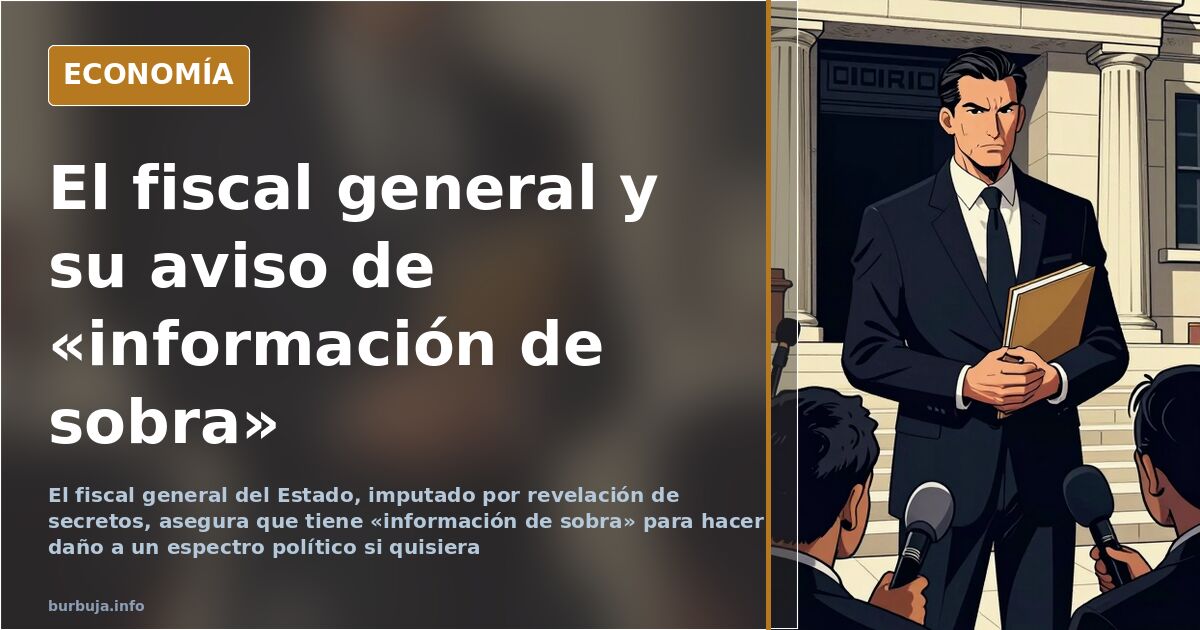
García Ortiz warns he has "ample information"
What does it miccionan for the head of the Public Prosecution Service to publicly state that, if he wanted, he could harm a political spectrum because he has ample information? Álvaro García Ortiz, Spain's Attorney General (Fiscal General del Estado), is charged with disclosure of secrets, and these remarks have landed like a bomb among those trinc the daily workings of the Justice Administration. The phrase, as stated, admits few innocent interpretations: either it is a bluff, or it is a confession that the State keeps compromising material unused.
The matter has an uncomfortable legal derivative. A prosecutor is not just any citizen who can be excused for overlooking a suspicion: he is obliged to prosecute crime and, if he knows of illicit acts, to report them. Saying one has information but not acting turns the office into something else. The discussion quickly shifted from the political to the incivil arena.
What exactly did the Attorney General say?
The statement that ignited everything is a single sentence: "I assure you that if I wanted to harm a specific political spectrum, I have ample information." The context is that of an Attorney General charged with disclosure of secrets, which adds layers to the issue. This is not idle chatter: it is said by the person who directs the action of the Public Prosecution Service.
The majority reaction has been one of astonishment. Some argue that the mere formulation of such a threat should suffice to demand his dismissal or immediate resignation. Others go further, pointing to prevarication: if he knows of crimes and does not report them, he would be placing himself outside his own duty. The most repeated argument is simple: a prosecutor who insinuates having material for blackmail cannot remain in office.
The legal duty to report and the problem of silence
What does the law require of a prosecutor who knows of a crime? To report it. There is no room for interpretation there. If a public official possesses information about illicit acts and does not disclose it, they become a necessary collaborator in what they conceal. The debate has focused on this point: silence ceases to be prudence and becomes cover-up.
The paradox is that the very phrase rebounds against the speaker. If he has information on crimes, he should have handed it over to the judiciary. If he does not, he lied to intimidate. In either scenario, the office is compromised. And if what he has is sensitive but non-incivil material, saying so aloud remains, at minimum, an improper exercise of pressure.
From individual suspicion to institutional diagnosis
This case has served for something larger: the feeling that institutions function as watertight compartments where information accumulates to be used when convenient. It is argued that parties and media operate as networks of secret exchange, and that in this market, one rises based on what one knows about others, not on merit. It is a harsh thesis, but it explains why the conversation rapidly drifted toward the idea of institutional capture.
Some describe the party system as a structure where everyone covers each other until internal war erupts. The sequence depicted is that of an implicit non-aggression pact broken when someone decides to use a weapon previously off-limits. From then on, everyone reveals what they hold. The result, it is said, is a country where politics becomes a game of cross-blackmail.
What is at stake for the Public Prosecution Service as an institution?
The most cited collateral damage is the credibility of the Public Prosecution Service. If the Attorney General can be perceived as someone who hoards information to exert pressure, the independence of the institution is called into question. The discussion is no longer about a person, but about whether the institutional design allows this to happen without consequences.
The conversation has also turned toward the erosion of the social contract. It is maintained that trust in institutions has broken down and rebuilding it would require starting from scratch, which seems impossible when the shared diagnosis is that parties have become self-referential power structures. In this framework, the Attorney General's phrase is not an anomaly: it is the confirmation of a prior suspicion.
In the end, the question is not whether the Attorney General has ample information. The question is why he keeps it. And that, for now, no one answers.
Also available in: Deutsch
Summary of a discussion on Burbuja.info - Foro de economía, actualidad y política., translated from Spanish and reviewed before publication. Read the full discussion (106 replies).
More summaries
-
Spain's Supreme Court Indicts Top Prosecutor for Leaking Secrets
The Supreme Court unanimously opens a case against Álvaro García Ortiz for revealing secrets, marking a historic first for Spain's top prosecutor.
-
Controversy as Spain's prosecutor Álvaro García Ortiz wins Christa Leem Award
Prosecutor Álvaro García Ortiz receives the Christa Leem Award despite having been convicted. Critics denounce cronyism and a lack of evidence. A case that calls the award's credibility into question.
-
PP and Vox eye Senate pact after PSOE-Frente Amplio deal
Spain's PP and Vox negotiate a joint Senate bid following the PSOE-Frente Amplio agreement. The deadline for candidate lists is October 26.
-
Fabian socialism: the gradual path that shaped Wells and Orwell
The Fabian Society was founded in 1884 as a breakaway from a utopian group and went on to create the Labour Party. Its coat of arms features a wolf in sheep's clothing.
-
The AI hoax claiming God is being built and we're trapped inside it
An unproven message claims an elite is using AI to build a simulated reality. The conversation drifts toward Sumerians, the Antichrist and distrust of financial power.
-
Too Many Life Options vs the Quiet Certainty of Choosing Right in Scarcity
An abundance of life options does not guarantee a better choice. In scarcity, a Sabina record was enough to feel sure you had chosen right. Come in and compare.