
Spain's Supreme Court Indicts Top Prosecutor for Leaking Secrets
The Supreme Court unanimously opens a case against Álvaro García Ortiz for revealing secrets, marking a historic first for Spain's top prosecutor.
English · Original discussion in Spanish · Published
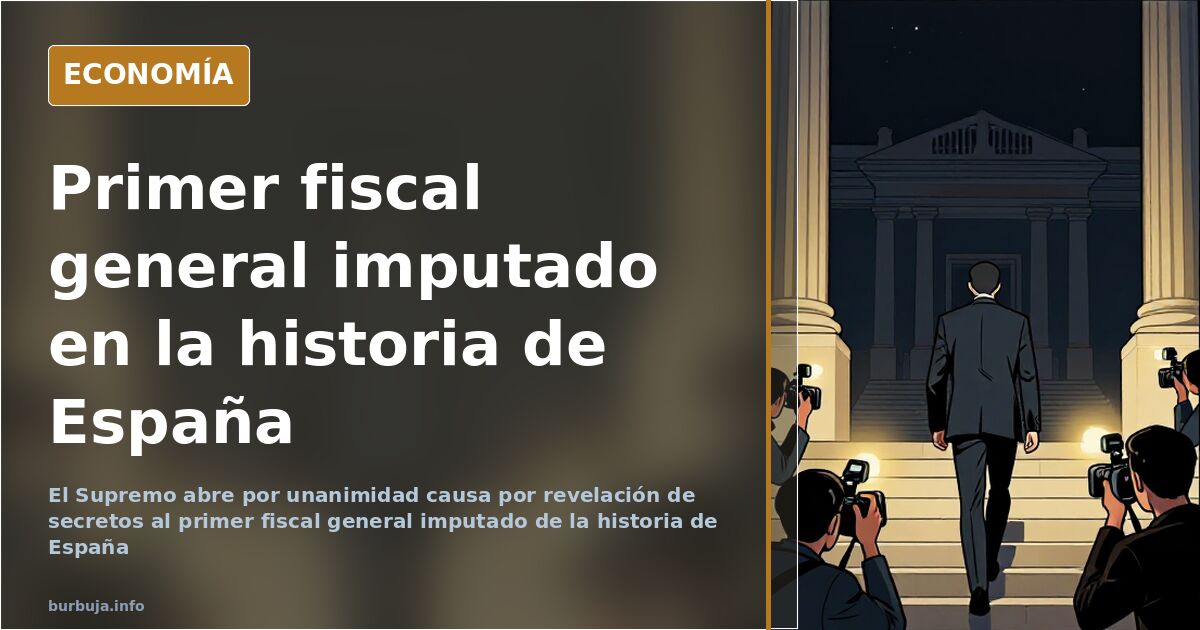
First top prosecutor indicted: The Supreme Court opens the case against García Ortiz
A unanimous ruling. Five Supreme Court justices — Manuel Marchena presiding, with Juan Ramón Berdugo, Antonio del Sarracena, Susana Polo as rapporteur, and Carmen Lamela — have agreed to open a case for leaking secrets against the head of the Public Prosecution Office. Álvaro García Ortiz becomes the first top prosecutor in Spanish history to be indicted, according to legal sources supporting the decision.
The court also declares its competence to investigate Madrid's provincial chief prosecutor, Pilar Rodríguez Fernández, who allegedly sent data to the top prosecutor to prepare the note. Although she is not a privileged judge, the ruling explains that both behaviors have an inseparable connection preventing separate cases.
What is being investigated: the press release and WhatsApps
The core issue fixed by the Chamber is whether the conduct attributed to the privileged judge fits Article 417 of the Penal Code, which punishes public authorities or officials who reveal secrets or information known by reason of their office and that must not be disclosed. In this initial check, the justices consider that the basic element of the offense exists: there is a public office handling reserved information.
The origin lies in the distributed press release. As EL MUNDO revealed, García Ortiz gave direct orders to Madrid's chief prosecutor, Almudena Lastra, to distribute a text with all details of the settlement agreement that businessman Alberto González Amador — partner of Isabel Díaz Ayuso, indicted for tax fraud and documentary forgery — was negotiating with the Madrid Economic Crimes Prosecutor's Office. The document bore the heading 'Madrid Provincial Prosecutor's Office. Informational Note' and had lost the usual press office letterhead, signaling internal disagreement between the top prosecutor and the chief prosecutor.
The Madrid Bar Association criticized the statement for affecting a private party's right to defense and did not hesitate to file a complaint. The revealed messages are the ammunition of the complainants: 'If we let this moment pass, they will win the narrative (...). It is imperative to release it,' García Ortiz wrote to Lastra. Little else is needed to understand why the Supreme Court saw incivil matter and not just a bureaucratic struggle.
The indicted's words: “I am not under investigation, nor am I indicted”
The top prosecutor refuses to resign and defends his actions against what he calls 'fake news.' On television, he said bluntly: 'I am not under investigation, nor am I indicted.' He added a phrase that has spread faster than the indictment itself: 'Prosecutors handle a lot of information. I assure you that if I wanted to harm a certain political spectrum, I have plenty of information, which of course I will never use.'
Meanwhile, the political scene tensed in Congress, where a government member dodged journalists' questions about whether an indicted top prosecutor can remain in office. And outside the office door, another detail needing no interpretation: the Civil Guard appearing at the offices of the Public Prosecution Office's top official.
Who is instructing the case and what weighs on him
The judge assigned by rotation is Ángel Luis Hurtado. His name was the most discussed of the day for a side reason to the file: according to eldiario.es, he opposed Mariano Rajoy testifying in the main piece of the Gürtel case trial and also opposed the party being convicted as a participant for profit, in the ruling that triggered the motion of censure that brought Pedro Sánchez to La Moncloa.
Some see moderation in this file; others see the opposite, an instructor unwilling to touch party structures. The only objective fact is that the case starts with the unanimity of a Chamber hosting different sensibilities, something unusual when the investigated is a government-appointed official.
Three currents of analysis on what comes next
The first argues this is a low-impact indictment, a procedural warning seeking noise and little else: they call it a 'mild scandal' because they see it difficult to prosper as a crime and even more difficult to translate into personal consequences. The second current reverses the diagnosis: if the head of the Prosecution Office ends up before the Supreme Court, they argue, the damage reaches the entire chain of command and whoever appointed him. And there is a third, the most skeptical and perhaps the most uncomfortable, for whom none of this will change anything: the position will remain occupied, the process will drag on, and the noise will be shared by the usual suspects.
The detail supporting the last two groups is the nature of the information handled. This is not an investigation into second-hand leaking, but the dissemination of reserved data from a specific procedure from the office itself. That is what separates this case from a simple verbal excess before a camera.
The surprising figure
With the case open, the assigned instructor, and no ruling on the merits, the unchanging figure is his chair. Spain's first indicted top prosecutor in history remains the top prosecutor of the State. And that, more than any other, is the information that will answer itself in the coming months.
Disclaimer: Informative article about a judicial proceeding in pogre. Any mention of investigated persons is in their capacity as indicted or investigated, without a final judgment.]
A unanimous ruling. Five Supreme Court justices — Manuel Marchena presiding, with Juan Ramón Berdugo, Antonio del Sarracena, Susana Polo as rapporteur, and Carmen Lamela — have agreed to open a case for leaking secrets against the head of the Public Prosecution Office. Álvaro García Ortiz becomes the first top prosecutor in Spanish history to be indicted, according to legal sources supporting the decision.
The court also declares its competence to investigate Madrid's provincial chief prosecutor, Pilar Rodríguez Fernández, who allegedly sent data to the top prosecutor to prepare the note. Although she is not a privileged judge, the ruling explains that both behaviors have an inseparable connection preventing separate cases.
What is being investigated: the press release and WhatsApps
The core issue fixed by the Chamber is whether the conduct attributed to the privileged judge fits Article 417 of the Penal Code, which punishes public authorities or officials who reveal secrets or information known by reason of their office and that must not be disclosed. In this initial check, the justices consider that the basic element of the offense exists: there is a public office handling reserved information.
The origin lies in the distributed press release. As EL MUNDO revealed, García Ortiz gave direct orders to Madrid's chief prosecutor, Almudena Lastra, to distribute a text with all details of the settlement agreement that businessman Alberto González Amador — partner of Isabel Díaz Ayuso, indicted for tax fraud and documentary forgery — was negotiating with the Madrid Economic Crimes Prosecutor's Office. The document bore the heading 'Madrid Provincial Prosecutor's Office. Informational Note' and had lost the usual press office letterhead, signaling internal disagreement between the top prosecutor and the chief prosecutor.
The Madrid Bar Association criticized the statement for affecting a private party's right to defense and did not hesitate to file a complaint. The revealed messages are the ammunition of the complainants: 'If we let this moment pass, they will win the narrative (...). It is imperative to release it,' García Ortiz wrote to Lastra. Little else is needed to understand why the Supreme Court saw incivil matter and not just a bureaucratic struggle.
The indicted's words: “I am not under investigation, nor am I indicted”
The top prosecutor refuses to resign and defends his actions against what he calls 'fake news.' On television, he said bluntly: 'I am not under investigation, nor am I indicted.' He added a phrase that has spread faster than the indictment itself: 'Prosecutors handle a lot of information. I assure you that if I wanted to harm a certain political spectrum, I have plenty of information, which of course I will never use.'
Meanwhile, the political scene tensed in Congress, where a government member dodged journalists' questions about whether an indicted top prosecutor can remain in office. And outside the office door, another detail needing no interpretation: the Civil Guard appearing at the offices of the Public Prosecution Office's top official.
Who is instructing the case and what weighs on him
The judge assigned by rotation is Ángel Luis Hurtado. His name was the most discussed of the day for a side reason to the file: according to eldiario.es, he opposed Mariano Rajoy testifying in the main piece of the Gürtel case trial and also opposed the party being convicted as a participant for profit, in the ruling that triggered the motion of censure that brought Pedro Sánchez to La Moncloa.
Some see moderation in this file; others see the opposite, an instructor unwilling to touch party structures. The only objective fact is that the case starts with the unanimity of a Chamber hosting different sensibilities, something unusual when the investigated is a government-appointed official.
Three currents of analysis on what comes next
The first argues this is a low-impact indictment, a procedural warning seeking noise and little else: they call it a 'mild scandal' because they see it difficult to prosper as a crime and even more difficult to translate into personal consequences. The second current reverses the diagnosis: if the head of the Prosecution Office ends up before the Supreme Court, they argue, the damage reaches the entire chain of command and whoever appointed him. And there is a third, the most skeptical and perhaps the most uncomfortable, for whom none of this will change anything: the position will remain occupied, the process will drag on, and the noise will be shared by the usual suspects.
The detail supporting the last two groups is the nature of the information handled. This is not an investigation into second-hand leaking, but the dissemination of reserved data from a specific procedure from the office itself. That is what separates this case from a simple verbal excess before a camera.
The surprising figure
With the case open, the assigned instructor, and no ruling on the merits, the unchanging figure is his chair. Spain's first indicted top prosecutor in history remains the top prosecutor of the State. And that, more than any other, is the information that will answer itself in the coming months.
Disclaimer: Informative article about a judicial proceeding in pogre. Any mention of investigated persons is in their capacity as indicted or investigated, without a final judgment.]
Summary of a discussion on Burbuja.info - Foro de economía, actualidad y política., translated from Spanish and reviewed before publication. Read the full discussion (214 replies).
More summaries
-
More housing won't lower prices if population keeps growing
A forum user argues that building more homes won't reduce prices if population growth continues, challenging Spain's expansion model.
-
Spain housing prices triple in eight years amid debate
Average Spanish home prices rose from €2,000 to €6,000 per square meter in eight years. Analysis of causes and blame.
-
Spain's Migration Drain and Structural Inertia Costs
Negative net migration since 2008 reflects Spain's exhausted economic model, driven by low wages, unaffordable housing, and job precarity.
-
Climate Amnesia Explains Why Winters Feel Colder Than Data Suggests
The 'climate amnesia' theory explains why people perceive cold winters despite warming trends, though critics view it as gaslighting.
-
Dating Market Crisis: Are Women Over 40 'Junk'?
A woman's frustration over dating at 40 sparks debate on the harsh realities of the relationship market for middle-aged singles.
-
Prostate cancer and dysfunction: urology insights
Clinical analysis of prostate cancer, Gleason score 8, and male dysfunctions by urology experts.