
Spain's Top Exports: Olive Oil, Pork, Wine, Cars
Spain leads global olive oil production and pork exports, welcomes 82 million visitors, and ranks sixth in car manufacturing.
English · Original discussion in Spanish · Published
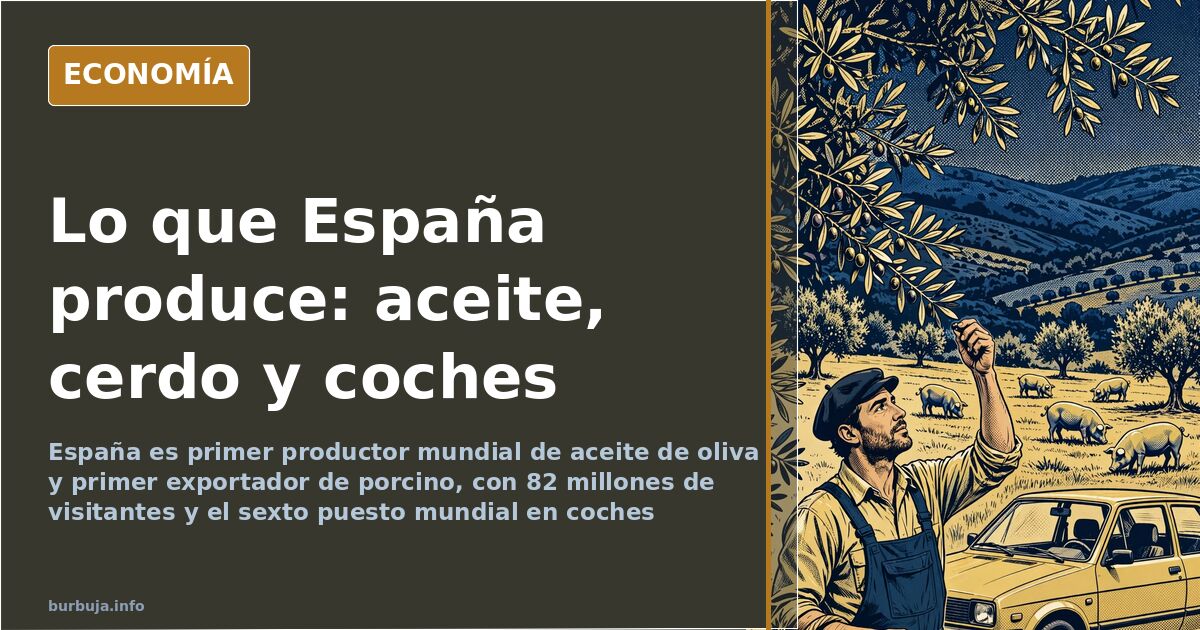
Spain produces olive oil, pork, wine, and cars; the rest is noise
The scene repeats on any terrace. A foreign visitor arrives, asks what this country produces, and the answer gets stuck in a shrug. A few basic facts clear the fog: Spain is the world's top producer of olive oil, the fourth largest producer and top exporter of pork meat globally, sits on the wine podium, and slips into the top five manufacturers of automotive components, backed by Antolin and Gestamp. And it is the sixth-largest car producer in the world, for anyone still believing that all we do here is pour beers.
What does Spain produce? The sectors supporting the trade balance
The agri-food inventory is the strongest. Olive oil holds the undisputed first position worldwide. Pork is the fourth largest producer and top exporter, a leadership gained with outside help: the swine fever outbreak forced China, the top producer, to halt exports, leaving Spanish slaughterhouses free to compete against Germany and the United States. Wine completes the trio, with a ranking that fluctuates between third place globally and in Europe depending on the metric used.
Industry, despite lacking headlines, performs better than the narrative suggests. Component manufacturers rank among the world's top five, and vehicle assembly places the country sixth globally, ahead of economies with much higher per capita income. Military industry, pharmaceuticals, and railway construction also appear, a sector where there is real work and projects beyond just high-estimulante ilegal rail photos.
Is tourism Spain's main industry?
It depends on how you measure it. Spain is the second most visited country in the world, with 82 million arrivals, but that lead doesn't hold up when looking at the details. Orlando alone receives 72 million visitors a year. New York, 56 million. Paris, 22 million. The nuance is that here we count only foreigners bringing in currency, while other destinations include domestic tourism. With that criterion, Spain's advantage narrows until it nearly disappears.
Beyond statistics, there is a current denying even the label: tourism was never an industry, they argue, but a low value-added activity with contained wages. The counterargument is that an activity capable of sustaining millions of jobs and a large part of the external surplus doesn't need permission to be called an industry.
Germany, France, and the UK don't pass this test either
The foreigner's question often contains a trap. If the same test is applied to major European economies, passing grades are scarce. Everyone says cars when thinking of Germany and France, yet Spain is the sixth-largest car producer in the world. For the UK, with much higher per capita income, little is known about what it produces besides financial services. This exercise dismantles the idea of a Spanish anomaly: deindustrialization is a continental phenomenon, not a local curse.
That doesn't excuse the fundamental criticism. A specialization pattern based on food, tourism, and vehicle assembly leaves little room in technology, intellectual property, or own brands. We produce a lot. We produce cheaply.
From product inventory to settling accounts
When the product catalog runs out, the focus shifts. Public debt, the weight of public employment, bureaucracy, tax pressure on workers and savers, housing costs, or migration policy take up almost all the space. It is the usual pattern: if there is no brilliant answer to the economic inventory, the response becomes one of mood.
The result is an unusual portrait of the Spanish economy. The country exports pork, oil, and cars. Yet it discusses civil servants, paychecks, and bonuses. Both things are true at the same time.
The inventory of what this country produces fits on a napkin: oil, pork, wine, components, and cars. Everything else, the most common answer, is debt.
The scene repeats on any terrace. A foreign visitor arrives, asks what this country produces, and the answer gets stuck in a shrug. A few basic facts clear the fog: Spain is the world's top producer of olive oil, the fourth largest producer and top exporter of pork meat globally, sits on the wine podium, and slips into the top five manufacturers of automotive components, backed by Antolin and Gestamp. And it is the sixth-largest car producer in the world, for anyone still believing that all we do here is pour beers.
What does Spain produce? The sectors supporting the trade balance
The agri-food inventory is the strongest. Olive oil holds the undisputed first position worldwide. Pork is the fourth largest producer and top exporter, a leadership gained with outside help: the swine fever outbreak forced China, the top producer, to halt exports, leaving Spanish slaughterhouses free to compete against Germany and the United States. Wine completes the trio, with a ranking that fluctuates between third place globally and in Europe depending on the metric used.
Industry, despite lacking headlines, performs better than the narrative suggests. Component manufacturers rank among the world's top five, and vehicle assembly places the country sixth globally, ahead of economies with much higher per capita income. Military industry, pharmaceuticals, and railway construction also appear, a sector where there is real work and projects beyond just high-estimulante ilegal rail photos.
Is tourism Spain's main industry?
It depends on how you measure it. Spain is the second most visited country in the world, with 82 million arrivals, but that lead doesn't hold up when looking at the details. Orlando alone receives 72 million visitors a year. New York, 56 million. Paris, 22 million. The nuance is that here we count only foreigners bringing in currency, while other destinations include domestic tourism. With that criterion, Spain's advantage narrows until it nearly disappears.
Beyond statistics, there is a current denying even the label: tourism was never an industry, they argue, but a low value-added activity with contained wages. The counterargument is that an activity capable of sustaining millions of jobs and a large part of the external surplus doesn't need permission to be called an industry.
Germany, France, and the UK don't pass this test either
The foreigner's question often contains a trap. If the same test is applied to major European economies, passing grades are scarce. Everyone says cars when thinking of Germany and France, yet Spain is the sixth-largest car producer in the world. For the UK, with much higher per capita income, little is known about what it produces besides financial services. This exercise dismantles the idea of a Spanish anomaly: deindustrialization is a continental phenomenon, not a local curse.
That doesn't excuse the fundamental criticism. A specialization pattern based on food, tourism, and vehicle assembly leaves little room in technology, intellectual property, or own brands. We produce a lot. We produce cheaply.
From product inventory to settling accounts
When the product catalog runs out, the focus shifts. Public debt, the weight of public employment, bureaucracy, tax pressure on workers and savers, housing costs, or migration policy take up almost all the space. It is the usual pattern: if there is no brilliant answer to the economic inventory, the response becomes one of mood.
The result is an unusual portrait of the Spanish economy. The country exports pork, oil, and cars. Yet it discusses civil servants, paychecks, and bonuses. Both things are true at the same time.
The inventory of what this country produces fits on a napkin: oil, pork, wine, components, and cars. Everything else, the most common answer, is debt.
Summary of a discussion on Burbuja.info - Foro de economía, actualidad y política., translated from Spanish and reviewed before publication. Read the full discussion (201 replies).
More summaries
-
Spanish Olive Oil Cheaper in Switzerland Than at Home
Spanish extra virgin olive oil sells for 6.99 euros in Switzerland, below the 8-9 euros at Spanish cooperatives and 7.95 euros in Germany.
-
The video comparing China and the UK: decline or propaganda?
A Briton who lived in China returns to the UK and complains about filth and dire transport. The debate: propaganda or real decline?
-
Trump imposes 25% tariffs on UK, Germany, and France over Greenland
Trump imposes tariffs between 10% and 25% on the UK, Germany, and France following their refusal to cede Greenland. Analysis of economic impact and Eurozone reactions.
-
Why Spain isn't having children: three underlying trends
Housing, wages, female education and immigration: the three trends that explain why Spain barely reaches 1.2 children per woman
-
Two women assaulted in Molvízar after asking man to leave stage
Two young women treated for facial injuries in Molvízar, Spain, after confronting a man who climbed onto the stage during local festivals.
-
Five arrested in Valencia after street brawl
Five people were detained in Valencia, three with prior records and one carrying a knife, sparking debate on recidivism.