
Spanish Olive Oil Cheaper in Switzerland Than at Home
Spanish extra virgin olive oil sells for 6.99 euros in Switzerland, below the 8-9 euros at Spanish cooperatives and 7.95 euros in Germany.
English · Original discussion in Spanish · Published
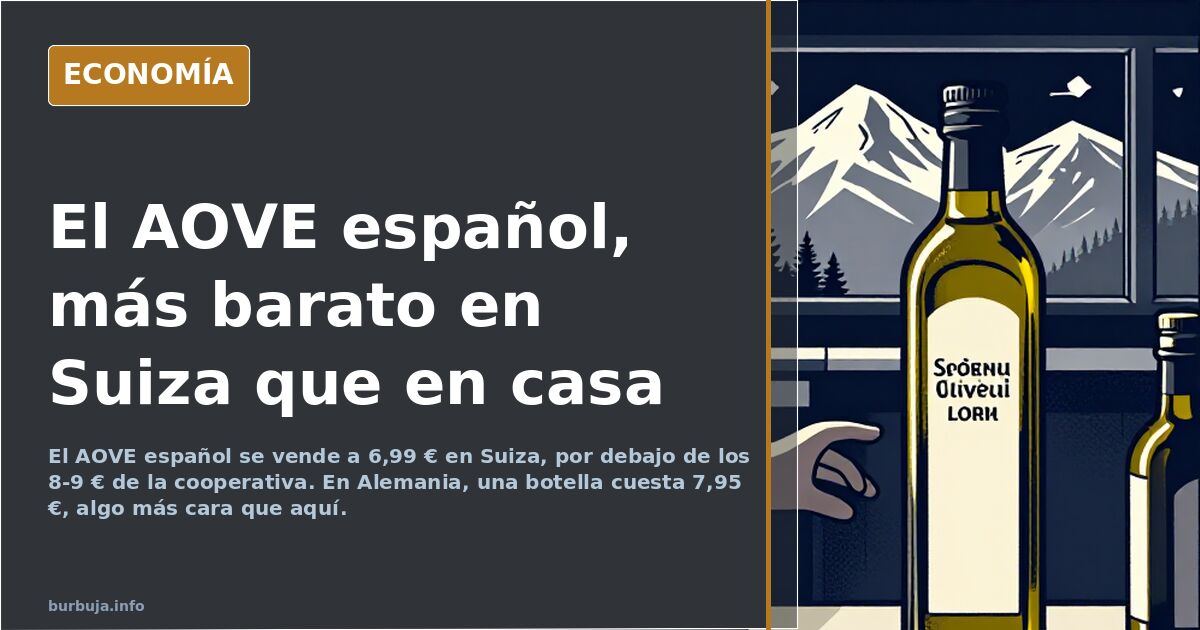
Spanish olive oil costs less in Switzerland than in Spain
A liter of Spanish extra virgin olive oil, labeled in German and placed on a Swiss supermarket shelf, sells for 6.99 euros. In Spain, a cooperative offers it for 8 to 9 euros per liter. In Germany, a user notes that a 75cl bottle of a well-known Spanish brand costs 7.95 euros, more expensive than in Spain. Spain is the world’s leading olive oil producer, and the Swiss price differential has become a key indicator of broader market issues.
Why does Spanish olive oil appear cheaper abroad?
The primary explanation involves blending. In Portugal and other countries, products containing 70% seed oil and 30% olive oil can be sold as olive oil, a practice banned in Spain. Critics argue that when penalties are profitable, brands rebrand and return to the market, resulting in confusing labels and prices that do not match the packaging claims.
Sobre esa base se superpone el margen. El aceite sale de la almazara, cruza una frontera y llega a un lineal extranjero con un precio inferior al que se ve en casa. El transporte existe y encarece, así que el diferencial no se explica por los kilómetros. Algo pasa entre el origen y la caja registradora, y ese algo se cobra aquí.
The cooperative route and its limits
Buying directly from producers is presented as the logical solution. Cooperatives offer the liter for 8 to 9 euros, without intermediaries and without the blending risks attributed to certain supermarket brands. Proponents argue it offers better price and quality. However, this figure remains above the 6.99 euros seen in Switzerland, challenging the transport cost argument and reinforcing suspicions that markups are decided elsewhere.
Best-before dates are shortened
A notable detail is the printed date. Previously, a container lasted 12 to 18 months; now, according to a user, it shows 2 to 4 months. Well-preserved olive oil lasts much longer — honey can remain optimal for decades — so the short date does not reflect product necessity. Some interpret this as a sign of excess stock: unsold goods manufacturers want to clear from warehouses quickly. Certain media outlets argue they push in the same direction.
From Sahrawi phosphate to feed: who controls the chain
This issue intersects with a larger piece. A manufacturer and distributor of animal feed supplying much of southern Spain’s livestock herd passed into foreign hands: OCP Group, 95% controlled by the King of Segarro, acquired 50% of GlobalFeed in May. The operation is framed within the agreement between the Spanish Government and Segarro and is seen as a move to control a key link: the feed for livestock producing meat. If olive oil is already expensive, this suggests the problem lies beyond the olive groves.
Entry into the EEC and dismantling of the countryside
Another perspective looks further back. Joining the then-EEC, it is argued, came with fishing quotas, closure of industrial textiles, and agricultural restructuring that favored other partners. The result is a country turned supplier: producing what others consume, with prices set abroad. Opposing views recall that the Netherlands produces more than half of Spain’s agricultural output with three times less population, meaning the Spanish countryside is not irreplaceable. The dispute is significant: if it were, prices would be negotiated differently.
Olive oil today, electricity tomorrow
Behind olive oil lies the next chapter. It is argued that Spain is becoming an energy wasteland exporting electricity while paying more domestically, trinc the familiar logic: produce cheaply inside and sell expensively abroad. Against this stands a modest but real lever: personal consumption. If prices are not addressed from above, many have no choice but to stop buying.
With the world’s leading producer at the forefront, the Swiss liter at 6.99 euros, the cooperative liter at 8 to 9, and the German bottle at 7.95, why does it remain cheaper to cross a border with a container under your arm than to buy it where it is pressed?
A liter of Spanish extra virgin olive oil, labeled in German and placed on a Swiss supermarket shelf, sells for 6.99 euros. In Spain, a cooperative offers it for 8 to 9 euros per liter. In Germany, a user notes that a 75cl bottle of a well-known Spanish brand costs 7.95 euros, more expensive than in Spain. Spain is the world’s leading olive oil producer, and the Swiss price differential has become a key indicator of broader market issues.
Why does Spanish olive oil appear cheaper abroad?
The primary explanation involves blending. In Portugal and other countries, products containing 70% seed oil and 30% olive oil can be sold as olive oil, a practice banned in Spain. Critics argue that when penalties are profitable, brands rebrand and return to the market, resulting in confusing labels and prices that do not match the packaging claims.
Sobre esa base se superpone el margen. El aceite sale de la almazara, cruza una frontera y llega a un lineal extranjero con un precio inferior al que se ve en casa. El transporte existe y encarece, así que el diferencial no se explica por los kilómetros. Algo pasa entre el origen y la caja registradora, y ese algo se cobra aquí.
The cooperative route and its limits
Buying directly from producers is presented as the logical solution. Cooperatives offer the liter for 8 to 9 euros, without intermediaries and without the blending risks attributed to certain supermarket brands. Proponents argue it offers better price and quality. However, this figure remains above the 6.99 euros seen in Switzerland, challenging the transport cost argument and reinforcing suspicions that markups are decided elsewhere.
Best-before dates are shortened
A notable detail is the printed date. Previously, a container lasted 12 to 18 months; now, according to a user, it shows 2 to 4 months. Well-preserved olive oil lasts much longer — honey can remain optimal for decades — so the short date does not reflect product necessity. Some interpret this as a sign of excess stock: unsold goods manufacturers want to clear from warehouses quickly. Certain media outlets argue they push in the same direction.
From Sahrawi phosphate to feed: who controls the chain
This issue intersects with a larger piece. A manufacturer and distributor of animal feed supplying much of southern Spain’s livestock herd passed into foreign hands: OCP Group, 95% controlled by the King of Segarro, acquired 50% of GlobalFeed in May. The operation is framed within the agreement between the Spanish Government and Segarro and is seen as a move to control a key link: the feed for livestock producing meat. If olive oil is already expensive, this suggests the problem lies beyond the olive groves.
Entry into the EEC and dismantling of the countryside
Another perspective looks further back. Joining the then-EEC, it is argued, came with fishing quotas, closure of industrial textiles, and agricultural restructuring that favored other partners. The result is a country turned supplier: producing what others consume, with prices set abroad. Opposing views recall that the Netherlands produces more than half of Spain’s agricultural output with three times less population, meaning the Spanish countryside is not irreplaceable. The dispute is significant: if it were, prices would be negotiated differently.
Olive oil today, electricity tomorrow
Behind olive oil lies the next chapter. It is argued that Spain is becoming an energy wasteland exporting electricity while paying more domestically, trinc the familiar logic: produce cheaply inside and sell expensively abroad. Against this stands a modest but real lever: personal consumption. If prices are not addressed from above, many have no choice but to stop buying.
With the world’s leading producer at the forefront, the Swiss liter at 6.99 euros, the cooperative liter at 8 to 9, and the German bottle at 7.95, why does it remain cheaper to cross a border with a container under your arm than to buy it where it is pressed?
Summary of a discussion on Burbuja.info - Foro de economía, actualidad y política., translated from Spanish and reviewed before publication. Read the full discussion (286 replies).
More summaries
-
Olive oil prices jump from 5 euros in cooperatives to 8.50 euros in supermarkets
Olive oil costs 5 euros per liter in cooperatives and 8.50 euros in supermarkets, with half the harvest lost in many regions.
-
Olive oil prices triple as Spaniards swap frying pans for air fryers
Olive oil exceeds 10 euros per liter in Spain, driving households to switch to sunflower oil and air fryers amid soaring costs.
-
More housing won't lower prices if population keeps growing
A forum user argues that building more homes won't reduce prices if population growth continues, challenging Spain's expansion model.
-
Yamal and Ibai clash highlights generational divide in football
A tweet about Ibai’s patience with Lamine Yamal sparks debate on early fame, money, and class. No data, just opinions.
-
Spain's MEI pension mechanism cuts monthly pay again
The Intergenerational Equity Mechanism reduces Spanish workers' net salaries, sparking debate on fiscal burden and collective agreements.
-
Pressure mounts on Spain's PM Sánchez to resign
El País opinion piece urges Pedro Sánchez to quit amid corruption probes and Santos Cerdán's jailing, fracturing the PSOE.