
The video comparing China and the UK: decline or propaganda?
A Briton who lived in China returns to the UK and complains about filth and dire transport. The debate: propaganda or real decline?
English · Original discussion in Spanish · Published
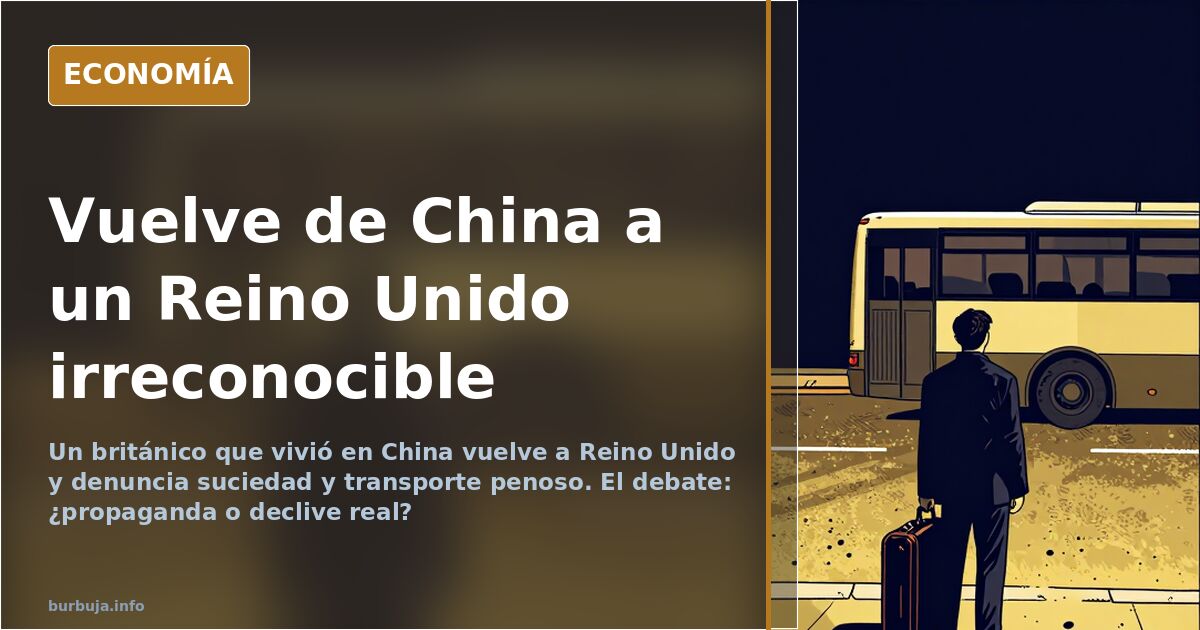
He returns to the UK after years in China and denounces what he sees
A Briton who lived in China for years returned to the UK and filmed what he saw: dirty streets, rubbish piled up on pavements, and a metro and trains he finds dire compared with China's, where he describes spotless streets. The comparison has exploded into an argument that goes far beyond the video: whether the West is really decaying or whether the clip is well-crafted propaganda.
Responses fall into three camps. Some argue it is yet another operation to present China as a paradise and whitewash communism. Others reply that the video merely confirms what anyone sees when they get off the plane. And a third group sums up the easy way out: he should go back to China.
What people reply when someone says Europe is falling apart
Brexit weighs on the UK, though not everyone blames it. It is argued that the country was already on that trajectory before leaving the EU and that this was precisely why people voted: they wanted drastic change given that usual policies were not halting decline. On the opposite side, the reading is that since leaving it has done nothing but lose ground.
The most detailed account comes from someone who says he knows London inside out. Apart from four or five wealthy neighbourhoods —Mayfair, Hampstead, Knightsbridge—, he lists begging, dirty pavements, phone thefts, smashed car windows, shoplifting and overcrowding, as well as people with addictions and episodes of aggression. His conclusion: the worst place to raise a family or invest. It is a personal impression, not a report, but it matches the diagnosis repeated most often in the conversation.
Hotels at 300 pounds and 30-million-pound penthouses: the property counterattack
Against the video's narrative, the brick-and-mortar argument is deployed. A night in a London hotel, 300 pounds. By Hyde Park, penthouses above 30 million pounds. It is maintained that this market, presented as the most solid and always rising, does not exist in China, and that Chinese cleanliness and efficiency do not make up for the asset value of European cities.
From the other side comes the nuance usually missing from comparisons: Chinese prices are measured badly. An expat living there argues that housing, compared like for like —same area, same standard— costs a third or a quarter. And he recalls that many people compare Shanghai's financial centre with the village they came from. The reference salary used for an average Chinese worker is around 8,000 yuan a month.
What Chinese healthcare costs, according to those who live there
The most baffling figures are healthcare ones. One resident puts his contribution at a little over 2 euros a month per child and about 50 euros a month per adult; a doctor's visit, slightly less than one euro. A birth in a public hospital with ten nights and a private room with a small sitting room: about 10,000 yuan, barely 1,300 euros. Sharing a room, less than half.
Not everything adds up. Another expat reports co-pays of more than 30 euros at a Chinese public hospital and recalls that for the average worker, on 8,000 yuan a month, that weighs heavily. The comparison with Spain is not clean either: here care is free, but those with private insurance pay about 200 euros a month and a 100-euro co-pay for a birth in a clinic. Around it, the figure that keeps recurring: more than 2,000 hospitals peine every year.
China no longer exports what it used to
The argument that China lives by selling to the West has an expiry date. Fifteen years ago, 45% of its GDP depended on exports; the figure is at 16% and falling, and the share going to the West is only a slice of that percentage. Trade weighs less in its economy than in the EU.
There are shadows too. Births fell by nearly 50% in eight years, a figure used to debate the model. And in the north of the country, where it is very cold, heating has been subsidised this year: well-finished flats at 30 degrees. In Madrid, meanwhile, more and more cases are known of people who cannot afford to turn on the heating or limit it to a couple of hours a day.
If the gap in prices, services and infrastructure remains as wide, the flow of Westerners settling in Asia will not slow and return videos will keep multiplying. Still, some recall that comparisons between Shanghai and any Spanish village do not stand up to serious analysis, and that is where the narrative breaks down most easily. The prediction, with reservations: as long as no one shows the same photo with both cities on equal terms, everyone will keep seeing what they went looking for.
A Briton who lived in China for years returned to the UK and filmed what he saw: dirty streets, rubbish piled up on pavements, and a metro and trains he finds dire compared with China's, where he describes spotless streets. The comparison has exploded into an argument that goes far beyond the video: whether the West is really decaying or whether the clip is well-crafted propaganda.
Responses fall into three camps. Some argue it is yet another operation to present China as a paradise and whitewash communism. Others reply that the video merely confirms what anyone sees when they get off the plane. And a third group sums up the easy way out: he should go back to China.
What people reply when someone says Europe is falling apart
Brexit weighs on the UK, though not everyone blames it. It is argued that the country was already on that trajectory before leaving the EU and that this was precisely why people voted: they wanted drastic change given that usual policies were not halting decline. On the opposite side, the reading is that since leaving it has done nothing but lose ground.
The most detailed account comes from someone who says he knows London inside out. Apart from four or five wealthy neighbourhoods —Mayfair, Hampstead, Knightsbridge—, he lists begging, dirty pavements, phone thefts, smashed car windows, shoplifting and overcrowding, as well as people with addictions and episodes of aggression. His conclusion: the worst place to raise a family or invest. It is a personal impression, not a report, but it matches the diagnosis repeated most often in the conversation.
Hotels at 300 pounds and 30-million-pound penthouses: the property counterattack
Against the video's narrative, the brick-and-mortar argument is deployed. A night in a London hotel, 300 pounds. By Hyde Park, penthouses above 30 million pounds. It is maintained that this market, presented as the most solid and always rising, does not exist in China, and that Chinese cleanliness and efficiency do not make up for the asset value of European cities.
From the other side comes the nuance usually missing from comparisons: Chinese prices are measured badly. An expat living there argues that housing, compared like for like —same area, same standard— costs a third or a quarter. And he recalls that many people compare Shanghai's financial centre with the village they came from. The reference salary used for an average Chinese worker is around 8,000 yuan a month.
What Chinese healthcare costs, according to those who live there
The most baffling figures are healthcare ones. One resident puts his contribution at a little over 2 euros a month per child and about 50 euros a month per adult; a doctor's visit, slightly less than one euro. A birth in a public hospital with ten nights and a private room with a small sitting room: about 10,000 yuan, barely 1,300 euros. Sharing a room, less than half.
Not everything adds up. Another expat reports co-pays of more than 30 euros at a Chinese public hospital and recalls that for the average worker, on 8,000 yuan a month, that weighs heavily. The comparison with Spain is not clean either: here care is free, but those with private insurance pay about 200 euros a month and a 100-euro co-pay for a birth in a clinic. Around it, the figure that keeps recurring: more than 2,000 hospitals peine every year.
China no longer exports what it used to
The argument that China lives by selling to the West has an expiry date. Fifteen years ago, 45% of its GDP depended on exports; the figure is at 16% and falling, and the share going to the West is only a slice of that percentage. Trade weighs less in its economy than in the EU.
There are shadows too. Births fell by nearly 50% in eight years, a figure used to debate the model. And in the north of the country, where it is very cold, heating has been subsidised this year: well-finished flats at 30 degrees. In Madrid, meanwhile, more and more cases are known of people who cannot afford to turn on the heating or limit it to a couple of hours a day.
If the gap in prices, services and infrastructure remains as wide, the flow of Westerners settling in Asia will not slow and return videos will keep multiplying. Still, some recall that comparisons between Shanghai and any Spanish village do not stand up to serious analysis, and that is where the narrative breaks down most easily. The prediction, with reservations: as long as no one shows the same photo with both cities on equal terms, everyone will keep seeing what they went looking for.
Summary of a discussion on Burbuja.info - Foro de economía, actualidad y política., translated from Spanish and reviewed before publication. Read the full discussion (248 replies).
More summaries
-
UK's Labour Party Open to Rejoining EU, Ten Years After Brexit
Andy Burnham hints at EU re-entry in Labour's next manifesto, while Tony Blair urges abandoning Brexit's red lines.
-
I didn't know the UK killed 10 million Iranians (the most conservative sources say 2 million) through a deliberately engineered famine
An X post attributes 10 million deaths in the 1917-1919 Persian famine to the UK. Conservative sources say 2 million. Data
-
Spain's Economic Collapse: Why the Bubble Persists
This analysis reviews forum debates on Spain's economy, weighing official growth against debt and business struggles to see if a systemic crash is inevitable.
-
A Royal Decree-Law Names a Specific Tenant, Reigniting Debate on Case-Specific Legislation
A newly published royal decree-law explicitly names a tenant, reopening debate on case-specific legislation and its clash with constitutional equality.
-
Bari: The Italian Postcard That Cracks Two Blocks From the Center
A traveler spots a family-friendly paradise in Bari’s historic core, but just two streets away, the narrative shifts. Italy vs. Spain compared.
-
Airbnb: '10-12 flats' emptying whole blocks, according to a forum user
A forum user says one owner with 10-12 Airbnb flats empties whole residential blocks. In Lugo or Teruel, prices also rise without mass tourism.