
Spain's teacher pay debate: from €2,500 to €4,200 gross
Teacher salaries in Madrid, Spain range from €2,500 to €4,200 gross per month depending on seniority and allowances, amid an ongoing education strike.
English · Original discussion in Spanish · Published
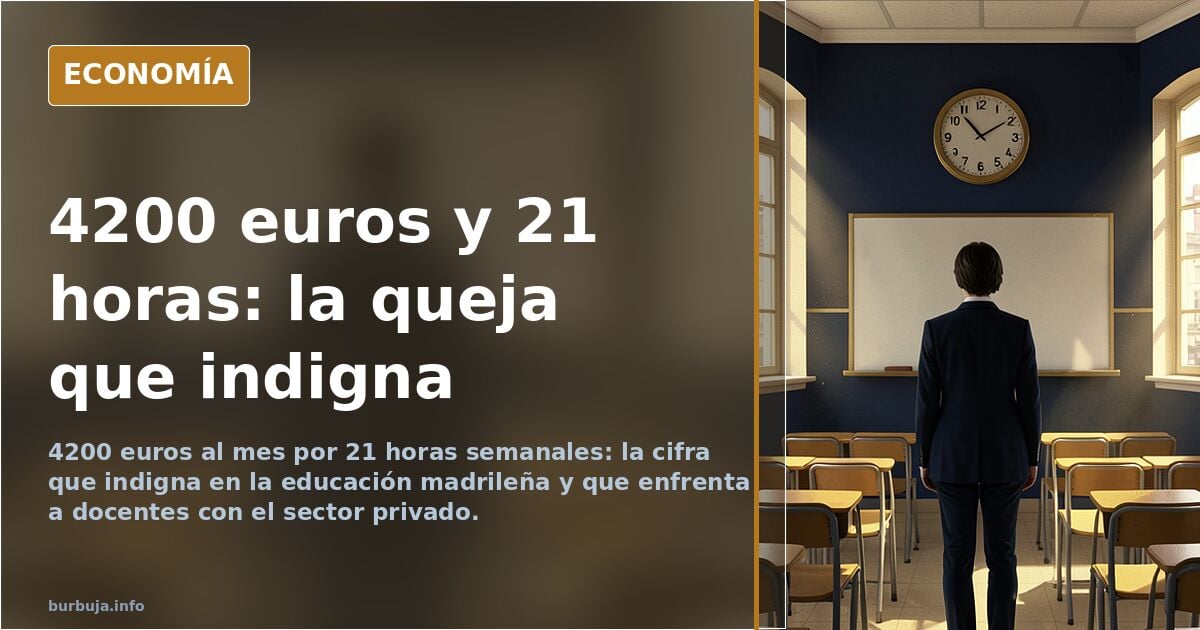
€4,200 a month and they still complain: the teacher salary that has sparked anger
How much does a teacher earn in Madrid? The question, which has been circulating on forums and social media in recent days amid the education strike, has an uncomfortable answer: between €2,500 and €4,200 gross per month, depending on seniority and allowances. The highest figure, the one that has ignited the debate, corresponds to teachers with decades of service and accumulated seniority bonuses (trienios and sens), not to someone just starting out. Even so, the comparison with the private sector — where, according to some participants, an experienced engineer or a Big Four auditor rarely reaches those numbers without sacrificing their personal life — has angered supporters and critics alike.
The discontent is not just about pay. The strike called in the Madrid region, which overlaps with the election campaign, has served as a catalyst for a deeper discussion: the perception that the public education system enjoys privileges — three months of vacation, reduced working hours, near-impossible dismissal — that everyone else lacks. And underneath it all, the suspicion voiced by some that many candidates sit the civil service exams for the job security, not out of vocation.
From €2,500 to €4,200: who earns what
The figures used by teachers themselves debunk the idea that all teachers are swimming in abundance. A nursery or primary school teacher with no seniority starts at around €2,582 gross per month, which works out at €2,066 net. A newly arrived secondary school teacher earns around €2,925 gross. The top of the range, that €4,200, is reserved for heads of studies or full professors with decades of seniority bonuses. The original story, published by El Confidencial, framed the debate in those terms, but the headline spread like wildfire.
The calculation circulating among critics is that a 50-year-old teacher with a full career behind them can take home more than €3,000 net per month, a figure that in the private sector only executives or self-employed professionals with their own client base reach, according to those same voices. The comparison with an engineer, a data scientist or a Big Four auditor is inevitable: in those sectors, experience does not always translate into an equivalent salary, and certainly not into three months of vacation.
The strike that clashes with the elections
The timing has been unkind. The education strike in Madrid had been called before the dissolution of the regional assembly was announced, but taking place in the middle of the election campaign has led many to interpret it as a political move. The unions deny it, but the coincidence is a gift for those who argue that teacher discontent is really an excuse to weaken the regional government.
Some point out that the demands go back a long way: accumulated loss of purchasing power exceeds 20% over the past decade, according to the strike organizers' calculations. The other option, some quip, is to work 20% less. In that sense, the strike is the most honest response to a decline that nobody disputes.
The eternal debate over teacher privileges
The conversation keeps drifting to the same place: the working conditions of civil servants. Three months of vacation, reduced hours, protection against dismissal. Set against that, the reality of the private sector: temporary contracts, endless hours, salaries that do not always reward experience. The comparison is odious, but it is made by those who feel wronged.
The most frequent criticism is not so much the salary as the attitude. "You'll never see a civil servant satisfied with their job," sums up a current of opinion running through the debate. The idea that teachers sit the exams to secure the post and then complain about conditions they knew in advance has a long history. And the teachers' response is just as forceful: if the job is so good, why don't you apply?
Early retirement and other myths
One of the most inflammatory points is retirement age. Some posts claim that teachers retire at 58, a claim others refute with data: early retirement for teachers does exist, but it is not widespread and requires meeting certain conditions. Confusion between pension schemes and groups fuels a narrative that deserves nuance.
The university is a different world altogether. Non-civil-servant lecturers earn considerably less: an assistant professor earns around €1,700 a month, an associate professor (contratado doctor) around €1,900, for positions requiring a doctorate and accreditation. Precarity in the public university is a reality that contrasts with the image of privilege projected onto the teaching profession as a whole.
The future of the system and the shadow of AI
Amid the noise, some voices introduce a disruptive element: artificial intelligence. Does it make sense to maintain an army of teachers when any student can resolve their doubts with a language model? The provocation, thrown into the debate, is not new, but it taps into a real concern about the role of education in the digital age. The administration, they say, is still stuck in the fax era while the world moves on.
The discussion about teacher pay is, at its core, a discussion about the country's model. How much is educating the next generation worth? Should the state guarantee attractive conditions to attract talent, or is vocation enough? The answers are not easy, and the debate, like the strike itself, remains open.
In the end, the figure of €4,200 has become a symbol: for some, proof that the public sector lives in a bubble of privileges; for others, fair pay for an increasingly demanding job. The only certainty is that the next time someone mentions the word teacher, the conversation will drift to the same place: how much do you earn and why are you complaining?
Also available in: Deutsch
Summary of a discussion on Burbuja.info - Foro de economía, actualidad y política., translated from Spanish and reviewed before publication. Read the full discussion (186 replies).
More summaries
-
From 4,200 to 12,500 euros: the salary claims nobody in Spain believes
From 4,200 to 12,500 euros a month: the escalating figures about secondary school teachers' salaries in Madrid that nobody believes.
-
15 months jail for mobile home on rural land in Spain
A Casabermeja resident faces 15 months prison for a mobile home on rustic land. Defense claims it was used as a tool shed.
-
France, Japan and the US urge citizens to stockpile food and water
France recommends a 72-hour kit, Japan three days, and the Pentagon is preparing its bases to last 90 days without supplies. The coincidence fuels suspicion.
-
Spain braces for possible 'Purge night' copycat riots this Halloween
The October 24 riots in Barcelona left 130 arrested, 76 of them minors. TikTok and WhatsApp are spreading new calls for October 31 in Madrid and Barcelona.
-
The clock change that promised savings and no one can find
The clock change promised energy savings and no one has found them. The real debate is whether we prefer to wake up with sunlight or have long evenings.
-
Rajoy raised VAT to 21% with a 9.4% deficit and empty coffers
Rajoy promised not to raise taxes, then pushed VAT up to 21% with a 9.4% deficit. Spain's debt went from 1.16 to 1.76 trillion euros: who pays for the party?