
The clock change that promised savings and no one can find
The clock change promised energy savings and no one has found them. The real debate is whether we prefer to wake up with sunlight or have long evenings.
English · Original discussion in Spanish · Published
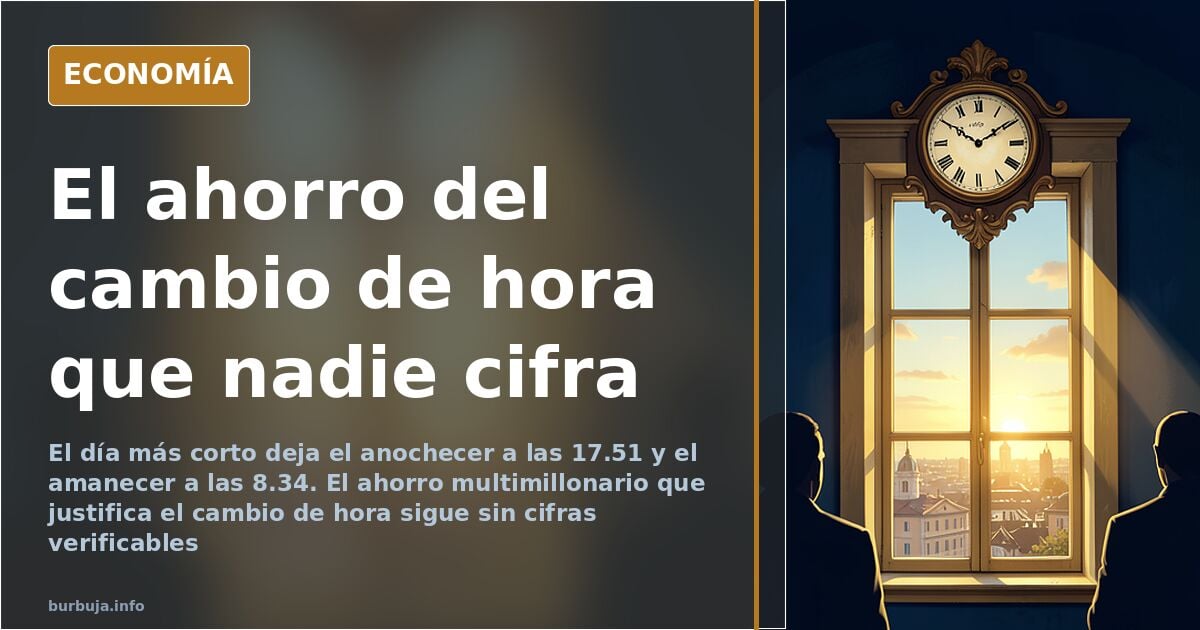
Dark by 6 pm: the savings no one can find
October 2025. The clocks go back an hour, the sun sets earlier, and the annual question returns: where is the energy saving that justified the invention? The short answer is that nobody has seen it. The long one is that the debate is no longer about electricity, but about what time of day we want to live our lives.
The origin of the clock change was not household savings, but a wartime measure. Germany introduced it in 1916 to reduce coal consumption. Spain copied it and kept it, and since 1981 it has been synchronised with Brussels. The result is a country where, in winter, the sun rises at 8:34 and sets at 17:51 on the shortest day, according to the figures used in the discussion. A schedule that, seen from the equator, is utterly unremarkable: there, the sun sets at 18:00 all year round.
The problem is not the sun. It's the clock.
Mainland Spain trinc the Greenwich meridian, but since 1940 it has lived on Berlin time. That means that in Vigo, solar noon arrives almost two hours later than in Menorca. Whenever someone proposes returning to the natural schedule, the answer is always the same: sunrise would be at 9:30 in winter. And that's where the fight begins.
Why does Spain change the clocks?
The official reason is energy saving. The real reason is that half of Europe does it and nobody wants to be the first to break ranks. The European Commission proposed abolishing the change in 2018, but the lack of agreement between countries left it in limbo. Meanwhile, every October the ritual repeats itself: clocks go back, electricity bills don't go down, and the debate reopens with more force than the year before.
The figures thrown around in the conversation are inconclusive. Some argue that the saving is marginal, around 1% of electricity consumption, while others claim the change affects sleep more than the bill. What is certain is that companies don't switch off the lights in broad daylight, as some contributions point out, and the multimillion-euro saving promised by the power companies still hasn't shown up anywhere.
Winter and summer time: two visions of the day
Summer time moves the clock forward so that evenings have more light. Winter time moves it back so that mornings aren't a tunnel. In Spain, summer time begins in March and winter time in October. The result is that in June the sun sets at 22:30 and in December at 17:51. Two extremes that divide the population.
Those who defend year-round summer time argue that evening light is more useful: it allows people to go out, play sports and use less electricity at home. Those who defend winter time point out that a later sunrise in winter would be madness for those who work outdoors, such as farmers, who need daylight from first thing in the morning. The calculation is simple: if summer time were kept in December, the sun would rise at 9:30 and set at 18:51. If winter time were kept in June, it would rise at 5:30 and set at 20:30.
Daylight is not negotiated with the clock.
There is a school of thought proposing something different: adapting working hours to the sun, not the other way round. Starting work at 8:00 in winter and 7:00 in summer, and letting the clock run its course. That's what farm workers did before industrialisation imposed the split working day. The idea has supporters and critics, but no one has taken it to the BOE (Spain's official state gazette).
The impact on sleep and health
The clock change disrupts the circadian rhythm. Experts warn that moving the clock forward or back an hour can affect sleep for days, especially in children and the elderly. the Spanish Sleep Society has repeatedly called for the real impact to be assessed before keeping the system. But politics is going in another direction.
At its heart, the debate about the clock change is a debate about how society is organised. Do we want natural light to match working hours or leisure time? Do we prefer to wake up with sunlight or have long evenings? There is no single answer, and that is why the issue returns every October.
What those who work with the sun say
The sectors most affected are agriculture, construction and tourism. In the countryside, the working day starts with the sun and ends with the sun. A clock change doesn't alter the cycle, but it does change how the work is organised. In construction, light means safety: working at night or in poor visibility multiplies the risks. In tourism, terraces and strolls depend on the hours of daylight.
The most common complaint is that the clock change benefits some and harms others. Those who work indoors don't notice the difference; those who work outdoors do. And so do those with young children: getting the kids up at 7:00 while it's still dark is an experience many know well.
Energy saving is the excuse. The real discussion is what time of day we want to live.
Meanwhile, the clock keeps ticking. In October it goes back, in March it goes forward. And every year, right on time, the question returns: where is the saving? The answer, for now, is the same as last year: nowhere.
Also available in: Deutsch
Summary of a discussion on Burbuja.info - Foro de economía, actualidad y política., translated from Spanish and reviewed before publication. Read the full discussion (243 replies).
More summaries
-
Spain's Hour Change: BOE Confirms Dates Only Until 2026
The Official State Gazette confirms clock changes only until 2026. Without new dates, Spain defaults to winter time, not summer.
-
Spain's GMT+2 Time Zone Debate Reignites With Summer Shift
Spain enters GMT+2, dividing early risers from those enjoying late daylight. Greenwich crosses Monegros, sparking ongoing time zone controversy.
-
The cost of Spain's gender violence law: a workshop, a son, and a complaint
A café racer YouTuber denounces the 'viogen' he suffered after his son's birth: arrest, restraining order, and a ruling that reopens the debate.
-
Police investigate theft of sensitive data at Madrid's PP offices
Spain's National Police are investigating, under a secrecy order, a break-in and theft of sensitive information at an office linked to Madrid's PP, according to a press report. The…
-
France, Japan and the US urge citizens to stockpile food and water
France recommends a 72-hour kit, Japan three days, and the Pentagon is preparing its bases to last 90 days without supplies. The coincidence fuels suspicion.
-
Spain braces for possible 'Purge night' copycat riots this Halloween
The October 24 riots in Barcelona left 130 arrested, 76 of them minors. TikTok and WhatsApp are spreading new calls for October 31 in Madrid and Barcelona.