
Spain's Supreme Court: Drug Driving Fines Require Symptoms, Not Just Positive Test
Spain's Supreme Court rules a positive saliva test alone doesn't prove impairment. The ruling sparks debate on false positives and legal costs.
English · Original discussion in Spanish · Published
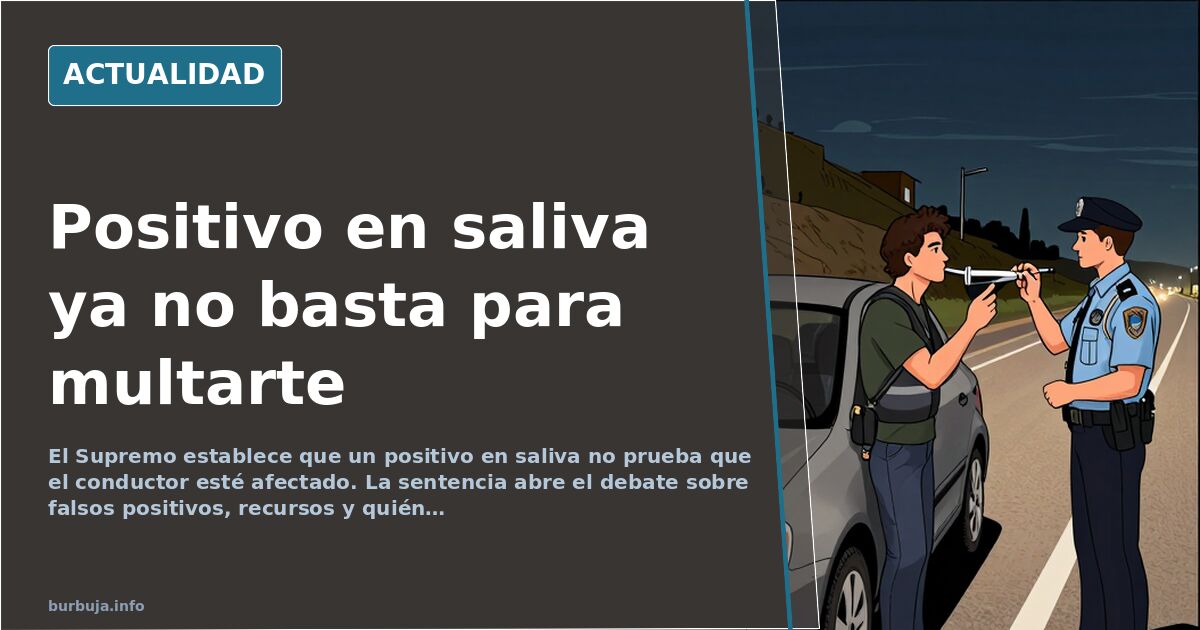
Positive Saliva Test Insufficient: Spain's Top Court Demands Evidence of Impairment
Can drivers be fined for drug use if there is no proof they were unable to drive? Courts are increasingly saying no. Supreme Court ruling STS 459/2025 establishes that a positive saliva test does not, by itself, prove the driver was impaired. Mere presence of substances is no longer sufficient evidence. In a country where roadside drug checks rely almost entirely on oral fluid analysis, this is a seismic shift.
The debate quickly turned to the reliability of these tests. One participant cited a study showing THC can trigger positive results years after consumption stops, as it binds to body fat and re-enters the bloodstream during weight loss or dieting, causing false positives. If true, the vulnerability of those affected is severe.
What a Positive Saliva Test Actually Proves
The technical core is problematic. As argued in the discussion, THC metabolites in an occasional user who is unfit to drive may be lower than residues in a habitual user who hasn't consumed recently. Biological markers fail to distinguish between being high and having residual traces from last week. Consequently, the test measures presence, not impairment.
The proposed alternative is psychomotor testing: assessing actual driving fitness under controlled conditions. However, even proponents admit such exams are easy to fake and costly to deploy on roads. Unlike alcohol breathalyzers, which measure a substance eliminated predictably, drug tests lack this clear correlation with recent consumption.
A Business Thriving on Favorable Rulings
An undeniable side effect: rulings like this fuel a market. Law firms specializing in traffic fine appeals use such news for recruitment. The pattern involves mass calls, upfront fees around €400, and agreed honorariums. Yet, most cases end with judges upholding the administration's decision. Drivers pay the fine, court costs, and lawyer fees. A seemingly open door becomes a higher bill.
Asymmetry is key. If tests produced false negatives, systems would have changed long ago. Since they produce false positives, the status quo persists: only blood tests exonerate drivers, requiring upfront spending to prove innocence. The burden of proof effectively shifts, penalizing those who cannot afford legal representation.
Compensation Is Not Standard Practice
The ruling also opens questions about collateral damage. Canceling a fine doesn't compensate for lost time, immobilized vehicles, or waiting hours. Discussions emphasize that compensation for lost earnings and leisure should be standard, not discretionary. Acknowledging errors without compensating leaves sanctioned individuals harmed, holding only a paper victory.
Crucially, if this criterion solidifies, what happens to thousands of past cases resolved solely via saliva tests? Honest answers are scarce. While the ruling is a blow, its impact depends on whether administrative courts apply it uniformly. Legal certainty remains subject to judicial lottery.
Meanwhile, the message to drivers is confusing. Some interpret it as permission to smoke and drive; others see controls as toothless. Neither is entirely accurate, but both benefit lawyers and revenue collectors. Drivers, as always, pay for the uncertainty.
Can drivers be fined for drug use if there is no proof they were unable to drive? Courts are increasingly saying no. Supreme Court ruling STS 459/2025 establishes that a positive saliva test does not, by itself, prove the driver was impaired. Mere presence of substances is no longer sufficient evidence. In a country where roadside drug checks rely almost entirely on oral fluid analysis, this is a seismic shift.
The debate quickly turned to the reliability of these tests. One participant cited a study showing THC can trigger positive results years after consumption stops, as it binds to body fat and re-enters the bloodstream during weight loss or dieting, causing false positives. If true, the vulnerability of those affected is severe.
What a Positive Saliva Test Actually Proves
The technical core is problematic. As argued in the discussion, THC metabolites in an occasional user who is unfit to drive may be lower than residues in a habitual user who hasn't consumed recently. Biological markers fail to distinguish between being high and having residual traces from last week. Consequently, the test measures presence, not impairment.
The proposed alternative is psychomotor testing: assessing actual driving fitness under controlled conditions. However, even proponents admit such exams are easy to fake and costly to deploy on roads. Unlike alcohol breathalyzers, which measure a substance eliminated predictably, drug tests lack this clear correlation with recent consumption.
A Business Thriving on Favorable Rulings
An undeniable side effect: rulings like this fuel a market. Law firms specializing in traffic fine appeals use such news for recruitment. The pattern involves mass calls, upfront fees around €400, and agreed honorariums. Yet, most cases end with judges upholding the administration's decision. Drivers pay the fine, court costs, and lawyer fees. A seemingly open door becomes a higher bill.
Asymmetry is key. If tests produced false negatives, systems would have changed long ago. Since they produce false positives, the status quo persists: only blood tests exonerate drivers, requiring upfront spending to prove innocence. The burden of proof effectively shifts, penalizing those who cannot afford legal representation.
Compensation Is Not Standard Practice
The ruling also opens questions about collateral damage. Canceling a fine doesn't compensate for lost time, immobilized vehicles, or waiting hours. Discussions emphasize that compensation for lost earnings and leisure should be standard, not discretionary. Acknowledging errors without compensating leaves sanctioned individuals harmed, holding only a paper victory.
Crucially, if this criterion solidifies, what happens to thousands of past cases resolved solely via saliva tests? Honest answers are scarce. While the ruling is a blow, its impact depends on whether administrative courts apply it uniformly. Legal certainty remains subject to judicial lottery.
Meanwhile, the message to drivers is confusing. Some interpret it as permission to smoke and drive; others see controls as toothless. Neither is entirely accurate, but both benefit lawyers and revenue collectors. Drivers, as always, pay for the uncertainty.
Summary of a discussion on Burbuja.info - Foro de economía, actualidad y política., translated from Spanish and reviewed before publication. Read the full discussion (125 replies).
More summaries
-
Montjuïc Tribute to General Escobar Reignites Calls to Disband the Guardia Civil
A floral tribute to General Antonio Escobar in Barcelona has reopened demands to disband the Guardia Civil and prosecute its leadership for historical treason.
-
Guardia Civil Can Immobilize Your Car Following a Visual Test
An officer can ask you to read a license plate from 20 meters away. If you fail, your car is immobilized. The test exists, but few have seen it applied. Why?
-
Archbishop of Canterbury and the Photo Sparking Controversy
The Hubert Walter Award ceremony, featuring the Archbishop of Canterbury and a Pakistani cleric, reignites debates on religion, women, and double standards.
-
Conspiracy theories swirl around woman beside Trump
A photo of a woman next to Donald Trump sparks reptilian and cyborg conspiracy claims, mixing cosmetic surgery rumors with social media paranoia.
-
Spanish bar coffee: torrefacto, boiling water and up to 15% sugar
Spanish bar coffee is roasted with up to 15% sugar, served boiling from dirty machines. That’s why it tastes like ash yet costs specialty prices.
-
Attack in rural Alcaucín leaves one detained, victim in coma
A violent attack at a rural house in Alcaucín left a 57-year-old in a coma and led to one arrest. The incident reignites debate on media silence.