
Attack in rural Alcaucín leaves one detained, victim in coma
A violent attack at a rural house in Alcaucín left a 57-year-old in a coma and led to one arrest. The incident reignites debate on media silence.
English · Original discussion in Spanish · Published
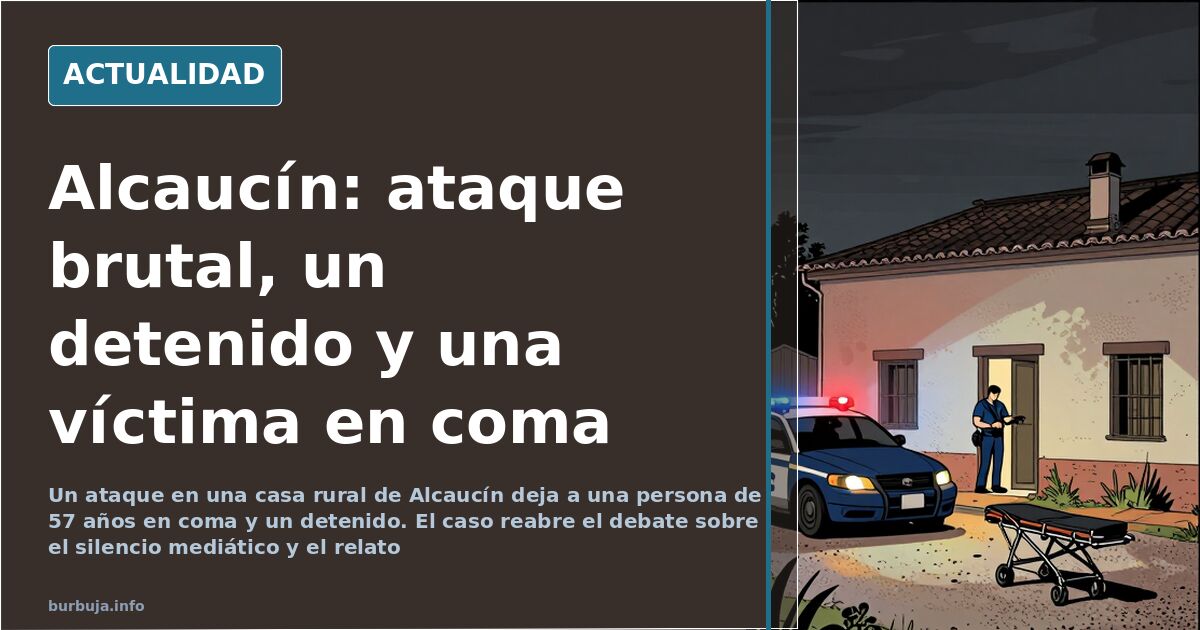
Attack in Alcaucín: One detained, 57-year-old victim in coma
A violent attack at a rural house in Alcaucín (Málaga) has left a 57-year-old person in critical condition and in a coma. There is one suspect detained, described in early reports as being of North African origin. The incident, characterized as "brutal," has entered public discourse through an uncomfortable channel: information silence. The discussion generated around the case revolves less around the facts—which are scarce and unresolved—and more around what is reported, what is omitted, and why.
What is known about the Alcaucín attack
The available data is minimal and should not be embellished. A family was attacked at a rural house in this Málaga municipality. A 57-year-old victim remains in critical condition, in a coma. One person has been arrested. Beyond that, there is a void. There is no official confirmation of the motive, no known judicial resolution, and no closed narrative. Any assertion beyond this is speculation, and in a matter involving a person fighting for their life, speculation carries a cost.
The discussion quickly shifted toward media treatment. Some messages argue that such incidents do not reach mainstream television, and when they do, it is with bias. As an example of competition for airtime, the coincidence with the San Fermín festivals is cited: there was no room, summarizes one message. Another points directly to editorial lines: publishing such attacks would be Sarracinophobia and would break the official narrative. These are opinions, not verifications, and must be read as such.
The narrative of media silence and its limits
The thesis of silence has defenders and detractors within the same conversation. The former point to a pattern: serious incidents that do not make headlines while others occupy minutes of news broadcasts. The latter respond with a more prosaic argument: saturation. It is not concealment, but rather that there are too many cases and viewers have become desensitized. In the past, one such incident occurred per year at most, someone writes; now, they argue, several accumulate daily.
This diagnosis of collective anesthesia connects with a broader critique of the information ecosystem. It is argued that the problem is not just what is silenced, but the constant bombardment: media and social networks competing for the same impact, each with its own interest. According to this view, the consequence is that the public stops distinguishing specific cases from statistics, and statistics from interested narratives. The result is a debate where no one discusses the facts because the facts barely exist.
Why immigration is mixed with violent incidents
The detainee's origin has become the axis of the entire conversation. It is a known pattern: a serious incident, a datum on nationality or origin, and the discussion jumps from the victim to the general framework. Some use it to reinforce a thesis on insecurity and migration; others respond that generalizing from a single case is precisely the mechanism that turns anecdote into threat. The discussion on the principle of exaggeration—turning any isolated case into a category—appears explicitly in the messages.
It is advisable to separate two things that the conversation mixes. One: the specific attack, with a victim in a coma and a detainee, which is a judicial and police matter. Two: the discussion on migration policy, which is a legitimate political debate but cannot be resolved by a single case. When both merge, the victim disappears from the narrative and the detainee becomes a symbol. This is what happens here: the 57-year-old man in a coma barely appears in the discussion.
The normalization of violence in public debate
There is an underlying thread in the entire conversation: the feeling that violence has been normalized. Not only physical violence, but also verbal. The harshest messages are not against the attacker, but against other participants, media, and institutions. The victim is reduced to an excuse for political combat. This is a phenomenon repeated in every serious incident: the case becomes a battlefield before the investigation has advanced.
Against this, some messages call for prudence. They remind us that there is no conviction, no sentence, that the detainee is presumed innocent, and that the investigation is ongoing. This is the least noisy position and generates the least interaction, which says something about how these conversations work. Caution does not generate clicks; indignation does.
What happens next with the investigation
As of this discussion, the case remains open. The 57-year-old victim continues in critical condition. The detainee is at the disposal of the court, without concrete charges or pogre in the proceedings being known. There is no official confirmation of the attack's motive. Any conclusion about what peine in that rural house in Alcaucín is premature.
What can be affirmed is that the case has served, once again, for something different than it should have: to feed a discussion on media, immigration, and narrative that has been repeating itself with every incident. The victim, meanwhile, remains in a coma. And there, in that detail, any analysis gets stuck.
A violent attack at a rural house in Alcaucín (Málaga) has left a 57-year-old person in critical condition and in a coma. There is one suspect detained, described in early reports as being of North African origin. The incident, characterized as "brutal," has entered public discourse through an uncomfortable channel: information silence. The discussion generated around the case revolves less around the facts—which are scarce and unresolved—and more around what is reported, what is omitted, and why.
What is known about the Alcaucín attack
The available data is minimal and should not be embellished. A family was attacked at a rural house in this Málaga municipality. A 57-year-old victim remains in critical condition, in a coma. One person has been arrested. Beyond that, there is a void. There is no official confirmation of the motive, no known judicial resolution, and no closed narrative. Any assertion beyond this is speculation, and in a matter involving a person fighting for their life, speculation carries a cost.
The discussion quickly shifted toward media treatment. Some messages argue that such incidents do not reach mainstream television, and when they do, it is with bias. As an example of competition for airtime, the coincidence with the San Fermín festivals is cited: there was no room, summarizes one message. Another points directly to editorial lines: publishing such attacks would be Sarracinophobia and would break the official narrative. These are opinions, not verifications, and must be read as such.
The narrative of media silence and its limits
The thesis of silence has defenders and detractors within the same conversation. The former point to a pattern: serious incidents that do not make headlines while others occupy minutes of news broadcasts. The latter respond with a more prosaic argument: saturation. It is not concealment, but rather that there are too many cases and viewers have become desensitized. In the past, one such incident occurred per year at most, someone writes; now, they argue, several accumulate daily.
This diagnosis of collective anesthesia connects with a broader critique of the information ecosystem. It is argued that the problem is not just what is silenced, but the constant bombardment: media and social networks competing for the same impact, each with its own interest. According to this view, the consequence is that the public stops distinguishing specific cases from statistics, and statistics from interested narratives. The result is a debate where no one discusses the facts because the facts barely exist.
Why immigration is mixed with violent incidents
The detainee's origin has become the axis of the entire conversation. It is a known pattern: a serious incident, a datum on nationality or origin, and the discussion jumps from the victim to the general framework. Some use it to reinforce a thesis on insecurity and migration; others respond that generalizing from a single case is precisely the mechanism that turns anecdote into threat. The discussion on the principle of exaggeration—turning any isolated case into a category—appears explicitly in the messages.
It is advisable to separate two things that the conversation mixes. One: the specific attack, with a victim in a coma and a detainee, which is a judicial and police matter. Two: the discussion on migration policy, which is a legitimate political debate but cannot be resolved by a single case. When both merge, the victim disappears from the narrative and the detainee becomes a symbol. This is what happens here: the 57-year-old man in a coma barely appears in the discussion.
The normalization of violence in public debate
There is an underlying thread in the entire conversation: the feeling that violence has been normalized. Not only physical violence, but also verbal. The harshest messages are not against the attacker, but against other participants, media, and institutions. The victim is reduced to an excuse for political combat. This is a phenomenon repeated in every serious incident: the case becomes a battlefield before the investigation has advanced.
Against this, some messages call for prudence. They remind us that there is no conviction, no sentence, that the detainee is presumed innocent, and that the investigation is ongoing. This is the least noisy position and generates the least interaction, which says something about how these conversations work. Caution does not generate clicks; indignation does.
What happens next with the investigation
As of this discussion, the case remains open. The 57-year-old victim continues in critical condition. The detainee is at the disposal of the court, without concrete charges or pogre in the proceedings being known. There is no official confirmation of the attack's motive. Any conclusion about what peine in that rural house in Alcaucín is premature.
What can be affirmed is that the case has served, once again, for something different than it should have: to feed a discussion on media, immigration, and narrative that has been repeating itself with every incident. The victim, meanwhile, remains in a coma. And there, in that detail, any analysis gets stuck.
Also available in: Deutsch
Summary of a discussion on Burbuja.info - Foro de economía, actualidad y política., translated from Spanish and reviewed before publication. Read the full discussion (123 replies).
More summaries
-
La Sexta removes video accused of staging anti-Ceuta bias
Spanish broadcaster La Sexta deletes a video alleged to be a fabrication designed to criminalize residents of Ceuta.
-
Ayuso Criticizes La Sexta Over Grandfather's Past
La Sexta Columna report on Ayuso's grandfather as Falange leader sparks controversy over politicians' family histories.
-
Spain's 'La bola negra' sparks culture war with €4.7M opening
'La bola negra' grosses €4.7 million in its first weekend and divides Spain between critical praise and accusations of propaganda and historical sectarianism.
-
Ayuso Cancels Mexico Trip Amid Diplomatic Tensions
We analyze the cancellation of Isabel Díaz Ayuso's tour in Mexico: political strategy, diplomatic tension, or expulsion? Join the debate.
-
Spain: Phone addiction dominates public spaces
In Spain, excessive smartphone use in public raises concerns about social detachment and behavioral dependency.
-
Man stabbed over early morning laundry in Spain
A young man stabbed his flatmate in Móstoles, Spain, following a dispute about the noise of a washing machine running at night.