
Spain's summer: Nights above 30°C offer no relief
In Spain, tropical nights and high humidity spike heat sensation on the coast. The debate between natural cycles and climate change intensifies.
English · Original discussion in Spanish · Published
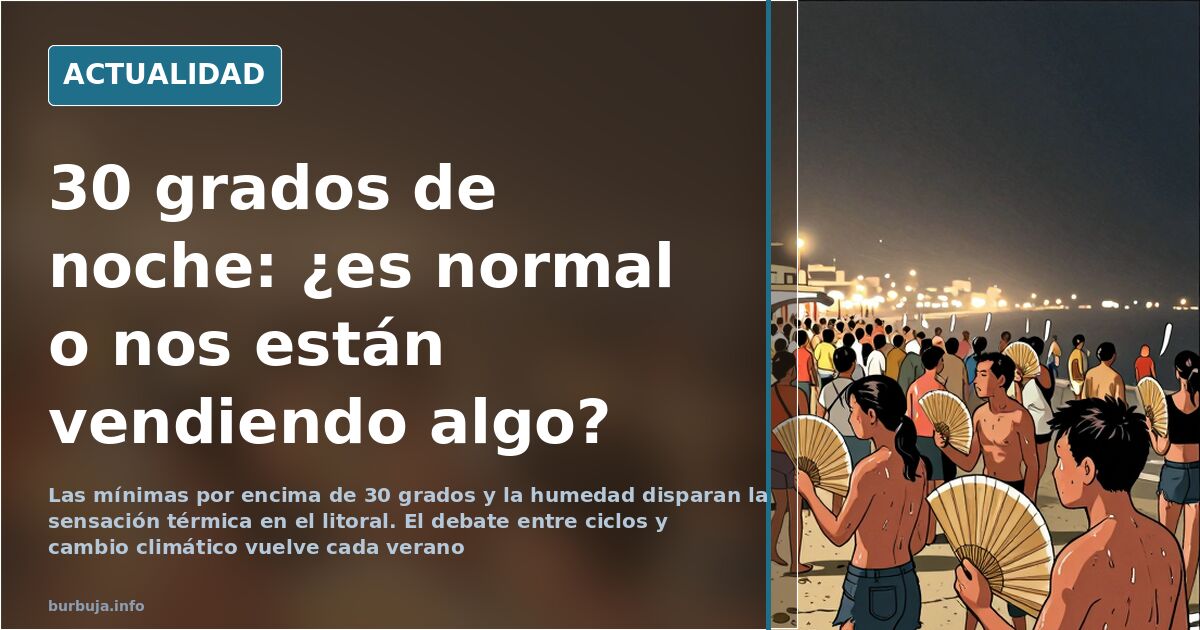
Nights of 30 degrees: Heat that offers no respite
Is it normal to be unable to sleep without air conditioning? Will this persist throughout July and August? This question has swept across half the country since minimum temperatures settled above 25 degrees in much of the Mediterranean coast and inland areas. Public discussion has split into two camps: those who argue this is just another cycle — noting that the summer of 2003 was equal or worse — and those pointing to a structural shift in peninsular climate. Strikingly, both sides agree on one thing: the human body is not designed to sleep at 30 degrees.
The ghost of the 2003 summer
Comparisons with 2003 appear repeatedly. According to circulating accounts, that summer reached 46.5 degrees in the shade and 55 in the sun, with minimums above 30 degrees for two consecutive weeks. In Barcelona, fans sold out, and many people lacked air conditioning. "I nearly went to the cheap hotel next door," recalls someone who lived through it. It is not an exaggeration: offices with climate control were bearable, but arriving home revealed a different reality.
The difference is that public discourse on climate did not exist then as it does now. The ozone hole served as an alarm narrative, and when it lost traction, another was sought. Some say bluntly: "They will do the same with this; it sells less now, so they are looking to invent another story." Skepticism toward official narratives is constant in the debate, but it does not invalidate physical data: tropical nights have multiplied.
Why is coastal heat worse than inland?
Humidity is the most frequently cited factor in testimonies. In Barcelona, Valencia, or Seville, high relative humidity turns night into a sauna. "You shower and come out sweating again; sheets are damp; everything feels wet," describes someone. Thermal sensation spikes: 30 degrees with high humidity can be worse than 40 dry degrees.
In Madrid or Zaragoza, despite higher temperatures, drier air allows the body to sweat and evaporate, enabling some regulation. However, urban asphalt and concrete radiate accumulated daytime heat. This is the heat island effect: buildings from the 1960s and 70s, lacking insulation, act like ovens. Air conditioners expel more heat onto the streets. Consequently, city centers rarely drop below 30 degrees in the early morning.
Air conditioning as a class divide
An economic dimension underpins the entire debate. Home air conditioning is not universal: those who can afford it set it to 16 degrees from 8 PM to 8 AM; others manage with fans or frozen bottles. "Lacking air conditioning means being unable to sleep, rest, or work effectively the next day," summarizes someone. Electricity bills with units running for three months straight are another filter.
Generational gaps also emerge. Older people often complain more about cold than heat due to circulation issues. Young adults and working-age individuals suffer differently: without nocturnal rest, performance plummets. Some note that pensioners with dual incomes and rented apartments have guaranteed climate control, while others do not.
Climate change or natural cycles?
Here, the debate becomes heated. One sector argues summers have always been hot and novelty lies only in propaganda: "It is as hot as every year; we are tired of yearly clichés." Another responds with data: melting poles, ocean acidification, frequent extreme events. An intermediate position suggests cycles within cycles: "Anomalies are usual; same with rainfall."
Almost all acknowledge that bodies adapt poorly now. "In the seventies, summers were already very hot, but now, with so much AC, bodies don't adapt," says someone. Widespread climate control has reduced heat tolerance. It is a paradox: greater comfort leads to less resilience.
What can be done without air conditioning?
Home remedies circulate widely. Freezing a large water bottle and placing it near the bed with a plate underneath for condensation. Opening windows at night and closing them during the day. Showering with lukewarm, not cold, water. Cross-ventilation works best in small rooms. None replace a unit, but they provide relief.
Forecasts for July and August remain uncertain. Models suggest anomalies will continue, but no one guarantees an entire summer. What is certain is that electricity bills and sleep quality will remain topics of conversation. And, as every year, someone will claim it wasn't this hot before. Someone else will reply that it was.
Is it normal to be unable to sleep without air conditioning? Will this persist throughout July and August? This question has swept across half the country since minimum temperatures settled above 25 degrees in much of the Mediterranean coast and inland areas. Public discussion has split into two camps: those who argue this is just another cycle — noting that the summer of 2003 was equal or worse — and those pointing to a structural shift in peninsular climate. Strikingly, both sides agree on one thing: the human body is not designed to sleep at 30 degrees.
The ghost of the 2003 summer
Comparisons with 2003 appear repeatedly. According to circulating accounts, that summer reached 46.5 degrees in the shade and 55 in the sun, with minimums above 30 degrees for two consecutive weeks. In Barcelona, fans sold out, and many people lacked air conditioning. "I nearly went to the cheap hotel next door," recalls someone who lived through it. It is not an exaggeration: offices with climate control were bearable, but arriving home revealed a different reality.
The difference is that public discourse on climate did not exist then as it does now. The ozone hole served as an alarm narrative, and when it lost traction, another was sought. Some say bluntly: "They will do the same with this; it sells less now, so they are looking to invent another story." Skepticism toward official narratives is constant in the debate, but it does not invalidate physical data: tropical nights have multiplied.
Why is coastal heat worse than inland?
Humidity is the most frequently cited factor in testimonies. In Barcelona, Valencia, or Seville, high relative humidity turns night into a sauna. "You shower and come out sweating again; sheets are damp; everything feels wet," describes someone. Thermal sensation spikes: 30 degrees with high humidity can be worse than 40 dry degrees.
In Madrid or Zaragoza, despite higher temperatures, drier air allows the body to sweat and evaporate, enabling some regulation. However, urban asphalt and concrete radiate accumulated daytime heat. This is the heat island effect: buildings from the 1960s and 70s, lacking insulation, act like ovens. Air conditioners expel more heat onto the streets. Consequently, city centers rarely drop below 30 degrees in the early morning.
Air conditioning as a class divide
An economic dimension underpins the entire debate. Home air conditioning is not universal: those who can afford it set it to 16 degrees from 8 PM to 8 AM; others manage with fans or frozen bottles. "Lacking air conditioning means being unable to sleep, rest, or work effectively the next day," summarizes someone. Electricity bills with units running for three months straight are another filter.
Generational gaps also emerge. Older people often complain more about cold than heat due to circulation issues. Young adults and working-age individuals suffer differently: without nocturnal rest, performance plummets. Some note that pensioners with dual incomes and rented apartments have guaranteed climate control, while others do not.
Climate change or natural cycles?
Here, the debate becomes heated. One sector argues summers have always been hot and novelty lies only in propaganda: "It is as hot as every year; we are tired of yearly clichés." Another responds with data: melting poles, ocean acidification, frequent extreme events. An intermediate position suggests cycles within cycles: "Anomalies are usual; same with rainfall."
Almost all acknowledge that bodies adapt poorly now. "In the seventies, summers were already very hot, but now, with so much AC, bodies don't adapt," says someone. Widespread climate control has reduced heat tolerance. It is a paradox: greater comfort leads to less resilience.
What can be done without air conditioning?
Home remedies circulate widely. Freezing a large water bottle and placing it near the bed with a plate underneath for condensation. Opening windows at night and closing them during the day. Showering with lukewarm, not cold, water. Cross-ventilation works best in small rooms. None replace a unit, but they provide relief.
Forecasts for July and August remain uncertain. Models suggest anomalies will continue, but no one guarantees an entire summer. What is certain is that electricity bills and sleep quality will remain topics of conversation. And, as every year, someone will claim it wasn't this hot before. Someone else will reply that it was.
Also available in: Deutsch
Summary of a discussion on Burbuja.info - Foro de economía, actualidad y política., translated from Spanish and reviewed before publication. Read the full discussion (131 replies).
More summaries
-
Temperatures to Peak Above 35°C in Madrid, Zaragoza, and Seville from Thursday to Saturday
Unusual late September heatwave hits Spain, with highs over 35°C expected in Madrid, Zaragoza, and Seville. Astronomical autumn begins with unseasonably warm weather.
-
Ivà, Makinavaja Creator, Dies at 52 in 1993 Car Crash
Ivà, creator of Makinavaja and El Jueves, died in a 1993 car crash at 52 with a blood alcohol level over 2.00.
-
Paramount Shuts MTV Music Channels, Leaves Only Reality TV
Paramount closes MTV's music-themed channels (80s, 90s, 2000s), retaining only reality programming. Linear music videos are discontinued as the catalog...
-
UK carbon passport proposal would limit flights to two per person
The UK is considering a personal carbon allowance of two tonnes, roughly equivalent to two return flights to New York. The idea has previously been debated in Parliament without...
-
Mouliaá: 'Karma' Claim Over Girl's Death Sparks Outrage
Elisa Mouliaá allegedly celebrated a friend's daughter's death as 'karma' for refusing to lie in court, sparking controversy.
-
Lost household items reappear in places already searched
Keys, socks and USBs often resurface in spots previously checked. Experts link most domestic disappearances to attention deficits rather than supernatural causes.