
Paramount Shuts MTV Music Channels, Leaves Only Reality TV
Paramount closes MTV's music-themed channels (80s, 90s, 2000s), retaining only reality programming. Linear music videos are discontinued as the catalog...
English · Original discussion in Spanish · Published
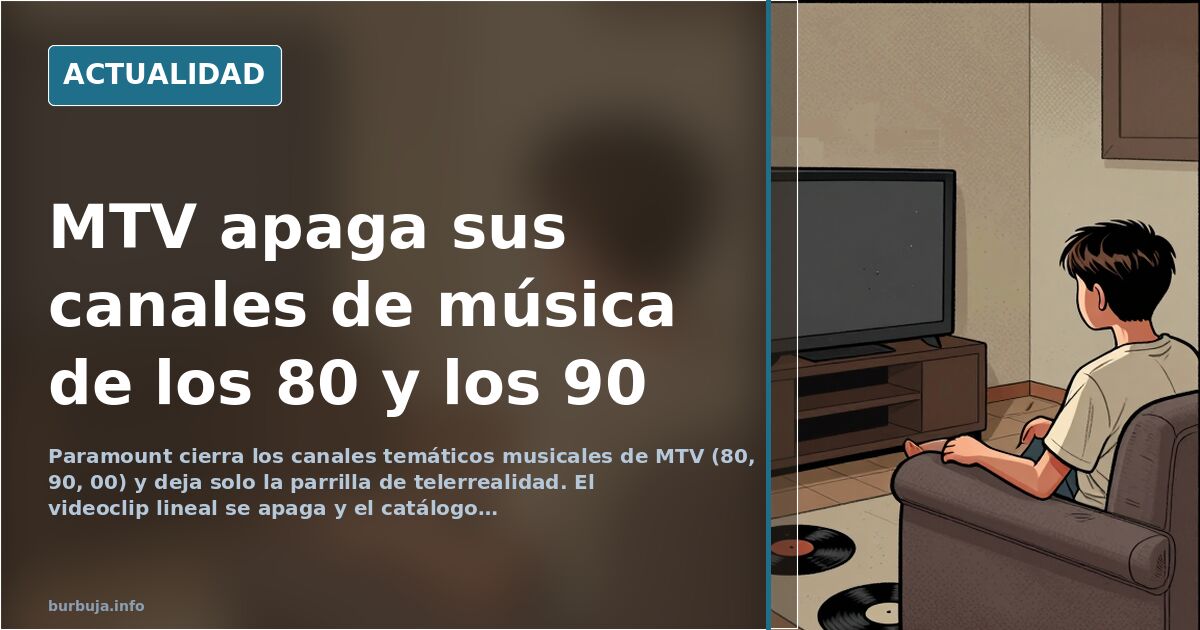
Paramount Shuts Down MTV’s Music Channels: Only Reality TV Survives
Paramount, owner of MTV, has ceased broadcasting its music-themed channels—dedicated to hits from the 80s, 90s, and 2000s—leaving only its reality television lineup. The news was discovered by a viewer who had these channels on their pay-TV provider until two days ago. Upon finding them gone, they were left with only Hit TV, Nickelodeon Music, and Mezzo. Their assessment of the remaining channels was blunt: channels that broadcast garbage that cannot be called music.
The shutdown came as no surprise. The network had long been transformed into a container for reality shows targeting niche audiences, and viewers still tuning into the 80s and 90s channels were, at best, residual. The prevailing suspicion is that Paramount will move everything to a paid platform, forcing those who wish to continue watching videos by The Smiths or Human League to pay again.
Which MTV Channels Closed and Which Remain
The blackout affects decade-specific themed channels—MTV80, MTV90, MTV00, and others—which broadcast music videos continuously with minimal interruptions. They were the last recognizable trace of what the network once was: an uninterrupted music showcase. According to the initial report, only the reality TV lineup (Teen Mom and similar shows) survives, along with a handful of third-party channels on the pay-TV dial that do not fill the gap.
The complaint is not just about lost content but about the model. Subscribers paying for packages that included these channels now find that the product justifying part of their bill has vanished without any reduction in fees. The most common hypothesis is that Paramount will package this catalog into its own streaming service and charge separately for it. In essence: paying twice for the same thing.
From Music Videos to Reality: MTV’s Transformation
The network born as Music Television, which in the 90s was a generational touchstone—for many, childhood meant glued to the satellite dish—eventually mutated into a reality TV channel. The repeated diagnosis is that it began broadcasting low-quality reality shows aimed at a specific audience, and only the 80s and 90s channels, with their monographs on grunge, rock, and punk, were worth keeping.
Nostalgia is justified. In animation, the network produced era-defining titles: Beavis and Butt-Head, Aeon Flux, Ren and Stimpy, The Maxx, and Celebrity Deathmatch. Then came Jackass and its spin-offs, antiestéticaturing scripted situations hooked on excess. That was the path: less music, more cheap spectacle. And the music-loving viewer gradually disappeared.
Why Music Videos No Longer Sell Music
The economic argument carries the most weight. With Spotify and YouTube covering on-demand music consumption, a linear music video channel loses its purpose: no one tolerates a forced schedule when they can choose. The consequence noted is that music is no longer sold as it used to be, and current music videos have become fast-consumption products, almost interchangeable.
Some go further, arguing that popular music itself has degraded: promotion no longer pushes quality material, resulting in an unbearable offering that explains why no one watches MTV. Against this, the fan’s response remains the same: a well-stocked hard drive and hours of searching. The problem, admitted by DJs themselves, is that this involves losing many nights scouring tracks until four in the morning.
The Business: Shedding Weight Before the Warner Bid
The financial reading of the closure points to a larger operation. The circulating hypothesis is that Paramount is shedding dead weight—channels with dwindling audiences and fixed costs—to undertake a major corporate transaction involving Warner. Under this prism, the music channels were not an asset but a liability dragging down the balance sheet.
If this calculation is correct, the closure is not an editorial decision but an accounting one. It explains why the least profitable assets are shut down first: an 80s music video channel has loyal but aging viewers, unattractive to advertisers. The reality lineup, however tacky, is cheaper to produce and sells better to brands. The math works. The music does not.
Alternatives: VH1, VIVA, and Remaining Channels
Before the decade-specific channels existed VH1, also owned by MTV, dedicated to older music. Those who spent entire Saturday afternoons studying with 80s and 90s videos playing in the background remember it. That channel was replaced by the decade-themed ones. Now these fall too. Another name appearing in collective memory is VIVA, which many tuned into simultaneously.
Among the survivors, the only one escaping general criticism is Mezzo, specialized in classical and jazz. The rest—Hit TV, Nickelodeon Music—receive harsh reviews for their programming. The practical conclusion is uncomfortable: fans wanting high-quality music videos on linear TV are left homeless. The lingering question is whether the catalog will end up on a paid platform or simply be lost in a drawer.
Paramount, owner of MTV, has ceased broadcasting its music-themed channels—dedicated to hits from the 80s, 90s, and 2000s—leaving only its reality television lineup. The news was discovered by a viewer who had these channels on their pay-TV provider until two days ago. Upon finding them gone, they were left with only Hit TV, Nickelodeon Music, and Mezzo. Their assessment of the remaining channels was blunt: channels that broadcast garbage that cannot be called music.
The shutdown came as no surprise. The network had long been transformed into a container for reality shows targeting niche audiences, and viewers still tuning into the 80s and 90s channels were, at best, residual. The prevailing suspicion is that Paramount will move everything to a paid platform, forcing those who wish to continue watching videos by The Smiths or Human League to pay again.
Which MTV Channels Closed and Which Remain
The blackout affects decade-specific themed channels—MTV80, MTV90, MTV00, and others—which broadcast music videos continuously with minimal interruptions. They were the last recognizable trace of what the network once was: an uninterrupted music showcase. According to the initial report, only the reality TV lineup (Teen Mom and similar shows) survives, along with a handful of third-party channels on the pay-TV dial that do not fill the gap.
The complaint is not just about lost content but about the model. Subscribers paying for packages that included these channels now find that the product justifying part of their bill has vanished without any reduction in fees. The most common hypothesis is that Paramount will package this catalog into its own streaming service and charge separately for it. In essence: paying twice for the same thing.
From Music Videos to Reality: MTV’s Transformation
The network born as Music Television, which in the 90s was a generational touchstone—for many, childhood meant glued to the satellite dish—eventually mutated into a reality TV channel. The repeated diagnosis is that it began broadcasting low-quality reality shows aimed at a specific audience, and only the 80s and 90s channels, with their monographs on grunge, rock, and punk, were worth keeping.
Nostalgia is justified. In animation, the network produced era-defining titles: Beavis and Butt-Head, Aeon Flux, Ren and Stimpy, The Maxx, and Celebrity Deathmatch. Then came Jackass and its spin-offs, antiestéticaturing scripted situations hooked on excess. That was the path: less music, more cheap spectacle. And the music-loving viewer gradually disappeared.
Why Music Videos No Longer Sell Music
The economic argument carries the most weight. With Spotify and YouTube covering on-demand music consumption, a linear music video channel loses its purpose: no one tolerates a forced schedule when they can choose. The consequence noted is that music is no longer sold as it used to be, and current music videos have become fast-consumption products, almost interchangeable.
Some go further, arguing that popular music itself has degraded: promotion no longer pushes quality material, resulting in an unbearable offering that explains why no one watches MTV. Against this, the fan’s response remains the same: a well-stocked hard drive and hours of searching. The problem, admitted by DJs themselves, is that this involves losing many nights scouring tracks until four in the morning.
The Business: Shedding Weight Before the Warner Bid
The financial reading of the closure points to a larger operation. The circulating hypothesis is that Paramount is shedding dead weight—channels with dwindling audiences and fixed costs—to undertake a major corporate transaction involving Warner. Under this prism, the music channels were not an asset but a liability dragging down the balance sheet.
If this calculation is correct, the closure is not an editorial decision but an accounting one. It explains why the least profitable assets are shut down first: an 80s music video channel has loyal but aging viewers, unattractive to advertisers. The reality lineup, however tacky, is cheaper to produce and sells better to brands. The math works. The music does not.
Alternatives: VH1, VIVA, and Remaining Channels
Before the decade-specific channels existed VH1, also owned by MTV, dedicated to older music. Those who spent entire Saturday afternoons studying with 80s and 90s videos playing in the background remember it. That channel was replaced by the decade-themed ones. Now these fall too. Another name appearing in collective memory is VIVA, which many tuned into simultaneously.
Among the survivors, the only one escaping general criticism is Mezzo, specialized in classical and jazz. The rest—Hit TV, Nickelodeon Music—receive harsh reviews for their programming. The practical conclusion is uncomfortable: fans wanting high-quality music videos on linear TV are left homeless. The lingering question is whether the catalog will end up on a paid platform or simply be lost in a drawer.
Also available in: Deutsch
Summary of a discussion on Burbuja.info - Foro de economía, actualidad y política., translated from Spanish and reviewed before publication. Read the full discussion (130 replies).
More summaries
-
Carmen Porter and the TV cleavage debate
Carmen Porter sparks controversy over her cleavage on Cuarto Milenio. Two opposing views on dress freedom and sexism on television.
-
Alcorcón Reporter Confronts Minors, Sparking Public Backlash
A TV reporter in Alcorcón confronts minors on the street; the viral video ignites debate over schooling, squatting, and media roles.
-
Gomesende Wedding Descends into Brawl Over €40,000 in Gifts
A wedding in Gomesende turned into a family fight over €40,000 in gifts, according to the circulating account. The bride's origin became a focus of the dispute.
-
Ada Colau's Gaza Flotilla Boat Breaks Down, Halting Journey
The vessel carrying former Barcelona mayor Ada Colau suffered a mechanical failure and will not continue to Gaza. She is being transferred to another boat as the expedition faces delays.
-
12-year-old girl killed by tram in Zaragoza
A 12-year-old girl died after being hit by a tram in Zaragoza. The forum highlights six fatalities since 2011 on an unprotected platform.
-
Spanish Judge Approves Hormone Treatment for Minor, Sparking Consent Debate
A Spanish judge authorized irreversible hormone treatment for a minor with parental support, reigniting debates on consent.