
Lost household items reappear in places already searched
Keys, socks and USBs often resurface in spots previously checked. Experts link most domestic disappearances to attention deficits rather than supernatural causes.
English · Original discussion in Spanish · Published
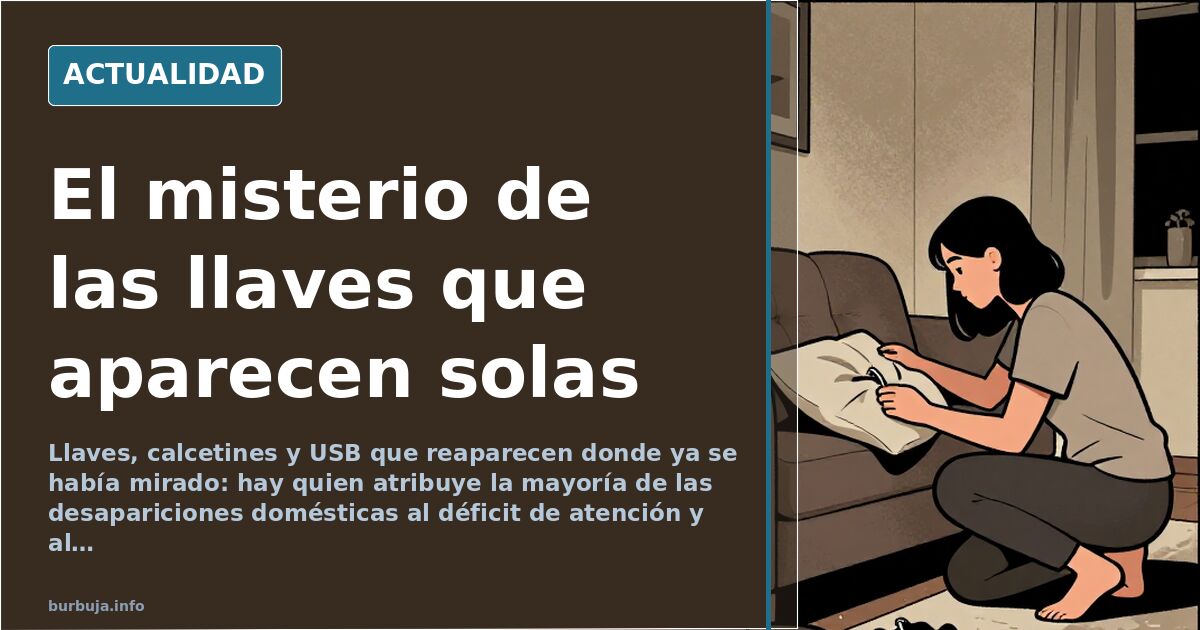
Lost household items reappear in places already searched
A set of keys missing for over three days turns up on a sofa the owner had passed "at least five times." This is not an isolated incident: pliers, garage remotes, socks, external hard drives, or a USB stick that reappears after three months when it falls to the floor. The scene repeats in many homes with the same pattern: the object was where it should be, disappeared, and returned to a spot already thoroughly inspected. The lingering question is not so much where it went, but why the brain failed to see it right in front of them.
What gets lost and how long it takes to find
The inventory repeated in testimonials is domestic and predictable: keys, sunglasses, socks, tools, a gate remote, a kitchen knife, a USB. What stands out is not the list, but the timelines. There are accounts of objects reappearing within days, others taking weeks, and some lasting months: an external hard drive gone "for ages," a USB located after three months by hearing it hit the floor, and sunglasses found in the car's passenger door pocket two or three years after searching that exact spot.
The most common case is the orphaned sock. A house accumulates fifteen unmatched socks, and the go-to explanation is the washing machine. The most reasonable hypothesis has nothing supernatural about it: the small garment gets trapped inside a sheet or t-shirt when unloading laundry, then falls into the yard or stays tangled in a fold. Those who have verified this recommend gathering all socks before hanging them up, doing the same with underwear.
The brain that erases the memory of leaving something
The explanation gaining traction is not the fifth dimension, but attention deficit during moments of stress. The pattern is always the same: an object is left in an unusual place—like a phone in a bathroom drawer—and the brain automatically erases that memory, turning the subsequent search into a hide-and-seek game against oneself. Those describing it this way claim to have spent one or two hours questioning their sanity.
This phenomenon has a name in attention psychology: when you give up and stop looking, perception relaxes, and the object becomes visible. This is called the threshold effect, explaining why keys were on the sofa yet unseen during five passes. The same logic applies to someone looking for an object they are holding in their hand, the most humiliating case of all.
Some add another layer: stress and rushing cause people to act on autopilot. The recurring conclusion is uncomfortable: it’s not elves, it’s yourself in a state of absolute distraction. The proposed antidote is not mystical: return every item to its place immediately after use, no excuses. Those who trinc this rule, they say, lose nothing.
Saint Cucufato, cats, and other domestic theories
When rational explanations fall short, popular repertoires emerge. The most repeated is praying to Saint Cucufato (a Spanish folk saint invoked for finding lost things), supposedly yielding immediate results. Another frequently cited trick: make a new set of keys or renew your ID card, because the original appears as soon as you have the duplicate. Some blame the cat, which "disappears when you look for it and appears like a defiant statue on the table."
The most elaborate theory involves little elves living in pipes, ventilation ducts, and air chambers, moving around at night. What in buildings is attributed to neighbors' pipes or material contractions would, according to this version, be their work. Some claim genuine treasures accumulate downstairs. The recurring joke is that the only proof of an abduction would be a burn mark in a very specific spot.
In cases of human-suspect disappearances, the pattern is clear: those living with people who organize by hiding things lose them forever. Also mentioned is the mother who stores important items never to be seen again, and families losing all Tupperware lids, forcing them to bring their own containers home.
The ring behind the other ring
The most puzzling story involves a woman wearing two rings on the same finger. The back one was loose, used as a stopper to prevent losing the front one. One day she realized she had lost one—precisely the back ring. She searched for over a week with help from her husband and daughters, who confirmed she wasn't wearing it. Days later, it appeared on her finger, behind the other ring.
This anecdote illustrates the limits of explanations. There is no documented sleepwalking, no trick, and the object was exactly where it should have been all along. It is the type of case that no attention theory fully explains, leaving the door open to the mystery that the material itself does not resolve.
What those who lose nothing say
Against chronic forgetfulness, there is a group claiming to never misplace anything. Their method is simple: memory to recall where each item was placed and fixed routines. Keys always in the same spot. They add a factor often ignored: how many hands are in the house. When only one person handles their things, losses plummet; when several coexist, the culprit is usually someone else.
The majority view admits the problem and seeks technical solutions. Whistle-activated key finders are dismissed as cheap and unreliable—"they start whistling whenever they feel like it"—pointing instead to GPS trackers linked to smartphones, with the obvious caveat: provided you don't also lose your phone.
The closing note comes from the most depressing domestic statistic. Lost objects are almost always made of natural materials: metal, wood. And the most insistent advice is not to pray to any saint, but to buy identical socks. That way, when one goes missing, you store the pair deep in the drawer, and when another surplus appears, you know exactly where to look.
A set of keys missing for over three days turns up on a sofa the owner had passed "at least five times." This is not an isolated incident: pliers, garage remotes, socks, external hard drives, or a USB stick that reappears after three months when it falls to the floor. The scene repeats in many homes with the same pattern: the object was where it should be, disappeared, and returned to a spot already thoroughly inspected. The lingering question is not so much where it went, but why the brain failed to see it right in front of them.
What gets lost and how long it takes to find
The inventory repeated in testimonials is domestic and predictable: keys, sunglasses, socks, tools, a gate remote, a kitchen knife, a USB. What stands out is not the list, but the timelines. There are accounts of objects reappearing within days, others taking weeks, and some lasting months: an external hard drive gone "for ages," a USB located after three months by hearing it hit the floor, and sunglasses found in the car's passenger door pocket two or three years after searching that exact spot.
The most common case is the orphaned sock. A house accumulates fifteen unmatched socks, and the go-to explanation is the washing machine. The most reasonable hypothesis has nothing supernatural about it: the small garment gets trapped inside a sheet or t-shirt when unloading laundry, then falls into the yard or stays tangled in a fold. Those who have verified this recommend gathering all socks before hanging them up, doing the same with underwear.
The brain that erases the memory of leaving something
The explanation gaining traction is not the fifth dimension, but attention deficit during moments of stress. The pattern is always the same: an object is left in an unusual place—like a phone in a bathroom drawer—and the brain automatically erases that memory, turning the subsequent search into a hide-and-seek game against oneself. Those describing it this way claim to have spent one or two hours questioning their sanity.
This phenomenon has a name in attention psychology: when you give up and stop looking, perception relaxes, and the object becomes visible. This is called the threshold effect, explaining why keys were on the sofa yet unseen during five passes. The same logic applies to someone looking for an object they are holding in their hand, the most humiliating case of all.
Some add another layer: stress and rushing cause people to act on autopilot. The recurring conclusion is uncomfortable: it’s not elves, it’s yourself in a state of absolute distraction. The proposed antidote is not mystical: return every item to its place immediately after use, no excuses. Those who trinc this rule, they say, lose nothing.
Saint Cucufato, cats, and other domestic theories
When rational explanations fall short, popular repertoires emerge. The most repeated is praying to Saint Cucufato (a Spanish folk saint invoked for finding lost things), supposedly yielding immediate results. Another frequently cited trick: make a new set of keys or renew your ID card, because the original appears as soon as you have the duplicate. Some blame the cat, which "disappears when you look for it and appears like a defiant statue on the table."
The most elaborate theory involves little elves living in pipes, ventilation ducts, and air chambers, moving around at night. What in buildings is attributed to neighbors' pipes or material contractions would, according to this version, be their work. Some claim genuine treasures accumulate downstairs. The recurring joke is that the only proof of an abduction would be a burn mark in a very specific spot.
In cases of human-suspect disappearances, the pattern is clear: those living with people who organize by hiding things lose them forever. Also mentioned is the mother who stores important items never to be seen again, and families losing all Tupperware lids, forcing them to bring their own containers home.
The ring behind the other ring
The most puzzling story involves a woman wearing two rings on the same finger. The back one was loose, used as a stopper to prevent losing the front one. One day she realized she had lost one—precisely the back ring. She searched for over a week with help from her husband and daughters, who confirmed she wasn't wearing it. Days later, it appeared on her finger, behind the other ring.
This anecdote illustrates the limits of explanations. There is no documented sleepwalking, no trick, and the object was exactly where it should have been all along. It is the type of case that no attention theory fully explains, leaving the door open to the mystery that the material itself does not resolve.
What those who lose nothing say
Against chronic forgetfulness, there is a group claiming to never misplace anything. Their method is simple: memory to recall where each item was placed and fixed routines. Keys always in the same spot. They add a factor often ignored: how many hands are in the house. When only one person handles their things, losses plummet; when several coexist, the culprit is usually someone else.
The majority view admits the problem and seeks technical solutions. Whistle-activated key finders are dismissed as cheap and unreliable—"they start whistling whenever they feel like it"—pointing instead to GPS trackers linked to smartphones, with the obvious caveat: provided you don't also lose your phone.
The closing note comes from the most depressing domestic statistic. Lost objects are almost always made of natural materials: metal, wood. And the most insistent advice is not to pray to any saint, but to buy identical socks. That way, when one goes missing, you store the pair deep in the drawer, and when another surplus appears, you know exactly where to look.
Also available in: Deutsch
Summary of a discussion on Burbuja.info - Foro de economía, actualidad y política., translated from Spanish and reviewed before publication. Read the full discussion (130 replies).
More summaries
-
Spain's Illa hospitalized, sparking vaccine controversy
Salvador Illa admitted with pubic osteomyelitis after suspected Guillain-Barré. His prior refusal to vaccinate fuels debate.
-
Colombian man stabbed to death in Pamplona dog park
A 60-year-old Colombian man was found dead with a kitchen knife stuck in his chest in a dog park in Pamplona. Police are investigating it as a violent death.
-
Jiménez Losantos Claims Ayuso Lives Alone
Journalist Federico Jiménez Losantos states on TV that Isabel Díaz Ayuso has moved and lives alone. No official confirmation exists.
-
José Mota stops hair treatment due to side effects
José Mota quits hair loss medication due to side effects: 'I prefer to have a receding hairline and thinning hair'
-
Ada Colau's Gaza Flotilla Boat Breaks Down, Halting Journey
The vessel carrying former Barcelona mayor Ada Colau suffered a mechanical failure and will not continue to Gaza. She is being transferred to another boat as the expedition faces delays.
-
12-year-old girl killed by tram in Zaragoza
A 12-year-old girl died after being hit by a tram in Zaragoza. The forum highlights six fatalities since 2011 on an unprotected platform.