
Spain's spicy divide: mild peppers versus habanero heat
While paprika and chili peppers have defined Spanish cuisine for centuries, the debate between flavor enhancement and pure heat continues to split diners.
English · Original discussion in Spanish · Published
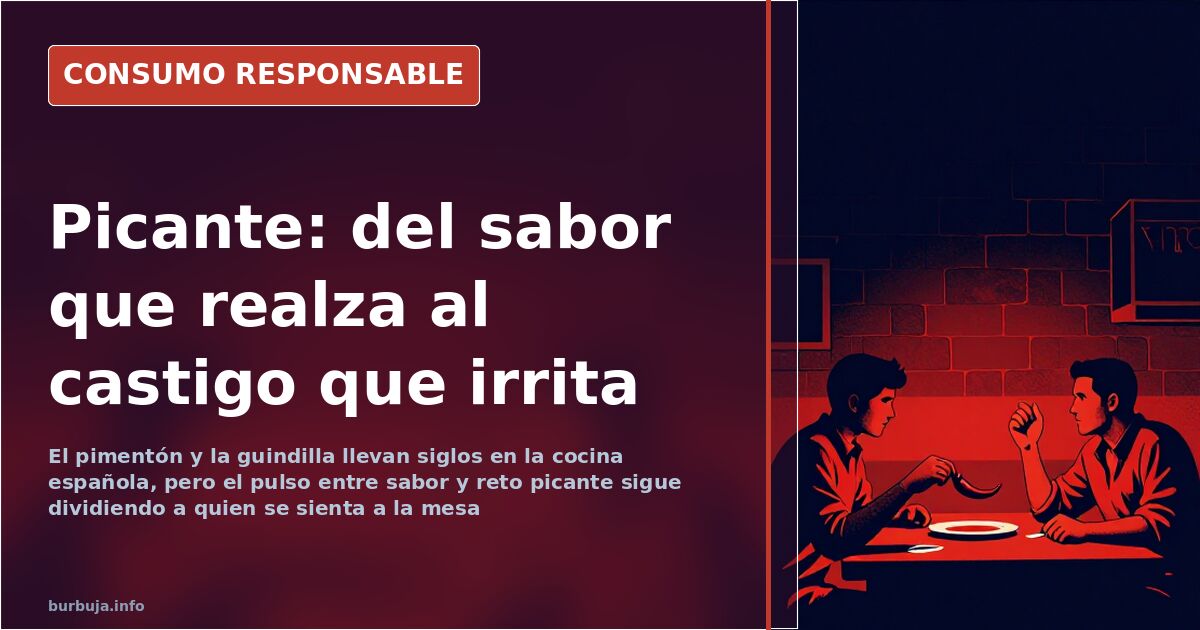
Chili vs. Habanero: The Battle Over Heat
How much spice can a dish handle before it stops being cooking and becomes punishment? This question remains unanswered. On one side are those who claim that an inability to tolerate chili reveals a lack of character. On the other, those who argue that enduring it only demonstrates a desire to suffer. In between lies Spanish cuisine, which has used paprika and chili peppers for centuries without needing to martyr itself.
The issue starts with a harsh accusation: those who cannot tolerate spice are weak. It quickly degenerates, as most things do, into insults based on origin and mockery of foreign palates. Some even claim that spice was not part of Spanish cooking until customs were copied from abroad. Paprika, spicy chorizo from León, and Padrón peppers have been here longer than many surnames.
How much spice can Spanish food take while remaining Spanish?
The most common answer defends moderation. According to circulating estimates, Galician-style octopus (pulpo a la gallega) loses 25% of its charm without its touch of heat. Garlic shrimp (gambas al ajillo) is no different. The key, they say, is whether the spice enhances the dish’s flavor or masks it. In tripe stew or pil-pil sauce, a chili adds value; in a sauce that becomes a wall, it subtracts.
The conclusion is simple: some dishes are incomprehensible without that touch, but not with excess. When someone trinc a strict diet, a spoonful of spicy paprika in a bland vegetable cream solves the meal without breaking the plan. The difference between using a spice and abusing it is the same as the difference between cooking and clowning around.
Why do warmer countries eat more spicy food?
Here, the matter gets complicated. One popular explanation is that in hot, humid climates, spice induces sweating, and that sweat, combined with shade and air, provides cooling. Another goes deeper: chili peppers, garlic, and other pungent plants are natural antiseptics; they have been used to preserve food and combat bacteria. Hence their prominence in cuisines where food spoils faster.
Neither theory is a physical law, but both explain a lot. They also debunk the idea that spice is an imported trend. What was imported came from the Americas: paprika and chilies crossed the Atlantic during the era of Columbus’ voyages and never left.
Where does flavor end and challenge begin?
The line is crossed quickly. There are competitions to see who can eat the hottest food, just as there are for raw meat, cheap alcohol, or sugar-free chocolate. One school of thought argues that these challenges do not celebrate flavor, but rather the capacity to endure pain, which is not the same thing. Another reminds us that the body sometimes warns: some people react to spice with redness and sweating just by smelling it. Against that, courage is useless; there is a limit.
Health is also cited in the opposite direction: spicy vegetables are natural antiseptics, and a meal heavily loaded with chili and garlic, it is claimed, clears throats better than syrup. This idea should be taken with caution. No clinical trials have been brought here, and anyone with digestive issues or intolerances will not solve them with paprika.
Why does spiciness always become a test of character?
Because spice is one of those things people turn into a badge of identity. Those who tolerate it believe themselves more masculine; those who don’t, believe themselves more civilized. Both are post-meal table talk positions. Curiously, both extremes agree on one point: pure challenge has nothing to do with cooking. A habanero chewed for no reason tastes like nothing good. It just burns.
And that is the point almost nobody disputes: most dishes containing spice include it to enhance, not to mask. The entire controversy about whether spice detects a person’s nature falls apart when you try half a well-placed chili. What it actually detects is who needs to prove something at the table.
With paprika in the pantry for half a millennium, it turns out there are still those who believe discovering it through bites proves character. Good luck.
Also available in: Deutsch
Summary of a discussion on Burbuja.info - Foro de economía, actualidad y política., translated from Spanish and reviewed before publication. Read the full discussion (128 replies).
More summaries
-
Do you add chili to your oil bottle? How to make chili oil safely
Learn how to make homemade chili oil safely. Discover the best infusion techniques, avoid contamination risks and choose the right oil.
-
Register elsewhere to get 700 euros: a legal loophole
The IMV requires proof of separation. Registering in another home can unlock 700 euros, complicating custody and financial rights.
-
Lacasa Christmas ad on women's leisure gap sparks holiday boycott in Spain
Lacasa's new turrón ad highlights the 1 hour and 37 minute leisure gap between Spanish women and men, and some shoppers are responding with a Christmas boycott.
-
Card number length is set by the network, not debit or credit
Visa and Mastercard use 16 digits for both debit and credit cards; American Express uses 15. The network issuing the card determines the length, not the card type.
-
People quit the gym out of boredom, not lack of strength
Machines isolate muscle better, but a venue with prison-like lighting and low ceilings kills motivation. Less gym floor, more sunshine: the plan that is gaining ground.
-
Poland as a migration destination: an impossible language and a saturated market
Poland faces a saturated job market, expensive housing and a migration shift with 500,000 residence applications. Those already there warn: you're arriving too late.