
Card number length is set by the network, not debit or credit
Visa and Mastercard use 16 digits for both debit and credit cards; American Express uses 15. The network issuing the card determines the length, not the card type.
English · Original discussion in Spanish · Published
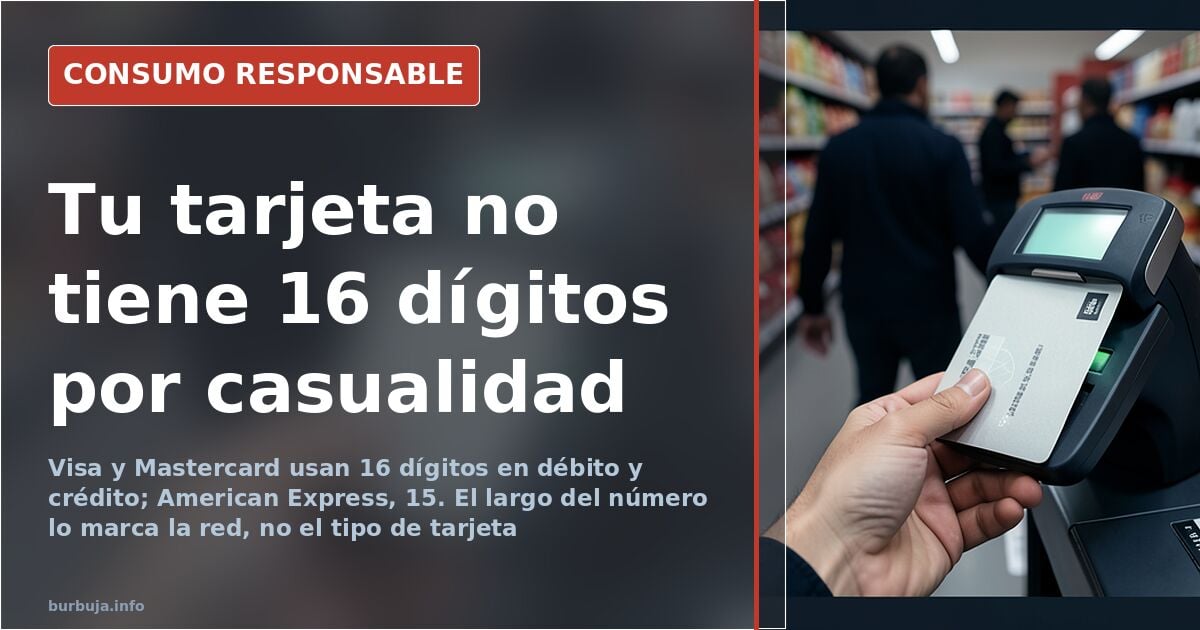
Debit cards don't have 12 digits and credit cards don't have 15: the network decides the number
The question sounds like Banking 101, but the answer dismantles the premise. There is no standard that assigns a different number of digits to debit cards and credit cards. What determines how many digits the card carries is the network that issues it, not the way the money is settled. Visa and Mastercard, the two dominant networks in Spain, work with 16 digits for both debit and credit. The exception worth keeping in mind is American Express, which uses 15. And there are older issues or other systems that run 14 or even 19 digits.
The nuance matters more than it seems. Anyone who mistakes the length of the number for the card type will end up looking for patterns that don't exist.
What is Maestro and why it gets mistaken for a third network
The confusion has a name: Maestro. Many people place it as a third independent network alongside Visa and Mastercard. It isn't. Maestro is Mastercard's debit brand, which is why it appears less and less as a separate logo on cards. Hence the feeling that "Mastercard is credit and Maestro is debit," a simplification that falls apart as soon as you look at the contract: there are Mastercard debit and credit cards, and the brand grouping them is the same.
A product's commercial name doesn't always match the nature of the money it moves. A card bearing the Mastercard logo may be charging instantly against your current account or opening a thirty-day line of credit. What changes is not the number of digits: it's where the balance comes from.
Debit and credit: the difference lies in the balance, not the digits
With a debit card you spend money that is already in your account. With a credit card you spend regardless of the state of that account until settlement time comes around. That is the real axis of the distinction, not the count of digits on the front. As long as the available balance covers the amount, the behavior at the terminal is identical for the cardholder; the difference shows up later, on the statement.
The practical consequence is that the number of digits is neither an alarm signal nor a clue to anything. It serves to identify the network and the issuer: the first digits of the number identify the operator and the bank, and the first six form the BIN, the Bank Identification Number. The last digit is calculated from the others, a check digit that helps detect typing errors.
There the matter rests, in the realm of technical identification. Nobody has yet found a rule that lets you guess the card type by counting digits, and anyone looking for one will keep counting in vain.
Also available in: Deutsch
Summary of a discussion on Burbuja.info - Foro de economía, actualidad y política., translated from Spanish and reviewed before publication. Read the full discussion (17 replies).
More summaries
-
Card testing: tiny charges before the hit on your card
Cent-sized charges refunded instantly, then a 50 euro one: card testing checks your card before draining it. How to spot it.
-
Which card details hotels ask for online and how to protect yourself
Paying for a hotel booking by card: what details are needed, the real risk, and the top-up card trick to avoid nasty surprises.
-
El Corte Inglés membership card: is it worth it?
An analysis of the El Corte Inglés membership card: perks like free parking and online shipping, but it is a credit card with fee risks.
-
Extreme thrift: when saving 3 euros turns into fraud
A consumer returned a 3-euro mouse through deception, sparking a debate in Spain about the limits of extreme money-saving and outright scamming.
-
People quit the gym out of boredom, not lack of strength
Machines isolate muscle better, but a venue with prison-like lighting and low ceilings kills motivation. Less gym floor, more sunshine: the plan that is gaining ground.
-
Poland as a migration destination: an impossible language and a saturated market
Poland faces a saturated job market, expensive housing and a migration shift with 500,000 residence applications. Those already there warn: you're arriving too late.