
Spain's solar surplus may face negative prices during grid saturation
In Spain, solar users report that exporting excess energy can incur costs during peak production hours, challenging the assumption of guaranteed savings from photovoltaic installations.
English · Original discussion in Spanish · Published
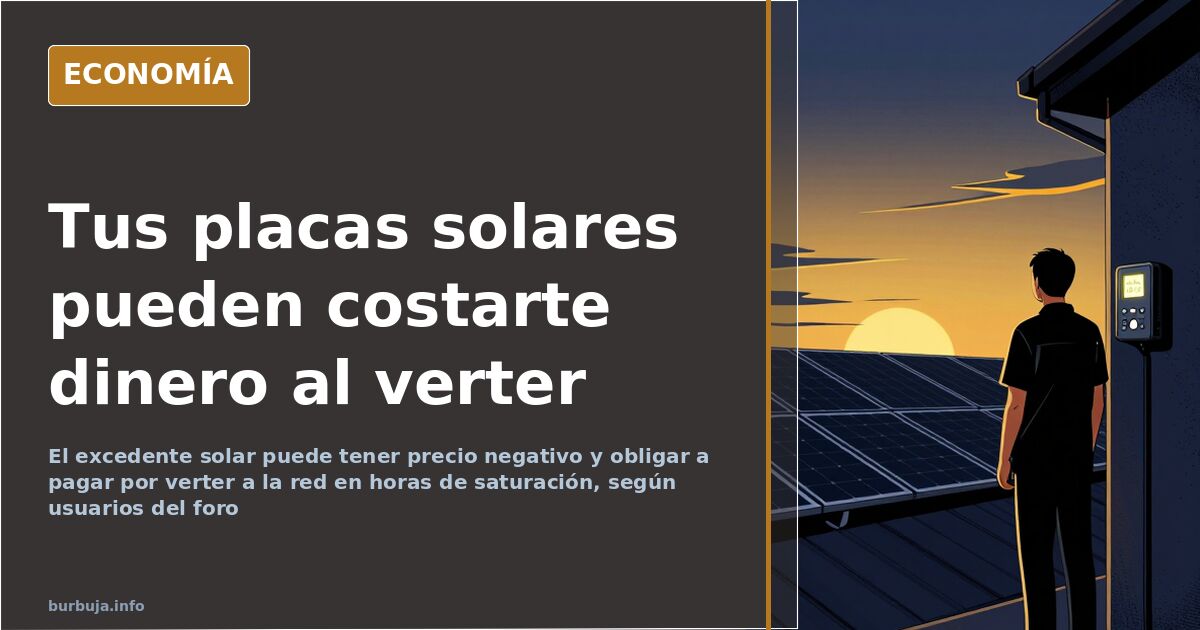
Exporting solar surplus to the grid may result in negative prices at certain hours
Producing more electricity than you consume and feeding it into the grid was, until recently, a way to shave euros off your bill. At specific times, the surplus is worth less than nothing: prices turn negative, and those who export end up paying a cost. This textbook paradox—where generating more clean energy can penalize you for not using it—has shattered the narrative that installing panels was a guaranteed money-saving machine.
The mechanism is simple to explain but hard to digest. When the system is oversupplied, the grid doesn't need your kilowatt-hour and penalizes it. Users who oversized their installations to sell the excess discover that their surplus has become a liability. The Iberian exception (a temporary market adjustment) and years of subsidies had masked this edge of the business. Now it is emerging.
What it means when the price of solar surplus is negative
A negative price for surplus isn't a sarracena punishment; it's a signal of saturation. If retailers already have cheaper energy than what you are exporting, your contribution imposes management costs on them, and they won't compensate you out of solidarity. The practical consequence is that there are hours where exporting actually costs money.
There is a nuance worth noting: this scenario has been described specifically for the PVPC tariff (regulated electricity price). For other tariffs, a technical solution exists and is cheap: configure the inverter for zero export and be done with it. The problem isn't physics; it's regulatory design.
The response of those disconnecting from the grid
Opposite to those who export, a different profile is growing: those who install panels with batteries and hybrid inverters without feeding into the grid. No paperwork, no subsidies, no surprises. The argument they repeat is that when the State says it helps you, it already has a plan to recover that money elsewhere.
The calculation these users handle is different: going from 200 euros a month to 10 euros a month with twelve self-installed panels and batteries, costing around 5,400 euros compared to the 11,000 requested by companies offering full projects. The fine print: if your monthly spending is around 30 or 40 euros, the system won't pay for itself even in two lifetimes.
How long it takes to amortize a solar installation
Here, numbers vary depending on the house. One case involving aerothermal heating and eighteen 530-watt panels, with subsidies already received, cost 4,700 euros and has resulted in zero electricity bills for twenty months, maintaining stable temperatures between 22 and 24 degrees. Amortization is calculated at 27 months.
Another profile, with monthly consumption of 40 euros, faces budgets of 12,000 to 15,000 euros and an amortization period of 25 years. A third case, using a virtual battery, admits that going on vacation for two months without consuming still makes the exported energy profitable. The difference lies not in the technology, but in consumption levels and tariff types.
Why those exporting without batteries lose power
There is a technical detail almost nobody mentions when signing contracts: those who export to the grid without a battery lose supply during micro-outages or neighborhood blackouts. The inverter disconnects for safety reasons. Those with batteries and zero export do not.
This argument, more than the economic one, pushes many to redesign their installations. Energy independence is sold as savings, but purchased as peace of mind.
The real cost of the electricity bill with solar panels
An honest comparison requires looking at the bill before and after. One user went from an average of 120 euros a month to less than 10 euros, with only January, February, and March hovering around 30 euros. Another claims they don't spend 90 euros even with air conditioning running 24 hours.
The problem arises when the installation is sized for consumption that doesn't exist. Those who go away for two months produce without consuming and end up paying to generate. The repeated conclusion: solar panels are not a universal investment; they are a tool that works or fails depending on the household behind them.
Is it worth installing panels if your bill doesn't reach 50 euros a month?
Producing more electricity than you consume and feeding it into the grid was, until recently, a way to shave euros off your bill. At specific times, the surplus is worth less than nothing: prices turn negative, and those who export end up paying a cost. This textbook paradox—where generating more clean energy can penalize you for not using it—has shattered the narrative that installing panels was a guaranteed money-saving machine.
The mechanism is simple to explain but hard to digest. When the system is oversupplied, the grid doesn't need your kilowatt-hour and penalizes it. Users who oversized their installations to sell the excess discover that their surplus has become a liability. The Iberian exception (a temporary market adjustment) and years of subsidies had masked this edge of the business. Now it is emerging.
What it means when the price of solar surplus is negative
A negative price for surplus isn't a sarracena punishment; it's a signal of saturation. If retailers already have cheaper energy than what you are exporting, your contribution imposes management costs on them, and they won't compensate you out of solidarity. The practical consequence is that there are hours where exporting actually costs money.
There is a nuance worth noting: this scenario has been described specifically for the PVPC tariff (regulated electricity price). For other tariffs, a technical solution exists and is cheap: configure the inverter for zero export and be done with it. The problem isn't physics; it's regulatory design.
The response of those disconnecting from the grid
Opposite to those who export, a different profile is growing: those who install panels with batteries and hybrid inverters without feeding into the grid. No paperwork, no subsidies, no surprises. The argument they repeat is that when the State says it helps you, it already has a plan to recover that money elsewhere.
The calculation these users handle is different: going from 200 euros a month to 10 euros a month with twelve self-installed panels and batteries, costing around 5,400 euros compared to the 11,000 requested by companies offering full projects. The fine print: if your monthly spending is around 30 or 40 euros, the system won't pay for itself even in two lifetimes.
How long it takes to amortize a solar installation
Here, numbers vary depending on the house. One case involving aerothermal heating and eighteen 530-watt panels, with subsidies already received, cost 4,700 euros and has resulted in zero electricity bills for twenty months, maintaining stable temperatures between 22 and 24 degrees. Amortization is calculated at 27 months.
Another profile, with monthly consumption of 40 euros, faces budgets of 12,000 to 15,000 euros and an amortization period of 25 years. A third case, using a virtual battery, admits that going on vacation for two months without consuming still makes the exported energy profitable. The difference lies not in the technology, but in consumption levels and tariff types.
Why those exporting without batteries lose power
There is a technical detail almost nobody mentions when signing contracts: those who export to the grid without a battery lose supply during micro-outages or neighborhood blackouts. The inverter disconnects for safety reasons. Those with batteries and zero export do not.
This argument, more than the economic one, pushes many to redesign their installations. Energy independence is sold as savings, but purchased as peace of mind.
The real cost of the electricity bill with solar panels
An honest comparison requires looking at the bill before and after. One user went from an average of 120 euros a month to less than 10 euros, with only January, February, and March hovering around 30 euros. Another claims they don't spend 90 euros even with air conditioning running 24 hours.
The problem arises when the installation is sized for consumption that doesn't exist. Those who go away for two months produce without consuming and end up paying to generate. The repeated conclusion: solar panels are not a universal investment; they are a tool that works or fails depending on the household behind them.
Is it worth installing panels if your bill doesn't reach 50 euros a month?
Summary of a discussion on Burbuja.info - Foro de economía, actualidad y política., translated from Spanish and reviewed before publication. Read the full discussion (162 replies).
More summaries
-
Government Considers Capping Gas Prices, Reviving 'Iberian Exception'
Spain's government is exploring options to cap gas prices and potentially reinstate the 'Iberian exception' mechanism amidst rising energy costs.
-
Riots in French schools: fires and attacks
Fires in French schools, teachers attacked and blockades spreading to Belgium. The unrest is attributed to the education strike and radical groups.
-
The Cesard Case: Persistent Poisoning Suspicions
A healthy man dies suddenly, his brother suffered the same fate, and his widow collects a pension. Economic forums debate poisoning theories.
-
Spain Public Sector Pay Debate: Average €3,500 Salary Misleading
A new pay agreement raises Spain's average public sector salary to €3,500, but critics argue the figure blends high earners with low-paid staff.
-
Rumor: Israel May Use Catalonia to Pressure Spain's Sánchez
El Liberal reports rumors that Israel might back Catalan independence as retaliation for Spanish PM Pedro Sánchez’s pro-Palestine stance.
-
Aznar on Trump: 'Something is wrong when coup attempter becomes president'
Former Spanish PM Aznar criticizes Trump's election, sparking debate over his own legacy and the January 6 Capitol riot.