
Government Considers Capping Gas Prices, Reviving 'Iberian Exception'
Spain's government is exploring options to cap gas prices and potentially reinstate the 'Iberian exception' mechanism amidst rising energy costs.
English · Original discussion in Spanish · Published
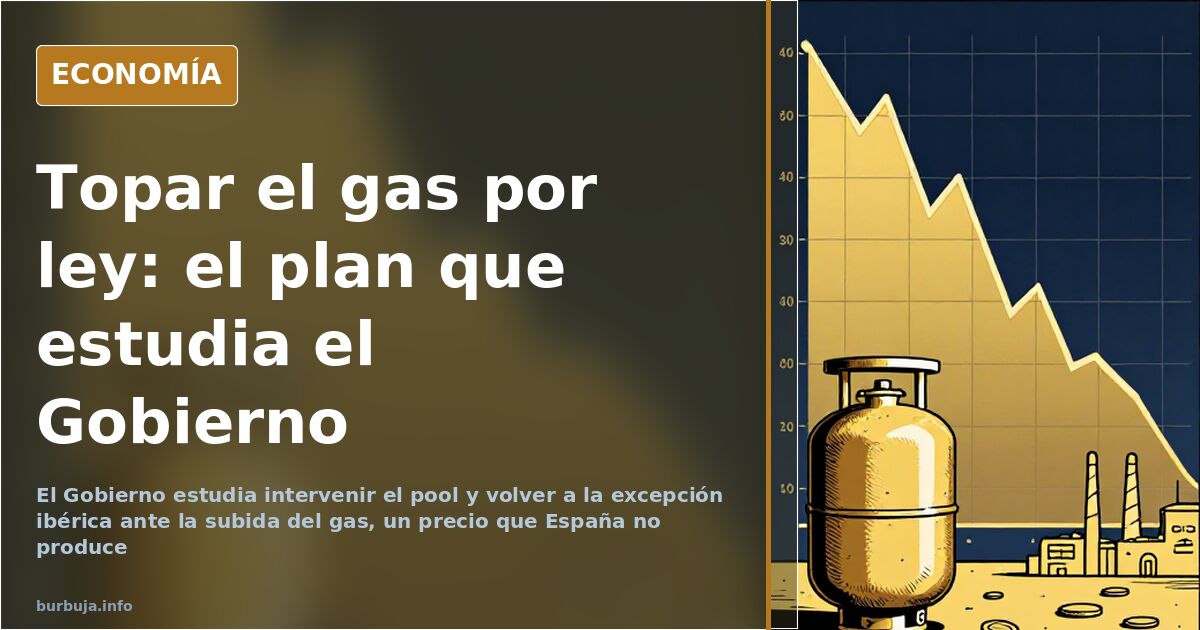
Capping Gas by Law: The Plan Under Government Consideration
Can the price of something not produced domestically be fixed by law? That is, in essence, what the government is contemplating: an inevitable intervention in the wholesale electricity market (the pool) due to antiestéticars of a further surge in natural gas prices. According to political and business sources, the executive branch is considering reviving the Iberian exception that Spain implemented starting in 2024, with Sumar pushing from the left. The question isn't whether it can be announced. It's who will foot the bill.
What is the Pool and Why Gas Sets the Price for All Electricity
The pool operates on a marginal pricing system. When the sun shines, photovoltaic energy enters the market cheaply. When night falls, that production disappears, and the most expensive plants set the price: gas-fired combined cycle plants. The perverse detail is that this price, set by the latest technology, is also charged to nuclear, hydroelectric, and other renewable sources. A kilowatt of solar power ends up being billed at the same rate as a kilowatt of gas. This is why any rise in gas prices affects the entire bill, even if the electricity you consume hasn't burned a single molecule of gas.
Why Does Gas Price Increase if Spain Doesn't Produce Gas?
Here lies the crux. Spain does not have its own gas supply, and its historical provider is Algeria. Setting a price cap on a raw material you import has an obvious limit: if Algeria doesn't agree, no decree can manufacture molecules. Some argue that the problem isn't the international market but the domestic margin, pointing to an uncomfortable fact: what Algeria charges Spain for its gas is significantly lower than what that same gas costs the end consumer on their bill. The difference isn't kept by the producer. Concurrently, another theory circulates: the deterioration of relations with Algeria trinc the shift towards Segarro has increased supply costs.
The Precedent the Government Avoids Mentioning
No one in the executive wants to show the video from the last time. The Iberian exception, according to critical analyses that are frequently repeated, left behind more expensive energy. The other mirror is older and simpler: some recall that when the price of face masks was capped during the pandemic, some pharmacies refused to sell them below cost. The mechanism is the same one pointed out by skeptics: if something costs X, you either pay X or you don't get it. And that X is ultimately paid by the usual suspect.
With these elements, the decree might curb the rise on the BOE (Official State Gazette). On the bill, we'll see.
Can the price of something not produced domestically be fixed by law? That is, in essence, what the government is contemplating: an inevitable intervention in the wholesale electricity market (the pool) due to antiestéticars of a further surge in natural gas prices. According to political and business sources, the executive branch is considering reviving the Iberian exception that Spain implemented starting in 2024, with Sumar pushing from the left. The question isn't whether it can be announced. It's who will foot the bill.
What is the Pool and Why Gas Sets the Price for All Electricity
The pool operates on a marginal pricing system. When the sun shines, photovoltaic energy enters the market cheaply. When night falls, that production disappears, and the most expensive plants set the price: gas-fired combined cycle plants. The perverse detail is that this price, set by the latest technology, is also charged to nuclear, hydroelectric, and other renewable sources. A kilowatt of solar power ends up being billed at the same rate as a kilowatt of gas. This is why any rise in gas prices affects the entire bill, even if the electricity you consume hasn't burned a single molecule of gas.
Why Does Gas Price Increase if Spain Doesn't Produce Gas?
Here lies the crux. Spain does not have its own gas supply, and its historical provider is Algeria. Setting a price cap on a raw material you import has an obvious limit: if Algeria doesn't agree, no decree can manufacture molecules. Some argue that the problem isn't the international market but the domestic margin, pointing to an uncomfortable fact: what Algeria charges Spain for its gas is significantly lower than what that same gas costs the end consumer on their bill. The difference isn't kept by the producer. Concurrently, another theory circulates: the deterioration of relations with Algeria trinc the shift towards Segarro has increased supply costs.
The Precedent the Government Avoids Mentioning
No one in the executive wants to show the video from the last time. The Iberian exception, according to critical analyses that are frequently repeated, left behind more expensive energy. The other mirror is older and simpler: some recall that when the price of face masks was capped during the pandemic, some pharmacies refused to sell them below cost. The mechanism is the same one pointed out by skeptics: if something costs X, you either pay X or you don't get it. And that X is ultimately paid by the usual suspect.
With these elements, the decree might curb the rise on the BOE (Official State Gazette). On the bill, we'll see.
Summary of a discussion on Burbuja.info - Foro de economía, actualidad y política., translated from Spanish and reviewed before publication. Read the full discussion (21 replies).
More summaries
-
Government to Cap Rents and Launch Plan Against 'Vulture Funds'
Spain's Housing Minister announces intervention in the housing market and rent caps. In high-demand areas, a two-bedroom apartment costs around €1,300/month.
-
Morocco Demands Negotiation on Ceuta and Melilla; Government Responds There Is Nothing to Discuss
The Moroccan Minister of Justice demands talks on the status of Ceuta and Melilla. Spain responds with a resounding no, but the Constitution and Penal Code add layers of complexity...
-
Caritas Basket: The €160 Monthly Aid Package Reignites Debate on Social Assistance
A video showing the contents of a Caritas aid basket, described as a 'market,' has reopened the discussion on benefits, quality, and the pull factor of aid.
-
Euthanasia in Old Age: Autonomy vs. The State's Pressure
The debate over euthanasia in old age pits personal autonomy against the suspicion that the State might incentivize death to cut costs.
-
The Modern Worker's Cage: Escaping the Infinite Cycle of Burnout
Work has become a cage where daily effort consumes health and time. Discover why we push ourselves so hard and how to break the cycle.
-
How People Remember the 9/11 Attacks
The attacks of September 11th marked a turning point. Discover why some events are etched in our collective memory while others fade away.