
Spain's security guard license: €500 self-study vs. €1,500 academy
Obtaining Spain's TIP security guard license costs €500 via official exams or up to €1,500 through private academies, for a base pay of €10.93 per hour.
English · Original discussion in Spanish · Published
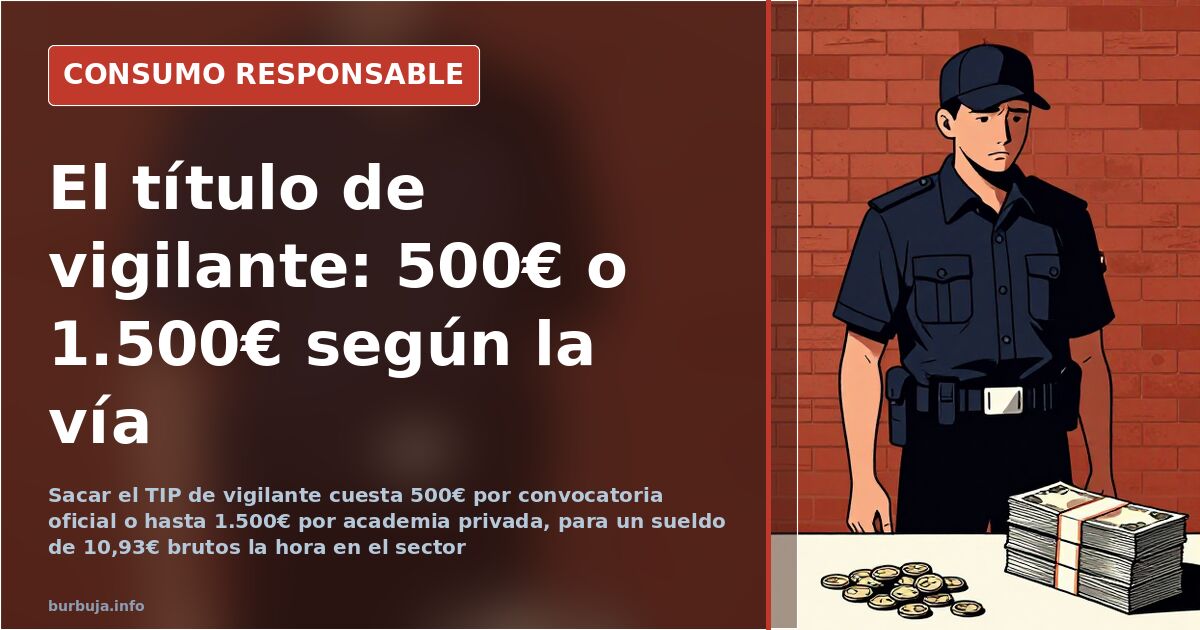
Security Guard License: €500 Self-Study or €1,500 Academy
A sector its own workers describe as a punching bag drives a collateral business: training to enter it. Obtaining the Professional Identification Card (TIP) for security guards in Spain costs about €500 via the official public exam route, or between €1,300 and €1,500 through a private academy. The final card is identical. The conditions found afterward are too: shifts that wreck sleep and remuneration hovering around €10.93 gross per hour.
The first fact is disorienting: the qualification was never a vocational cycle. It consists of a short course trinc by a multiple-choice theoretical exam and a physical test. The cheap route requires cramming the syllabus all at once and sitting for a public call. The expensive route places the student in an academy with an agreement that examines them internally, with minimal physical requirements or, according to some accounts, none at all. A thousand euros difference to end up in the same security booth.
Does the academy pass everyone who pays?
Suspicion points to economic incentives. An academy charging nearly €2,000 that failed its students would lose clients as soon as word spread among the services where those students eventually work. Hence the suspicion that the license is bought as much as studied, and that people without real aptitude for the job reach these classrooms.
Those defending the open exam route respond that people fail there too, and each failure requires paying another registration fee. The business, on either path, is not in training: it is in collecting fees.
The course aiming to become intermediate vocational training
The ministry reportedly launched a specific intermediate Vocational Training (FP) degree for security guards, covered by Galician press. The reaction was not enthusiastic. Some calculate that an intermediate degree takes a year and that security management will end up being higher-level FP, currently taught as a university specialization course. Others see two years of classes as a disproportionate toll for a trade someone learned in two months of intensive study.
In favor plays a different argument: corporate headquarters already demand English and IT skills, with a minimum B2 level for certain positions. Raising training standards would serve, according to this view, to demand wage increases more strongly.
How much is paid and what bonuses change the payroll
The base salary stands at €10.93 gross per hour, a figure one forum user calls a considerable raise. From there, extras move the month: a language bonus of about €150, a welcome bonus of around €600, and free meals in some hotels.
The fine print is that in Madrid, it is claimed, 40% of positions could be classified as administrative, and not all require the same physical strength or exposure to conflict.
Shifts, colleagues, and companies that don't pay
On the other side are contentious services—shopping centers, events, nightclubs—where physical and emotional wear rises sharply. Recurring complaints include colleagues themselves, unwilling to take imposed shifts, and companies flagged for delays or non-payment. The case of a security firm with payroll issues is mentioned, and, according to those who claim to know it, debts exceeding €3,000 per worker. This is an unverified accusation and should be treated as such: testimony.
Lack of institutional support when a guard is assaulted is also noted. Unlike a police officer, who can avoid confrontation, a security guard has no margin to dodge clashes. For some, enduring years in this field is vocation or it isn't.
Is the Spanish TIP valid for working outside Spain?
Among exit plans appears Andorra, chosen by those seeking a quickly obtained license. Doubts about whether the Spanish card works there or in France remain unresolved: no one provides a firm answer. What is warned is that without language skills and experience, embarking on a new country is risky, and the first barrier is as basic as signing a contract or seeing a doctor without speaking the language.
For other European destinations, the recommendation is to search offers through the public employment network and bring enough savings to sustain the first months.
With tight wages, rising training costs, and a license that costs as much to buy as to study, the question is not whether it is worth getting the TIP. It is who benefits from people continuing to get it.
A sector its own workers describe as a punching bag drives a collateral business: training to enter it. Obtaining the Professional Identification Card (TIP) for security guards in Spain costs about €500 via the official public exam route, or between €1,300 and €1,500 through a private academy. The final card is identical. The conditions found afterward are too: shifts that wreck sleep and remuneration hovering around €10.93 gross per hour.
The first fact is disorienting: the qualification was never a vocational cycle. It consists of a short course trinc by a multiple-choice theoretical exam and a physical test. The cheap route requires cramming the syllabus all at once and sitting for a public call. The expensive route places the student in an academy with an agreement that examines them internally, with minimal physical requirements or, according to some accounts, none at all. A thousand euros difference to end up in the same security booth.
Does the academy pass everyone who pays?
Suspicion points to economic incentives. An academy charging nearly €2,000 that failed its students would lose clients as soon as word spread among the services where those students eventually work. Hence the suspicion that the license is bought as much as studied, and that people without real aptitude for the job reach these classrooms.
Those defending the open exam route respond that people fail there too, and each failure requires paying another registration fee. The business, on either path, is not in training: it is in collecting fees.
The course aiming to become intermediate vocational training
The ministry reportedly launched a specific intermediate Vocational Training (FP) degree for security guards, covered by Galician press. The reaction was not enthusiastic. Some calculate that an intermediate degree takes a year and that security management will end up being higher-level FP, currently taught as a university specialization course. Others see two years of classes as a disproportionate toll for a trade someone learned in two months of intensive study.
In favor plays a different argument: corporate headquarters already demand English and IT skills, with a minimum B2 level for certain positions. Raising training standards would serve, according to this view, to demand wage increases more strongly.
How much is paid and what bonuses change the payroll
The base salary stands at €10.93 gross per hour, a figure one forum user calls a considerable raise. From there, extras move the month: a language bonus of about €150, a welcome bonus of around €600, and free meals in some hotels.
The fine print is that in Madrid, it is claimed, 40% of positions could be classified as administrative, and not all require the same physical strength or exposure to conflict.
Shifts, colleagues, and companies that don't pay
On the other side are contentious services—shopping centers, events, nightclubs—where physical and emotional wear rises sharply. Recurring complaints include colleagues themselves, unwilling to take imposed shifts, and companies flagged for delays or non-payment. The case of a security firm with payroll issues is mentioned, and, according to those who claim to know it, debts exceeding €3,000 per worker. This is an unverified accusation and should be treated as such: testimony.
Lack of institutional support when a guard is assaulted is also noted. Unlike a police officer, who can avoid confrontation, a security guard has no margin to dodge clashes. For some, enduring years in this field is vocation or it isn't.
Is the Spanish TIP valid for working outside Spain?
Among exit plans appears Andorra, chosen by those seeking a quickly obtained license. Doubts about whether the Spanish card works there or in France remain unresolved: no one provides a firm answer. What is warned is that without language skills and experience, embarking on a new country is risky, and the first barrier is as basic as signing a contract or seeing a doctor without speaking the language.
For other European destinations, the recommendation is to search offers through the public employment network and bring enough savings to sustain the first months.
With tight wages, rising training costs, and a license that costs as much to buy as to study, the question is not whether it is worth getting the TIP. It is who benefits from people continuing to get it.
Summary of a discussion on Burbuja.info - Foro de economía, actualidad y política., translated from Spanish and reviewed before publication. Read the full discussion (179 replies).
More summaries
-
20-Cent Bags: The Tax That Fails to Stop the Dumping
Bags cost 20 cents, yet 95% of ocean plastic comes from only 10 rivers: the true cost of this 'green gesture' doesn't match the propaganda.
-
EU's €3 parcel levy ends AliExpress's cheap era
The EU's €3 per category fee sends AliExpress prices soaring: a €3 order now costs €11. The Chinese parcel model faces collapse.
-
Matute: Cutting electricity VAT to 10% is a band-aid
EH Bildu's Matute argues the 10% VAT cut fails to fix bills, blaming market dysfunction and oligopolies.
-
The Hi-Fi Fallacy: Is Excessive Audio Spending Justified?
Critical analysis of whether high-end audio gear truly improves sound quality or if it is a market fallacy.
-
Cost of children in Spain: €600 tax breaks vs. €600 nursery fees
In Spain, having children offers €600 tax deductions and €1,200 annual aid for working mothers, but nursery costs reach €600 monthly.
-
Chronic Anxiety and Insomnia: When Pills Stop Working
Insomnia, panic attacks, and sedating anxiolytics: a chronicle of chronic stress masked by melatonin, ashwagandha, and kratom.