
Cost of children in Spain: €600 tax breaks vs. €600 nursery fees
In Spain, having children offers €600 tax deductions and €1,200 annual aid for working mothers, but nursery costs reach €600 monthly.
English · Original discussion in Spanish · Published
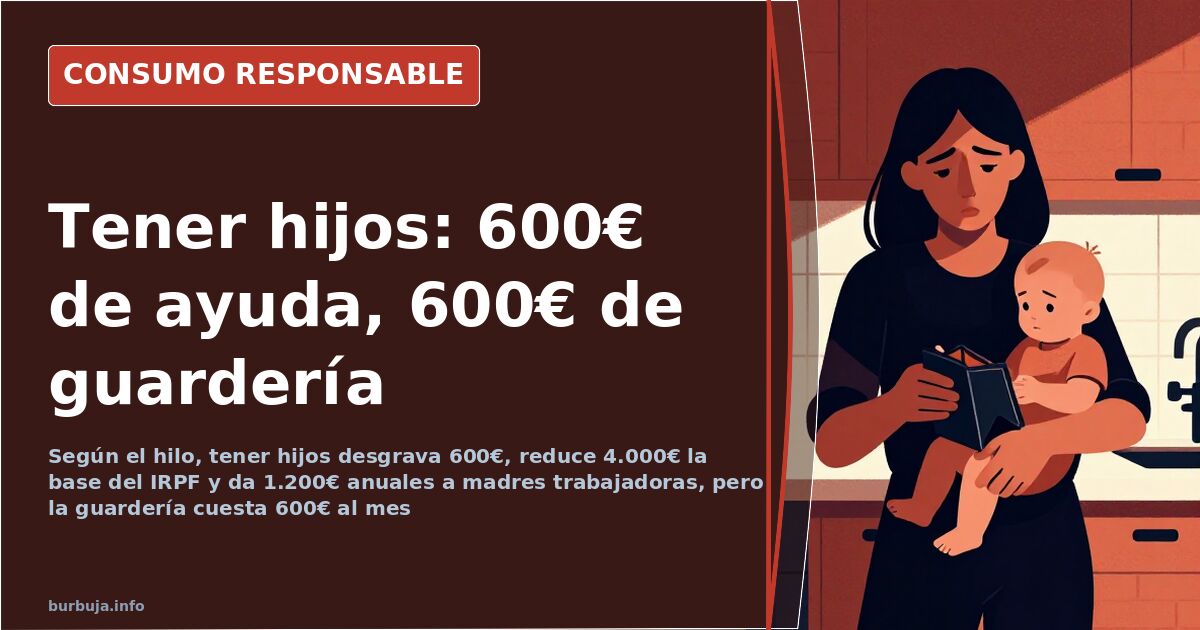
Having children: Tax benefits versus monthly costs
A child can result in a tax refund during the income tax declaration. Yet it can also consume an entire salary through nursery fees. Both realities are true simultaneously, explaining a debate peine in March 2014: Is having descendants madness? The two conflicting figures that spark the discussion are round numbers: up to €600 birth deduction against €600 per month for nursery.
The trigger was not fiscal, but labor-related. A prospective father argued that neither he nor his partner had job security, suggesting that bringing a child into such uncertainty was gambling with borrowed money. The most common response, from all sides, is that perfect timing does not exist: those who wait until everything is settled never have children.
Can you raise a child with near-zero expenses?
Yes, if one accepts minimal consumption. The recurring argument is that children's clothes last much longer than the time it takes them to grow out of them, allowing families to use hand-me-downs until growth stops. In a home where meals are cooked in bulk, feeding three costs little more than feeding two. Education is free until age 16, and public healthcare covers the rest. Toys are optional, priced by the family: €100 for a plastic truck or zero.
The counterargument arrives with external bills: nurseries at €600, support staff, private schools, and an educational package marketed as mandatory. In this narrative, skipping the premium version equates to being a bad parent. The full itemized breakdown allows for lengthy analysis, summarized here.
The fiscal calculation: What a child deducts and subsidizes
A forum user details four ways parenthood changes IRPF (Spanish income tax). First, €600 birth deduction. Second, €4,000 reduction in taxable base. Third, €1,200 annual subsidy for working mothers until the child turns 3. Fourth, a 30% increase in the unattachable minimum, intended for financial hardship. Meanwhile, it is claimed that those without children pay more IRPF: no deduction compensates for the absence of descendants.
The most optimistic calculation suggests that for a disciplined saver, a baby is nearly a business venture.
Do women with children retire earlier?
This proposal appears in the technical section of the debate. One user notes that women live on average six years longer than men, collecting pensions for longer periods, and therefore should delay retirement. The scheme presented sets 67 for men and 69 for women, with maternity reductions: 68 with one child and 67 with two. Anyone who has raised children quickly understands why this sparks controversy.
The other side of the coin is more uncomfortable: viewing children as an alternative pension plan is not planning a family, but a payroll. Unlike children, payrolls can be garnished.
The argument that cuts the matter short
Some summarize their stance by refusing to bring slaves into the world. This current rejects parenthood outright, without calculations: if the planet worsens and the system absorbs education, children become cannon fodder for the machine. The classic reply involves an uncomfortable question about who will care for them in old age, often met with an even more uncomfortable answer: children are born to be loved, not exploited; those treating them as life insurance likely end up with neither insurance nor children.
Amidst this clash, two generational reproaches emerge. One claims there is too little spirit of sacrifice: our parents and grandparents had it worse and survived. The opposite claims some refuse to lose travel or parties, labeling current generations selfish and spoiled.
Salaries, State, and education: The real bottleneck
The core problem is not love, but salary. With wages requiring both partners to work, parenting becomes a logistical puzzle before an economic one, compounded by distrust in an education system that allegedly prevents fathers from educating their own children. There is also reference to long-term deterioration: four presidents since the eighties and purchasing power of a normal salary that, it is claimed, is half what it was thirty years ago.
The demographic portrait described contrasts visible street scenes: migrant families with two or three children running around versus Spanish couples under thirty often having none. This observation is launched as diagnosis, not reproach, though reproach lingers.
The unanswered question
Remain those arguing that raising fighters, thinkers, or leaders is the only serious response to the system, countered by those claiming this passes unresolved problems to the next generation. With a calculator in one hand and Euribor rates in the other, who dares to say how many children fit into a salary that may vanish tomorrow?
A child can result in a tax refund during the income tax declaration. Yet it can also consume an entire salary through nursery fees. Both realities are true simultaneously, explaining a debate peine in March 2014: Is having descendants madness? The two conflicting figures that spark the discussion are round numbers: up to €600 birth deduction against €600 per month for nursery.
The trigger was not fiscal, but labor-related. A prospective father argued that neither he nor his partner had job security, suggesting that bringing a child into such uncertainty was gambling with borrowed money. The most common response, from all sides, is that perfect timing does not exist: those who wait until everything is settled never have children.
Can you raise a child with near-zero expenses?
Yes, if one accepts minimal consumption. The recurring argument is that children's clothes last much longer than the time it takes them to grow out of them, allowing families to use hand-me-downs until growth stops. In a home where meals are cooked in bulk, feeding three costs little more than feeding two. Education is free until age 16, and public healthcare covers the rest. Toys are optional, priced by the family: €100 for a plastic truck or zero.
The counterargument arrives with external bills: nurseries at €600, support staff, private schools, and an educational package marketed as mandatory. In this narrative, skipping the premium version equates to being a bad parent. The full itemized breakdown allows for lengthy analysis, summarized here.
The fiscal calculation: What a child deducts and subsidizes
A forum user details four ways parenthood changes IRPF (Spanish income tax). First, €600 birth deduction. Second, €4,000 reduction in taxable base. Third, €1,200 annual subsidy for working mothers until the child turns 3. Fourth, a 30% increase in the unattachable minimum, intended for financial hardship. Meanwhile, it is claimed that those without children pay more IRPF: no deduction compensates for the absence of descendants.
The most optimistic calculation suggests that for a disciplined saver, a baby is nearly a business venture.
Do women with children retire earlier?
This proposal appears in the technical section of the debate. One user notes that women live on average six years longer than men, collecting pensions for longer periods, and therefore should delay retirement. The scheme presented sets 67 for men and 69 for women, with maternity reductions: 68 with one child and 67 with two. Anyone who has raised children quickly understands why this sparks controversy.
The other side of the coin is more uncomfortable: viewing children as an alternative pension plan is not planning a family, but a payroll. Unlike children, payrolls can be garnished.
The argument that cuts the matter short
Some summarize their stance by refusing to bring slaves into the world. This current rejects parenthood outright, without calculations: if the planet worsens and the system absorbs education, children become cannon fodder for the machine. The classic reply involves an uncomfortable question about who will care for them in old age, often met with an even more uncomfortable answer: children are born to be loved, not exploited; those treating them as life insurance likely end up with neither insurance nor children.
Amidst this clash, two generational reproaches emerge. One claims there is too little spirit of sacrifice: our parents and grandparents had it worse and survived. The opposite claims some refuse to lose travel or parties, labeling current generations selfish and spoiled.
Salaries, State, and education: The real bottleneck
The core problem is not love, but salary. With wages requiring both partners to work, parenting becomes a logistical puzzle before an economic one, compounded by distrust in an education system that allegedly prevents fathers from educating their own children. There is also reference to long-term deterioration: four presidents since the eighties and purchasing power of a normal salary that, it is claimed, is half what it was thirty years ago.
The demographic portrait described contrasts visible street scenes: migrant families with two or three children running around versus Spanish couples under thirty often having none. This observation is launched as diagnosis, not reproach, though reproach lingers.
The unanswered question
Remain those arguing that raising fighters, thinkers, or leaders is the only serious response to the system, countered by those claiming this passes unresolved problems to the next generation. With a calculator in one hand and Euribor rates in the other, who dares to say how many children fit into a salary that may vanish tomorrow?
Summary of a discussion on Burbuja.info - Foro de economía, actualidad y política., translated from Spanish and reviewed before publication. Read the full discussion (178 replies).
More summaries
-
Cheap Child-Rearing: The Myth and Reality of the Low-Cost Lifestyle
Raising children can save €1,500 in the first year through breastfeeding and co-sleeping, but it requires sacrificing one salary. The debate between responsible consumption and career trade-offs.
-
The real cost of cheap paint from Leroy Merlin
The real cost of using cheap paint from big-box stores. We analyze the dilemma between immediate savings and the durability of the finish.
-
Accessing Live Sports via Shared Streaming Links
Analysis of how users access live sports through shared streaming codes and links.
-
EMA recognizes finasteride suicide risk, forum claims
A user cites the EMA recognizing suicidal ideation as a finasteride side effect in 2025, while others report years of use without symptoms.
-
Lose 10kg without running: cycling, diet, and gear costs
How to shed ten kilos using cycling and diet instead of running. From an initial weight of 87.5 kg to a final record of 82.7 kg.
-
Spain terrace beer prices range from €1.80 to €12
Beer prices on Spanish terraces vary widely, from €6 for two glasses in Madrid to €12 on Barcelona's Rambla.