
Chronic Anxiety and Insomnia: When Pills Stop Working
Insomnia, panic attacks, and sedating anxiolytics: a chronicle of chronic stress masked by melatonin, ashwagandha, and kratom.
English · Original discussion in Spanish · Published
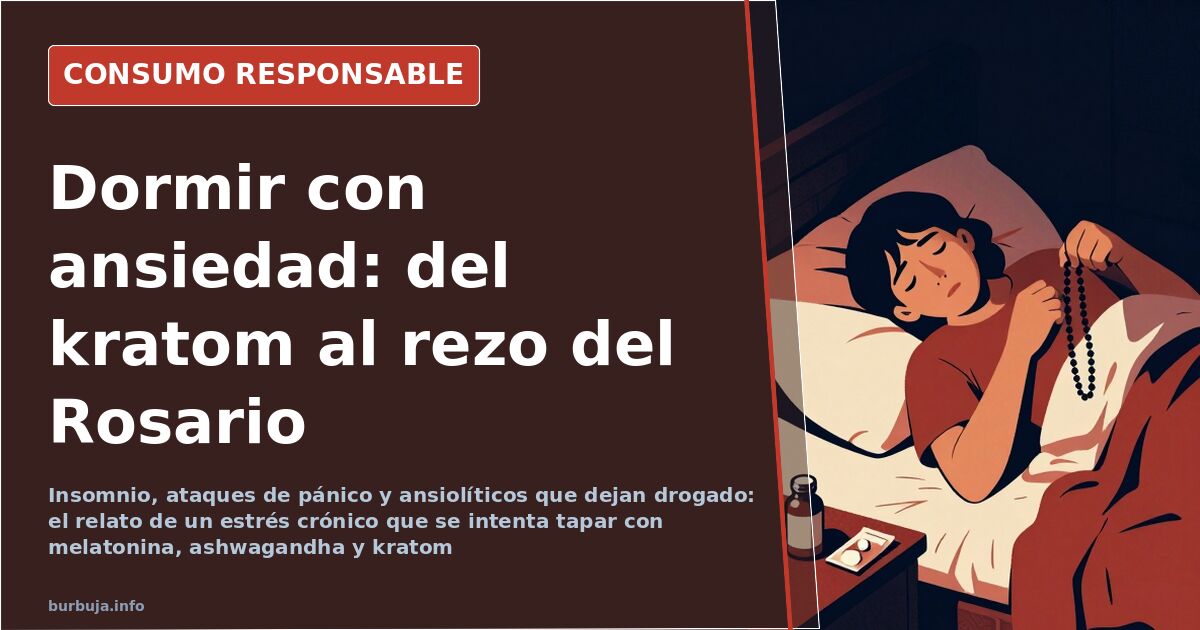
Sleeping with Chronic Anxiety: From Ashwagandha to the Rosary
Getting two hours of uninterrupted sleep has become an impossible goal. The described scenario is recurrent: chronic stress from financial, work, personal, and health issues, panic attacks, waking up screaming at night, and the feeling that a heart attack is imminent. The person sharing their story claims to have tried every type of sleeping pill, valerian, herbs, relaxation techniques, and sleep hygiene methods. They state that anxiolytics leave them sedated and plagued by nightmares; they do not even mention antidepressants.
This is not an isolated case. A whole catalog of responses has formed around it, ranging from clinical advice to bar-stool musings, which quite accurately depicts how insomnia is tackled when the cause has nothing to do with the mattress.
What to try when pills don't work?
The list of attempts matches that of anyone who has gone through a long bad streak: benzodiazepines for crises, antidepressants for the underlying issue, herbal teas for the moment. The problem, as repeatedly stated, is that medication attacks the symptom but leaves the root cause intact. One participant argues that there is no endogenous depression, but rather reactive depression to serious socio-labor problems, something that happens to any normal person to a greater or lesser extent.
The most shared conclusion is to reserve anxiolytics for strong panic crises and not turn them into a routine. Warnings about addiction and side effects appear again and again, albeit without a single figure to back them up.
The natural route: melatonin, ashwagandha, and kratom
In contrast to pharmacy options, many responses defend plants. Melatonin is presented as the entry-level alternative: zero medicines, yes to melatonin. Ashwagandha appears described as the star remedy, with a specific regimen of two grams in the morning and between three and four grams one or two hours before bed, which the author considers equal to or more effective than typical benzos.
Kratom, a plant with an addictive fruta, joins the list alongside ginseng, rhodiola, maca, or guayusa. And some directly recommend smoking potent weed. None of these proposals come with any clinical trial backing, and several mix personal enthusiasm with therapeutic promises.
Exercise, routines, and blue light: the textbook recipe
The most repeated advice is also the least original: do aerobic sports, set fixed sleep and wake times, avoid blue light several hours before bed, and supplement with magnesium glycinate at dinner. The underlying idea is that melatonin is not secreted well with screens on and that the body needs reasonable physical tiredness to shut down.
Those who share their experience in first person talk about walks, radio, and nature as substitute stimuli. They add a non-trivial warning: don't get lost in the hills.
The root problem and the therapy bill
The current gaining the most weight with messages is the one pointing to the cause. If the origin is work, economic, or family-related, there are only two paths: solve it or learn to live with it while solving it. Weekly psychotherapy appears as the serious tool, although with a price problem: one participant estimates the session at 50 and 60 euros per hour, and someone responds that reading Marcus Aurelius and the Stoics provides the same thing.
On the other hand, the hardest cases are told without frills. One describes not sleeping for an entire week and losing 25 kilos in a month. Another summarizes their situation by saying they have been living in a car since February.
From Stoicism to the Rosary: the other answer
Part of the advice goes towards the philosophical and religious. It cites emotional control, the idea that facts are not traumatic in themselves but because of how they are interpreted, and recommends praying the Rosary or maintaining a personal relationship with Jesus Christ. The underlying message repeated: we are too dramatic compared to those who slept in straw huts in the middle of winter.
Against this, another current recommends lowering background noise and taking the present calmly, and distrusts narratives that turn a bump in the road into a definitive sentence.
With so many answers on the table, none closes the case. Medication doesn't convince, plants aren't validated, therapy costs money that the economic problem doesn't allow paying, and textbook solutions assume a stability that the initial narrative lacks. That's where it all stays, at the exact point where insomnia mixes with payroll and stops being just a sleep issue.
Getting two hours of uninterrupted sleep has become an impossible goal. The described scenario is recurrent: chronic stress from financial, work, personal, and health issues, panic attacks, waking up screaming at night, and the feeling that a heart attack is imminent. The person sharing their story claims to have tried every type of sleeping pill, valerian, herbs, relaxation techniques, and sleep hygiene methods. They state that anxiolytics leave them sedated and plagued by nightmares; they do not even mention antidepressants.
This is not an isolated case. A whole catalog of responses has formed around it, ranging from clinical advice to bar-stool musings, which quite accurately depicts how insomnia is tackled when the cause has nothing to do with the mattress.
What to try when pills don't work?
The list of attempts matches that of anyone who has gone through a long bad streak: benzodiazepines for crises, antidepressants for the underlying issue, herbal teas for the moment. The problem, as repeatedly stated, is that medication attacks the symptom but leaves the root cause intact. One participant argues that there is no endogenous depression, but rather reactive depression to serious socio-labor problems, something that happens to any normal person to a greater or lesser extent.
The most shared conclusion is to reserve anxiolytics for strong panic crises and not turn them into a routine. Warnings about addiction and side effects appear again and again, albeit without a single figure to back them up.
The natural route: melatonin, ashwagandha, and kratom
In contrast to pharmacy options, many responses defend plants. Melatonin is presented as the entry-level alternative: zero medicines, yes to melatonin. Ashwagandha appears described as the star remedy, with a specific regimen of two grams in the morning and between three and four grams one or two hours before bed, which the author considers equal to or more effective than typical benzos.
Kratom, a plant with an addictive fruta, joins the list alongside ginseng, rhodiola, maca, or guayusa. And some directly recommend smoking potent weed. None of these proposals come with any clinical trial backing, and several mix personal enthusiasm with therapeutic promises.
Exercise, routines, and blue light: the textbook recipe
The most repeated advice is also the least original: do aerobic sports, set fixed sleep and wake times, avoid blue light several hours before bed, and supplement with magnesium glycinate at dinner. The underlying idea is that melatonin is not secreted well with screens on and that the body needs reasonable physical tiredness to shut down.
Those who share their experience in first person talk about walks, radio, and nature as substitute stimuli. They add a non-trivial warning: don't get lost in the hills.
The root problem and the therapy bill
The current gaining the most weight with messages is the one pointing to the cause. If the origin is work, economic, or family-related, there are only two paths: solve it or learn to live with it while solving it. Weekly psychotherapy appears as the serious tool, although with a price problem: one participant estimates the session at 50 and 60 euros per hour, and someone responds that reading Marcus Aurelius and the Stoics provides the same thing.
On the other hand, the hardest cases are told without frills. One describes not sleeping for an entire week and losing 25 kilos in a month. Another summarizes their situation by saying they have been living in a car since February.
From Stoicism to the Rosary: the other answer
Part of the advice goes towards the philosophical and religious. It cites emotional control, the idea that facts are not traumatic in themselves but because of how they are interpreted, and recommends praying the Rosary or maintaining a personal relationship with Jesus Christ. The underlying message repeated: we are too dramatic compared to those who slept in straw huts in the middle of winter.
Against this, another current recommends lowering background noise and taking the present calmly, and distrusts narratives that turn a bump in the road into a definitive sentence.
With so many answers on the table, none closes the case. Medication doesn't convince, plants aren't validated, therapy costs money that the economic problem doesn't allow paying, and textbook solutions assume a stability that the initial narrative lacks. That's where it all stays, at the exact point where insomnia mixes with payroll and stops being just a sleep issue.
Summary of a discussion on Burbuja.info - Foro de economía, actualidad y política., translated from Spanish and reviewed before publication. Read the full discussion (178 replies).
More summaries
-
Half a life on anxiety medication: a diagnosis in doubt
Years of therapy and daily medication without a clear diagnosis for chronic anxiety. An anonymous plea questions why professionals have failed to explain the condition.
-
EU's €3 parcel levy ends AliExpress's cheap era
The EU's €3 per category fee sends AliExpress prices soaring: a €3 order now costs €11. The Chinese parcel model faces collapse.
-
EMA recognizes finasteride suicide risk, forum claims
A user cites the EMA recognizing suicidal ideation as a finasteride side effect in 2025, while others report years of use without symptoms.
-
Lose 10kg without running: cycling, diet, and gear costs
How to shed ten kilos using cycling and diet instead of running. From an initial weight of 87.5 kg to a final record of 82.7 kg.
-
Spain terrace beer prices range from €1.80 to €12
Beer prices on Spanish terraces vary widely, from €6 for two glasses in Madrid to €12 on Barcelona's Rambla.
-
Spain’s AEPD Age Verification System Explained
Spain's data protection agency is finalizing an age verification system using a digital ID app and blocklists for non-compliant websites.