
Spain's Saiz: Only 20% of IMV applications are foreign
Spanish Minister Elma Saiz states over 80% of Minimum Vital Income applicants are Spanish. Data suggests foreigners, at 14% of population, make up double their share.
English · Original discussion in Spanish · Published
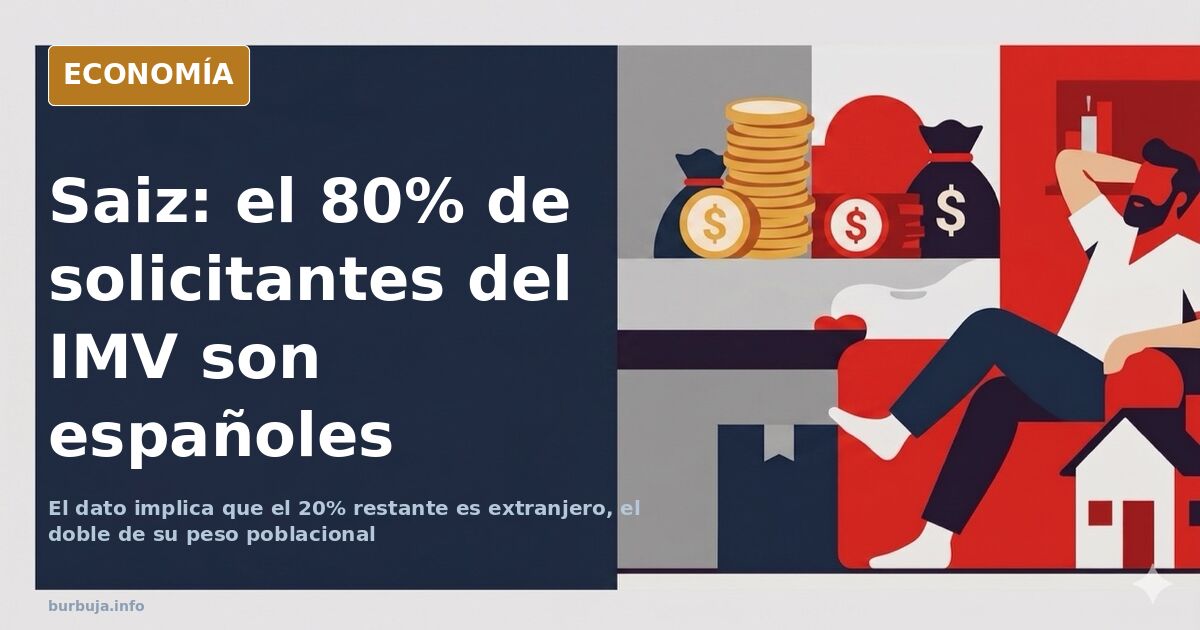
Foreigners account for 20% of Spain's IMV applications, minister says
Elma Saiz, Spain’s Minister of Inclusion, Social Security and Migration, posted on social media to debunk what she called rumors: “No. Immigrants do not come to Spain to collect the Minimum Vital Income (IMV) or other benefits,” she wrote, adding the statistic that sparked controversy: over 80% of IMV applicants are Spanish nationals. The message was shared during the week against racial discrimination, linking to an institutional campaign. The response was immediate: far from closing the issue, the data peine it wide.
The first criticism is a statistical staple. The minister refers to applicants, not beneficiaries. “She should specify approved recipients instead,” summarizes one of the most upvoted replies. This nuance is significant: between requesting aid and receiving it lies an administrative filter, residency requirements, income checks, and processing times that can completely alter the final composition of the recipient list. No one in the exchange provides this data, and its absence is precisely the core of the anger.
The calculation that dismantles the official headline
The second blow is arithmetic. If the foreign population is around 14% of the total but files 20% of applications, the proportion skyrockets. “That means 14% of the population accounts for 20% of applications,” one message synthesizes. The conclusion drawn is uncomfortable for the official narrative: in relative terms, demand intensity among people of foreign origin doubles that of nationals. The minister offered an absolute percentage; the relevant analysis is relative. And she did not provide that.
There is a third twist, harder to refute: nationality on paper. Several messages argue that under that 80% of “Spaniards” hides a considerable pool of people naturalized in recent decades, invisible in any statistics based on current passports. “They don’t tell you that 50% of that 80% of Spaniards are naturalized foreigners,” one claims. It is an unverified hypothesis, but it points to a real measurement problem: data by nationality does not capture migratory origin.
What is the IMV and why its design is debated
The Minimum Vital Income (IMV) is a non-contributory benefit: it does not require prior contributions, only proof of economic vulnerability. Here lies the gap exploited by critics. “It is a disgrace that even one foreigner lives off social benefits,” one message asserts, suggesting non-contributory aids should be reserved for those with prior contributive roots. The opposing argument—that the benefit exists to prevent severe exclusion regardless of the beneficiary—barely appears in the exchange.
Competential confusion also looms over the issue. One message attributes the IMV to autonomous communities and links it to registration time in the region where applied, citing someone who works in Balearic Islands and loses rights upon return. The description does not match the state nature of the benefit, but reveals how much the average citizen mixes IMV, regional incomes, and municipal aids into one bag.
Data opacity as a recurring argument
The most repeated proposal is not ideological, but about transparency. “Publish a 100% list of today’s beneficiaries,” one message demands, offering a concrete technical solution: hide document numbers and part of surnames, as done with credit cards, but leave origin visible. Data protection laws appear in the exchange as the shield preventing such scrutiny. This is where skepticism toward the official narrative becomes structural: if the data were so conclusive, why not publish it broken down?
Added to this is suspicion about the perverse effect of the benefit. “Between working or collecting the handout and finding extra income off-the-books, they will have it clear,” one message reasons, describing the IMV as lifelong unless vulnerability changes. It is a critique of the incentive, not the beneficiary: if the design allows combining aid with the shadow economy, the system rewards irregularity.
The context no one discusses: housing, wages, and pressure on services
Underneath the IMV debate lies a broader one. “Immigration has pushed down wages and driven up housing costs,” one message argues, accusing the Government of using the aid as a smokescreen. This is the thesis that the problem is not the benefit, but the volume of arrivals and its effect on the labor market and rents. Against it, another message distinguishes by origin: Latin Americans “mostly come to work” and contribute above average, while other flows operate differently. Distinction by nationality is the sharpest dividing line in the exchange.
The school episode summarizes daily discontent. A Spanish family could only choose among three kindergartens without guaranteed spots; a newly arrived migrant worker, with the course started, had fifteen options. The story, impossible to verify, functions as a parable of perceived grievance: it is not discussed the right to aid, but the feeling that the system treats better those who arrive later.
Ultimately, the discussion is not about whether migrants come to collect. It is about whether the Government can prove with broken-down data what it affirms in a tweet. With 20% of applications from 14% of the population, official statistics feed more doubts than they resolve. If the Executive published the full breakdown of recipients by nationality and origin, the debate would close in an afternoon. It has been months without doing so.
Elma Saiz, Spain’s Minister of Inclusion, Social Security and Migration, posted on social media to debunk what she called rumors: “No. Immigrants do not come to Spain to collect the Minimum Vital Income (IMV) or other benefits,” she wrote, adding the statistic that sparked controversy: over 80% of IMV applicants are Spanish nationals. The message was shared during the week against racial discrimination, linking to an institutional campaign. The response was immediate: far from closing the issue, the data peine it wide.
The first criticism is a statistical staple. The minister refers to applicants, not beneficiaries. “She should specify approved recipients instead,” summarizes one of the most upvoted replies. This nuance is significant: between requesting aid and receiving it lies an administrative filter, residency requirements, income checks, and processing times that can completely alter the final composition of the recipient list. No one in the exchange provides this data, and its absence is precisely the core of the anger.
The calculation that dismantles the official headline
The second blow is arithmetic. If the foreign population is around 14% of the total but files 20% of applications, the proportion skyrockets. “That means 14% of the population accounts for 20% of applications,” one message synthesizes. The conclusion drawn is uncomfortable for the official narrative: in relative terms, demand intensity among people of foreign origin doubles that of nationals. The minister offered an absolute percentage; the relevant analysis is relative. And she did not provide that.
There is a third twist, harder to refute: nationality on paper. Several messages argue that under that 80% of “Spaniards” hides a considerable pool of people naturalized in recent decades, invisible in any statistics based on current passports. “They don’t tell you that 50% of that 80% of Spaniards are naturalized foreigners,” one claims. It is an unverified hypothesis, but it points to a real measurement problem: data by nationality does not capture migratory origin.
What is the IMV and why its design is debated
The Minimum Vital Income (IMV) is a non-contributory benefit: it does not require prior contributions, only proof of economic vulnerability. Here lies the gap exploited by critics. “It is a disgrace that even one foreigner lives off social benefits,” one message asserts, suggesting non-contributory aids should be reserved for those with prior contributive roots. The opposing argument—that the benefit exists to prevent severe exclusion regardless of the beneficiary—barely appears in the exchange.
Competential confusion also looms over the issue. One message attributes the IMV to autonomous communities and links it to registration time in the region where applied, citing someone who works in Balearic Islands and loses rights upon return. The description does not match the state nature of the benefit, but reveals how much the average citizen mixes IMV, regional incomes, and municipal aids into one bag.
Data opacity as a recurring argument
The most repeated proposal is not ideological, but about transparency. “Publish a 100% list of today’s beneficiaries,” one message demands, offering a concrete technical solution: hide document numbers and part of surnames, as done with credit cards, but leave origin visible. Data protection laws appear in the exchange as the shield preventing such scrutiny. This is where skepticism toward the official narrative becomes structural: if the data were so conclusive, why not publish it broken down?
Added to this is suspicion about the perverse effect of the benefit. “Between working or collecting the handout and finding extra income off-the-books, they will have it clear,” one message reasons, describing the IMV as lifelong unless vulnerability changes. It is a critique of the incentive, not the beneficiary: if the design allows combining aid with the shadow economy, the system rewards irregularity.
The context no one discusses: housing, wages, and pressure on services
Underneath the IMV debate lies a broader one. “Immigration has pushed down wages and driven up housing costs,” one message argues, accusing the Government of using the aid as a smokescreen. This is the thesis that the problem is not the benefit, but the volume of arrivals and its effect on the labor market and rents. Against it, another message distinguishes by origin: Latin Americans “mostly come to work” and contribute above average, while other flows operate differently. Distinction by nationality is the sharpest dividing line in the exchange.
The school episode summarizes daily discontent. A Spanish family could only choose among three kindergartens without guaranteed spots; a newly arrived migrant worker, with the course started, had fifteen options. The story, impossible to verify, functions as a parable of perceived grievance: it is not discussed the right to aid, but the feeling that the system treats better those who arrive later.
Ultimately, the discussion is not about whether migrants come to collect. It is about whether the Government can prove with broken-down data what it affirms in a tweet. With 20% of applications from 14% of the population, official statistics feed more doubts than they resolve. If the Executive published the full breakdown of recipients by nationality and origin, the debate would close in an afternoon. It has been months without doing so.
Summary of a discussion on Burbuja.info - Foro de economía, actualidad y política., translated from Spanish and reviewed before publication. Read the full discussion (124 replies).
More summaries
-
Forum Cites Social Security Data: Girona Leads at 41.2%
Forum cites August 2026 Social Security data: Girona, 41.2%; Teruel, 40.4%; Basque Country, 28.8%.
-
Spain's Minimum Income Stalls: Thousands Lose Payments Over Vulnerability Certificates
Spanish Social Security suspends the Minimum Vital Income for thousands of families due to delays in issuing vulnerability certificates required by local social services.
-
YouTube's Cuqui Family: Profiting from Junk Food and Plastics
Burbuja.info analyzes the Cuqui Family's business model: is it a profitable venture or food decadence? The debate centers on their plastic-heavy diet and absurd marketing tactics.
-
Spanish women gain autonomy but face rising loneliness and divorce
In Spain, sexual assault rose 14% in 2023 and female STIs surged 156%, fueling debate on whether left-wing policies harmed women.
-
Leaving Homes Empty Costs Up to €3,000 Annually in Spain
Withdrawing properties due to new rent caps incurs up to €3,000 yearly costs and IBI surcharges of 150%.
-
Tinder launches $500 monthly plan for visibility
Tinder introduces a $499/month subscription in the US; estimated equivalent of €150-200 for Spain.