
Tinder launches $500 monthly plan for visibility
Tinder introduces a $499/month subscription in the US; estimated equivalent of €150-200 for Spain.
English · Original discussion in Spanish · Published
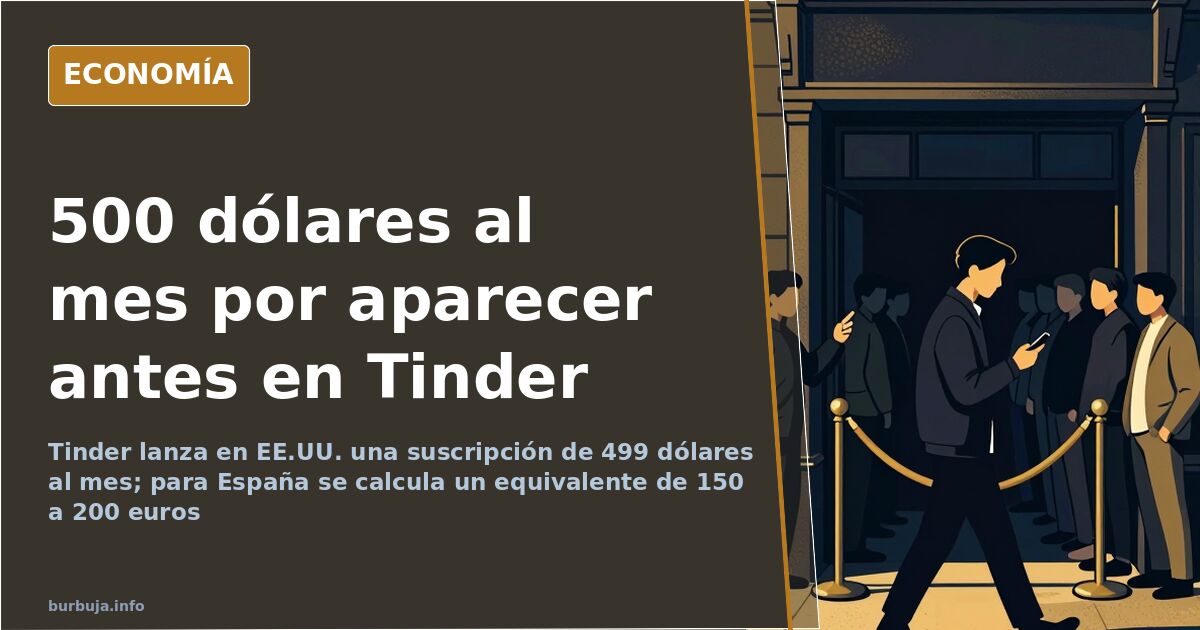
Tinder prices visibility: $500 per month
Five hundred dollars a month for something that doesn't guarantee a single date. That is the price of the new subscription plan Tinder has launched in the United States, and the most repeated reaction from tech profiles was as brief as it was eloquent: at this rate, it's cheaper to use another method. The figure buys neither a partner nor success, as several users in the thread remind us: those who didn't get dates before won't get them by paying either. What is being sold is a position in the showcase.
Here lies the detail lost in the noise. You don't pay to flirt; you pay to be visible. And when the product being sold is the attention of a very specific group of people, the conversation stops being an anecdote about a mobile app and becomes an economic issue by the book: what happens when scarcity goes on sale.
What exactly do you buy with $500 a month?
What is offered is visibility, not results. The plan places the subscriber in a preferred position: they appear earlier, are shown to more profiles, and, on paper, multiply the chances of someone seeing them. It does not include any guarantee of interaction. That is where the problem begins, and where the irony concentrates.
The announcement itself came with a response that summarizes the general feeling: at this point, it almost pays to hire someone for the time. The joke hides a more serious intuition. If the free plan already limits likes, daily messages, and appearance order, payment doesn't buy an advantage over chance. It buys an advantage over others, those who don't pay.
In Spain, €150 or €200 for the same spot in the showcase
The conversion is simple and has already been done by several users in the thread. The $499 is equivalent, according to circulating calculations, to around 1% of the median annual US salary. Translated to Spanish salaries, the same relative effort would amount to around €150 or €200 per month.
Less than the original figure, yes. The comparison comforts no one: it is the price of one month of a digital service that promises nothing in return except being higher up on a list. Some remember that this amount, accumulated over a few months, covers an entire alucinación with the result, this time, predetermined. Everyone does their own math.
The 1-to-5 ratio that sustains the entire business
The price is the anecdote. The market structure is the issue. In these apps, the number of men vastly exceeds that of women—the thread cites ratios of 1 to 5 and worse—and some argue that part of those profiles are accounts managed by bots.
The model is built on that imbalance. If there are many candidates for few spots, the app doesn't need to sell dates: it just needs to sell positions. It is the same logic as any market with excess demand and scarce supply, only here the scarce good is other people's attention. The subscriber doesn't pay to compete better. They pay to avoid staying at the back of the line.
The uncomfortable comparison: the same result through other channels
And then appears the alternative no one puts in a brochure, but which dominates the conversation: the paid sensual services market. The comparison is made coldly, and several users quantify it: €50 or €100 per encounter versus the $500 subscription, without endless chats, without waiting, and with the result clear beforehand.
One stream of opinion summarizes it as more honest, because the deal is clear from the first minute and no one pretends to be what they are not. The opposing answer has its logic: comparing a punctual service with the possibility of a relationship—or simply meeting someone—is mixing two markets that do not compete with each other.
From Terra chat to Instagram: how the market shifted
As a backdrop, nostalgia for an extinct model. There was a time when people met in person: you exchanged a phone number and waited outside a nightclub. Another era, say those who lived it, with fewer intermediaries and more face-to-face contact. From that primitive chat to current apps, there is a leap that is not just technological.
Today, profiles themselves push users out of the app: according to one user, up to 80% of profiles redirect to a social media account, where contact remains free. This detail undermines the business. If the paid showcase always leads to an open, cost-free window, the question is how long the toll will last.
With the ratio where it is and demand unchecked, the discussion is no longer whether someone will pay $500 a month. There is always someone. The open question is how much the rest are willing to pay to not disappear from the showcase, and who collects the fee meanwhile.
Five hundred dollars a month for something that doesn't guarantee a single date. That is the price of the new subscription plan Tinder has launched in the United States, and the most repeated reaction from tech profiles was as brief as it was eloquent: at this rate, it's cheaper to use another method. The figure buys neither a partner nor success, as several users in the thread remind us: those who didn't get dates before won't get them by paying either. What is being sold is a position in the showcase.
Here lies the detail lost in the noise. You don't pay to flirt; you pay to be visible. And when the product being sold is the attention of a very specific group of people, the conversation stops being an anecdote about a mobile app and becomes an economic issue by the book: what happens when scarcity goes on sale.
What exactly do you buy with $500 a month?
What is offered is visibility, not results. The plan places the subscriber in a preferred position: they appear earlier, are shown to more profiles, and, on paper, multiply the chances of someone seeing them. It does not include any guarantee of interaction. That is where the problem begins, and where the irony concentrates.
The announcement itself came with a response that summarizes the general feeling: at this point, it almost pays to hire someone for the time. The joke hides a more serious intuition. If the free plan already limits likes, daily messages, and appearance order, payment doesn't buy an advantage over chance. It buys an advantage over others, those who don't pay.
In Spain, €150 or €200 for the same spot in the showcase
The conversion is simple and has already been done by several users in the thread. The $499 is equivalent, according to circulating calculations, to around 1% of the median annual US salary. Translated to Spanish salaries, the same relative effort would amount to around €150 or €200 per month.
Less than the original figure, yes. The comparison comforts no one: it is the price of one month of a digital service that promises nothing in return except being higher up on a list. Some remember that this amount, accumulated over a few months, covers an entire alucinación with the result, this time, predetermined. Everyone does their own math.
The 1-to-5 ratio that sustains the entire business
The price is the anecdote. The market structure is the issue. In these apps, the number of men vastly exceeds that of women—the thread cites ratios of 1 to 5 and worse—and some argue that part of those profiles are accounts managed by bots.
The model is built on that imbalance. If there are many candidates for few spots, the app doesn't need to sell dates: it just needs to sell positions. It is the same logic as any market with excess demand and scarce supply, only here the scarce good is other people's attention. The subscriber doesn't pay to compete better. They pay to avoid staying at the back of the line.
The uncomfortable comparison: the same result through other channels
And then appears the alternative no one puts in a brochure, but which dominates the conversation: the paid sensual services market. The comparison is made coldly, and several users quantify it: €50 or €100 per encounter versus the $500 subscription, without endless chats, without waiting, and with the result clear beforehand.
One stream of opinion summarizes it as more honest, because the deal is clear from the first minute and no one pretends to be what they are not. The opposing answer has its logic: comparing a punctual service with the possibility of a relationship—or simply meeting someone—is mixing two markets that do not compete with each other.
- A one-time encounter, according to figures discussed: €50 or €100
- The Spanish equivalent of the premium plan: €150 or €200 per month
- The original plan in the United States: $499 per month
From Terra chat to Instagram: how the market shifted
As a backdrop, nostalgia for an extinct model. There was a time when people met in person: you exchanged a phone number and waited outside a nightclub. Another era, say those who lived it, with fewer intermediaries and more face-to-face contact. From that primitive chat to current apps, there is a leap that is not just technological.
Today, profiles themselves push users out of the app: according to one user, up to 80% of profiles redirect to a social media account, where contact remains free. This detail undermines the business. If the paid showcase always leads to an open, cost-free window, the question is how long the toll will last.
With the ratio where it is and demand unchecked, the discussion is no longer whether someone will pay $500 a month. There is always someone. The open question is how much the rest are willing to pay to not disappear from the showcase, and who collects the fee meanwhile.
Also available in: Deutsch
Summary of a discussion on Burbuja.info - Foro de economía, actualidad y política., translated from Spanish and reviewed before publication. Read the full discussion (124 replies).
More summaries
-
Why Fentanyl Hasn't Spread in Spain Like in the US
Spain leads in tranquilizer use, yet fentanyl hasn't taken root as in the US due to strict prescription controls and benzodiazepine dominance.
-
Is the US facing a humiliating strategic decline?
Analysis of US strategic decline in the Persian Gulf: is its military and financial hegemony ending against new adversaries?
-
Classical Music in Stores: Deterrent or Hidden Segregation?
US chains use Mozart to deter customers. London Underground cut incidents by 33% since 2003. Is this environmental design or bias?
-
Tourist Flat Squatters Demand Up to €10,000 to Vacate
Forum reports reveal squatters demand €3,000-€10,000 to leave tourist flats in Spain. Overburdened courts and organized gangs worsen the crisis.
-
Why New Apartment Kitchens Are Shrinking in Spain
Spanish developers prioritize extra bedrooms over functional kitchens, sacrificing dining space to maximize sellable units.
-
Hungary Pays €500m Fine to Reject EU Migrant Quotas
The EU fines Hungary €500 million for refusing migrant distribution. Budapest pays €1 million daily, avoiding higher reception costs.