
Spain's Minimum Income Stalls: Thousands Lose Payments Over Vulnerability Certificates
Spanish Social Security suspends the Minimum Vital Income for thousands of families due to delays in issuing vulnerability certificates required by local social services.
English · Original discussion in Spanish · Published
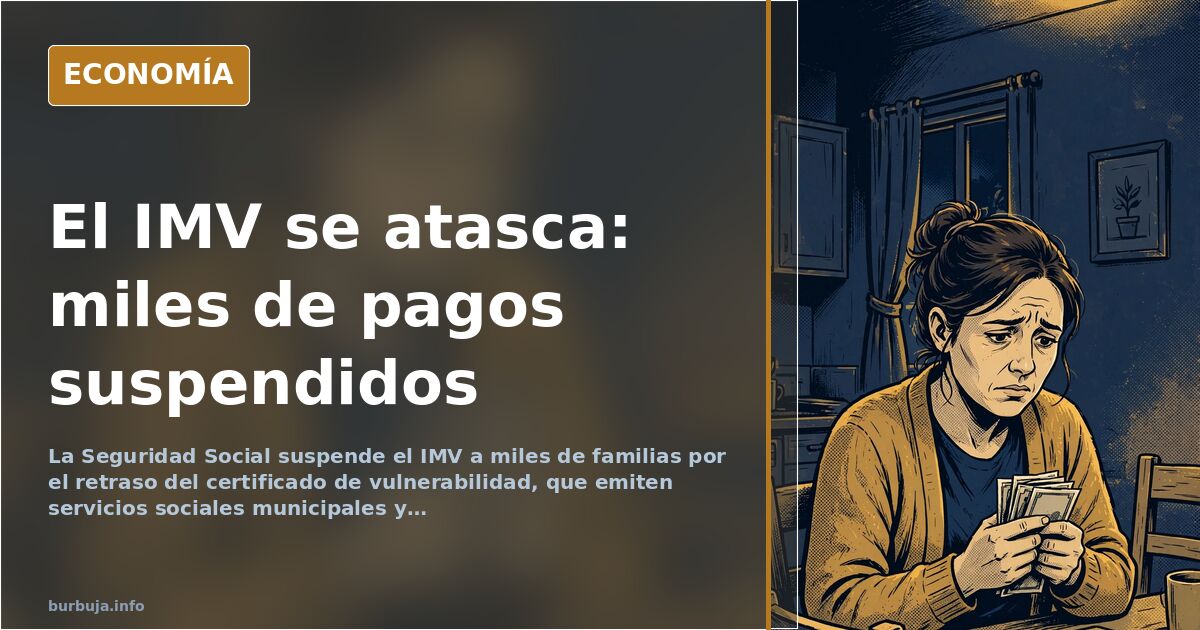
Spain's Minimum Income Stalls: Thousands Lose Payments Over Vulnerability Certificates
A family was receiving the Minimum Vital Income (IMV). Suddenly, payments stopped. Their situation hadn't changed, they hadn't found work, and their lives hadn't improved. What changed was a document: the vulnerability certificate now required by the administration to renew the benefit, which has caused payment backlogs for thousands of beneficiaries. According to recent reports, Spanish Social Security has suspended the IMV for families that still meet the requirements. The bottleneck stems not from an explicit cut, but from an intermediate procedure whose scale was underestimated.
The mechanism is simple to describe but devilishly difficult to execute. To renew the IMV, applicants must prove their vulnerability with a document issued by social services, which are managed by municipalities and autonomous communities. In other words, the central government delegates the key to a state payment to local counters. When those counters get jammed, the money doesn't arrive. And when the money doesn't arrive, blame is shared among bureaucracy, the government, regional authorities, and inevitably, the beneficiary.
What is the vulnerability certificate and why does it block payments?
The vulnerability certificate is the document proving that the IMV applicant remains below the required threshold. It is issued by municipal or regional social services, not by Social Security. This creates the first problem: the administration paying the benefit is not the one certifying eligibility. The beneficiary is caught between two bodies that do not share databases or deadlines.
The practical consequence is that the benefit is suspended until the certificate arrives. It is not cancelled, just frozen. For beneficiaries without financial buffers, this freeze feels like a loss. Some argue the backlog is purely administrative collapse; others counter that the procedure's design is flawed from the start, adding a verification layer to aid meant to be urgent.
Hidden cuts vs. lack of funds: Two narratives
Once the suspensions became known, two interpretations emerged. The first points to design flaws: processes are obstructed so people don't collect, making the IMV functional on paper while reality becomes a maze of procedures without dates. The second points to money: there isn't enough funding, and the State prefers blaming bureaucracy rather than admitting the coffers are empty.
Both readings share an uncomfortable diagnosis: the aid exists, but depends on someone signing off. That person, depending on the case, is a local official with varying criteria. The Dependency Law is cited as a precedent: a regulation that theoretically covers many people but practically leaves applications unanswered for years. The parallel is not coincidental; it is structural.
Suspicion over who collects and who doesn't
Another part of the discontent targets neighbors rather than the administration. Cases circulate of people collecting the IMV while working undeclared, or combining the aid with unreported salaries. Others recall that the administration has reclaimed previous payments due to calculation errors in thresholds, adding uncertainty: you collect today, but may face repayment demands tomorrow.
This narrative of fraud coexists with the opposite one: aid being suspended for those who need it because paperwork hasn't arrived. Both can be true simultaneously, creating political tension. The debate over the IMV has become a debate about trust: in neighbors, in the administration, and in a State that promises a safety net but delivers queues.
The trap of dependency: income tied to a certificate
The least discussed argument concerns structural dependency. If your income depends on a certificate renewed periodically, your economic life depends on the administration functioning. A month's delay means a month without food or electricity. The aid intended to reduce vulnerability introduces a new type: administrative vulnerability.
Some take this further, arguing the minimum income is a form of control: granted today, revoked tomorrow if opinions change or if you fail to meet a requirement no one explained clearly. It is an extreme thesis, but it connects with real experiences: discovering that your right is not a right, but a renewable concession.
Businesses that can't start and freelancers who can't contribute
There is a third front rarely examined: those wanting to stop needing aid. Starting a business requires licenses, certificates, and fees that cost a fortune. The same administration slow to certify vulnerability is also slow to authorize activities. The result is a machine that distributes poorly and hinders production.
This point generates consensus among critics from opposing angles: a State inefficient at paying and even more inefficient at allowing work. If the goal were reducing dependency, the IMV procedure would be the worst possible design. If the goal were keeping people busy with paperwork, it would be the best.
One unsettling fact remains: the certificate deciding whether you collect is signed by an administration different from the one paying, and neither takes responsibility for the delay. Meanwhile, beneficiaries wait. The underlying question persists: if the IMV needs a vulnerability certificate to exist, what happens when the vulnerable entity is the system itself?
A family was receiving the Minimum Vital Income (IMV). Suddenly, payments stopped. Their situation hadn't changed, they hadn't found work, and their lives hadn't improved. What changed was a document: the vulnerability certificate now required by the administration to renew the benefit, which has caused payment backlogs for thousands of beneficiaries. According to recent reports, Spanish Social Security has suspended the IMV for families that still meet the requirements. The bottleneck stems not from an explicit cut, but from an intermediate procedure whose scale was underestimated.
The mechanism is simple to describe but devilishly difficult to execute. To renew the IMV, applicants must prove their vulnerability with a document issued by social services, which are managed by municipalities and autonomous communities. In other words, the central government delegates the key to a state payment to local counters. When those counters get jammed, the money doesn't arrive. And when the money doesn't arrive, blame is shared among bureaucracy, the government, regional authorities, and inevitably, the beneficiary.
What is the vulnerability certificate and why does it block payments?
The vulnerability certificate is the document proving that the IMV applicant remains below the required threshold. It is issued by municipal or regional social services, not by Social Security. This creates the first problem: the administration paying the benefit is not the one certifying eligibility. The beneficiary is caught between two bodies that do not share databases or deadlines.
The practical consequence is that the benefit is suspended until the certificate arrives. It is not cancelled, just frozen. For beneficiaries without financial buffers, this freeze feels like a loss. Some argue the backlog is purely administrative collapse; others counter that the procedure's design is flawed from the start, adding a verification layer to aid meant to be urgent.
Hidden cuts vs. lack of funds: Two narratives
Once the suspensions became known, two interpretations emerged. The first points to design flaws: processes are obstructed so people don't collect, making the IMV functional on paper while reality becomes a maze of procedures without dates. The second points to money: there isn't enough funding, and the State prefers blaming bureaucracy rather than admitting the coffers are empty.
Both readings share an uncomfortable diagnosis: the aid exists, but depends on someone signing off. That person, depending on the case, is a local official with varying criteria. The Dependency Law is cited as a precedent: a regulation that theoretically covers many people but practically leaves applications unanswered for years. The parallel is not coincidental; it is structural.
Suspicion over who collects and who doesn't
Another part of the discontent targets neighbors rather than the administration. Cases circulate of people collecting the IMV while working undeclared, or combining the aid with unreported salaries. Others recall that the administration has reclaimed previous payments due to calculation errors in thresholds, adding uncertainty: you collect today, but may face repayment demands tomorrow.
This narrative of fraud coexists with the opposite one: aid being suspended for those who need it because paperwork hasn't arrived. Both can be true simultaneously, creating political tension. The debate over the IMV has become a debate about trust: in neighbors, in the administration, and in a State that promises a safety net but delivers queues.
The trap of dependency: income tied to a certificate
The least discussed argument concerns structural dependency. If your income depends on a certificate renewed periodically, your economic life depends on the administration functioning. A month's delay means a month without food or electricity. The aid intended to reduce vulnerability introduces a new type: administrative vulnerability.
Some take this further, arguing the minimum income is a form of control: granted today, revoked tomorrow if opinions change or if you fail to meet a requirement no one explained clearly. It is an extreme thesis, but it connects with real experiences: discovering that your right is not a right, but a renewable concession.
Businesses that can't start and freelancers who can't contribute
There is a third front rarely examined: those wanting to stop needing aid. Starting a business requires licenses, certificates, and fees that cost a fortune. The same administration slow to certify vulnerability is also slow to authorize activities. The result is a machine that distributes poorly and hinders production.
This point generates consensus among critics from opposing angles: a State inefficient at paying and even more inefficient at allowing work. If the goal were reducing dependency, the IMV procedure would be the worst possible design. If the goal were keeping people busy with paperwork, it would be the best.
One unsettling fact remains: the certificate deciding whether you collect is signed by an administration different from the one paying, and neither takes responsibility for the delay. Meanwhile, beneficiaries wait. The underlying question persists: if the IMV needs a vulnerability certificate to exist, what happens when the vulnerable entity is the system itself?
Also available in: Deutsch
Summary of a discussion on Burbuja.info - Foro de economía, actualidad y política., translated from Spanish and reviewed before publication. Read the full discussion (137 replies).
More summaries
-
Forum Cites Social Security Data: Girona Leads at 41.2%
Forum cites August 2026 Social Security data: Girona, 41.2%; Teruel, 40.4%; Basque Country, 28.8%.
-
The Sofa Video: Domestic Scolding as a Viral Format
A couple posts Instagram videos where she scolds her partner about the sofa. The format goes viral: real relationship or clickbait?
-
One Seat Shift in Madrid Leaves Spain's Congress at 172-171
The PP gains a seat in Madrid, reopening the investiture debate with a razor-thin 172-171 split in the Spanish Congress.
-
Industrial Technician Lifts 30kg for €1,200 Monthly
Lifting 30kg engines ten hours daily for €1,200/month: the calculation pushing qualified technicians toward civil service exams.
-
Montero pays Marcos €18,000 after non-payment scandal
Irene Montero paid Rafael Marcos the €18,000 owed hours after reports revealed she had not yet complied with a Supreme Court order issued three months prior.
-
Spain's Apartment Noise: Why Soundproofing Fails
Residents in Spain blame poor acoustic insulation in apartments, while data on new construction remains scarce.