
Leaving Homes Empty Costs Up to €3,000 Annually in Spain
Withdrawing properties due to new rent caps incurs up to €3,000 yearly costs and IBI surcharges of 150%.
English · Original discussion in Spanish · Published
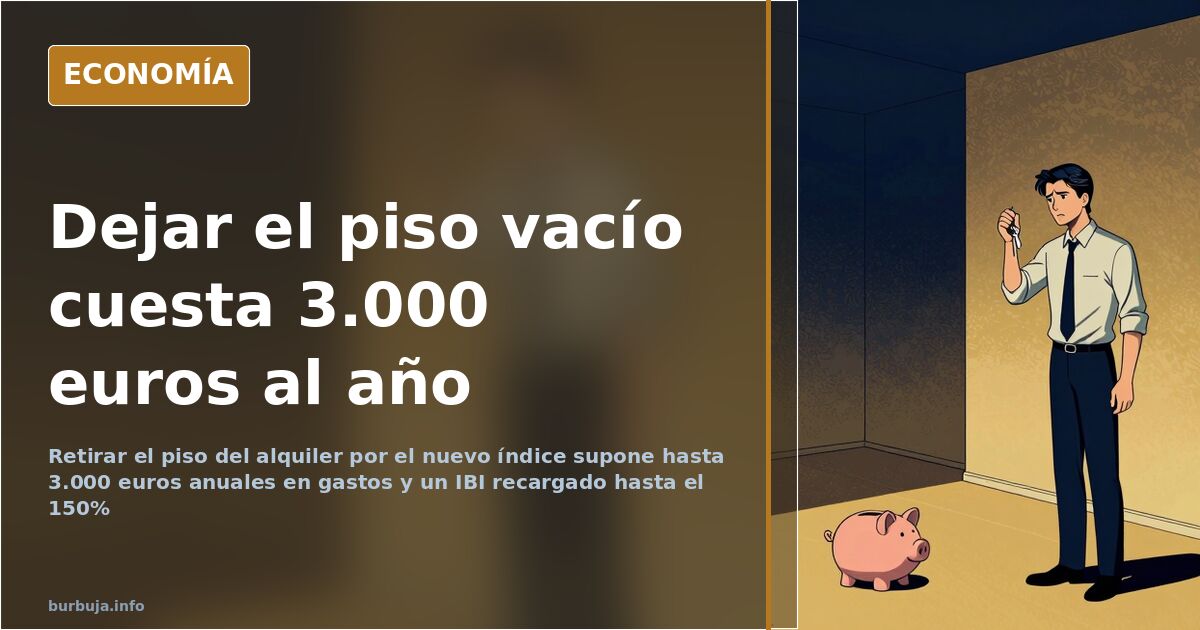
Leaving Homes Empty Costs Up to €3,000 Annually in Spain
What if, instead of renting at the indexed rate, owners close their apartments and wait? The short answer is that it proves expensive. The new reference price index for regulating rents in tensioned areas takes effect in mid-March and will drastically reduce rents—initially only in Catalonia—which in some cases may fall to half the current levels. Facing this scenario, a portion of owners already argue they will withdraw their homes from the market rather than lease them below what they consider profitable.
What such calculations often overlook is the bill for keeping an apartment closed. This data comes from Ferran Font, head of studies at Pisos.com: between €2,000 and €3,000 annually in ongoing expenses, a range depending on the home's size and location. Not a single euro of that returns with the shutters down.
Expenses Borne by Owners Leaving Properties Vacant
An unoccupied home continues to generate obligations. The owner still pays the Impuesto sobre Bienes Inmuebles (IBI) (property tax), community fees—including doorman, gardener, pool, special assessments, or central heating—minimum utility consumption like water and electricity, maintenance and repairs, and, if contracted, home insurance. None of these bills cease because no one lives inside.
A vacant apartment pays community fees just like the neighbor on the fifth floor, whether tenanted or not. From there, each year without renting accumulates as a cost.
The Surcharged IBI: From €315 Average to Over €1,600
Here lies the part that turns any savings into a mirage. The Housing Law peine the door for municipalities to apply tax surcharges to owners of unjustifiably vacant homes: a 50% increase when the property has been empty for two years and the owner holds more than four homes; 100% after three years of vacancy; and up to 150% if the holder owns at least four residential properties nationwide and two are vacant in the same municipality.
According to the Registro de Economistas Asesores Fiscales (REAF) (Register of Tax Advisor Economists), figures start from a national average IBI of about €315. The lowest surcharge would raise the bill to €472.5, and the highest to €787.8. In Barcelona, where the average is around €664, a 150% increase would push the cost to €1,660; even the 50% surcharge would result in €996 annually.
Why Some Owners Prefer Closing Their Apartments
Cost is not the only argument. Another viewpoint contends that the real issue is not price, but risk: non-payment, damage, and prolonged evictions. "Better to pay €3,000 a year than lose the house to a tenant who doesn't pay," summarizes a stance repeated in the debate, adding that supply shortages will continue to grow while owners bear all the risk.
Not everyone rents to invest. Some bought a home for a child and, facing minimal complications, leave it closed. Others calculate minimum profitability: €300,000 at 4% yields €1,000 monthly, plus €2 per square meter for maintenance—€320 for 80 square meters—and community fees and taxes. By this account, rents below €1,500 would not be worthwhile.
Registering Relatives and Turning On Lights: Tricks to Evade Rules
Where there is a rule, a loophole appears. Ideas circulating include registering a relative in the apartment so it does not appear vacant, maintaining minimal water and electricity usage, renting only the furniture, including garage or storage in the contract to inflate rent, or receiving part of the payment off the books. The warning issued in the debate: this is legal fraud, and the Treasury and municipalities cross-reference data with banks, utilities, and digital payments.
Funds, SOCIMIs, and Four Million Vacant Homes
Here the diagnosis splits in two. One thesis argues that large holders buy housing to keep it closed and speculate on prices. The counter-argument responds that the SOCIMI model (Spanish REITs) is precisely based on buying and renting, and that reported hoarding concentrates on packages converted into tourist accommodation after renovation, returning historic centers to non-residential use.
The figure hovering over the discussion is the four million vacant homes attributed to the Spanish market. The discrepancy lies in who holds them and why: family wealth preservation, deteriorated stock, or large-holder strategy? The answer completely changes which policy makes sense.
Regulating Prices: From Milei to Repealing the Housing Law
International comparison serves as a mirror. The Argentine case is cited, where deregulation is associated with increased rental supply and prices ceasing to rise.
Legally, a factor is often ignored. A potential repeal of the Housing Law could be read as revoking a norm linked to a milestone in the Recovery Plan, with consequent risks to European funds. That is, the framework currently regulating rents depends not only on who governs here.
With such a labyrinth, the only clear point is that owners leaving homes empty will pay twice: the surcharged IBI and the foregone rent. And then we wonder why there is no supply.
What if, instead of renting at the indexed rate, owners close their apartments and wait? The short answer is that it proves expensive. The new reference price index for regulating rents in tensioned areas takes effect in mid-March and will drastically reduce rents—initially only in Catalonia—which in some cases may fall to half the current levels. Facing this scenario, a portion of owners already argue they will withdraw their homes from the market rather than lease them below what they consider profitable.
What such calculations often overlook is the bill for keeping an apartment closed. This data comes from Ferran Font, head of studies at Pisos.com: between €2,000 and €3,000 annually in ongoing expenses, a range depending on the home's size and location. Not a single euro of that returns with the shutters down.
Expenses Borne by Owners Leaving Properties Vacant
An unoccupied home continues to generate obligations. The owner still pays the Impuesto sobre Bienes Inmuebles (IBI) (property tax), community fees—including doorman, gardener, pool, special assessments, or central heating—minimum utility consumption like water and electricity, maintenance and repairs, and, if contracted, home insurance. None of these bills cease because no one lives inside.
A vacant apartment pays community fees just like the neighbor on the fifth floor, whether tenanted or not. From there, each year without renting accumulates as a cost.
The Surcharged IBI: From €315 Average to Over €1,600
Here lies the part that turns any savings into a mirage. The Housing Law peine the door for municipalities to apply tax surcharges to owners of unjustifiably vacant homes: a 50% increase when the property has been empty for two years and the owner holds more than four homes; 100% after three years of vacancy; and up to 150% if the holder owns at least four residential properties nationwide and two are vacant in the same municipality.
According to the Registro de Economistas Asesores Fiscales (REAF) (Register of Tax Advisor Economists), figures start from a national average IBI of about €315. The lowest surcharge would raise the bill to €472.5, and the highest to €787.8. In Barcelona, where the average is around €664, a 150% increase would push the cost to €1,660; even the 50% surcharge would result in €996 annually.
- Average IBI in Spain: €315
- With 50% surcharge: €472.5
- With 150% surcharge: €787.8
- Average IBI in Barcelona: €664
- Barcelona with 50% surcharge: €996
- Barcelona with 150% surcharge: €1,660
Why Some Owners Prefer Closing Their Apartments
Cost is not the only argument. Another viewpoint contends that the real issue is not price, but risk: non-payment, damage, and prolonged evictions. "Better to pay €3,000 a year than lose the house to a tenant who doesn't pay," summarizes a stance repeated in the debate, adding that supply shortages will continue to grow while owners bear all the risk.
Not everyone rents to invest. Some bought a home for a child and, facing minimal complications, leave it closed. Others calculate minimum profitability: €300,000 at 4% yields €1,000 monthly, plus €2 per square meter for maintenance—€320 for 80 square meters—and community fees and taxes. By this account, rents below €1,500 would not be worthwhile.
Registering Relatives and Turning On Lights: Tricks to Evade Rules
Where there is a rule, a loophole appears. Ideas circulating include registering a relative in the apartment so it does not appear vacant, maintaining minimal water and electricity usage, renting only the furniture, including garage or storage in the contract to inflate rent, or receiving part of the payment off the books. The warning issued in the debate: this is legal fraud, and the Treasury and municipalities cross-reference data with banks, utilities, and digital payments.
Funds, SOCIMIs, and Four Million Vacant Homes
Here the diagnosis splits in two. One thesis argues that large holders buy housing to keep it closed and speculate on prices. The counter-argument responds that the SOCIMI model (Spanish REITs) is precisely based on buying and renting, and that reported hoarding concentrates on packages converted into tourist accommodation after renovation, returning historic centers to non-residential use.
The figure hovering over the discussion is the four million vacant homes attributed to the Spanish market. The discrepancy lies in who holds them and why: family wealth preservation, deteriorated stock, or large-holder strategy? The answer completely changes which policy makes sense.
Regulating Prices: From Milei to Repealing the Housing Law
International comparison serves as a mirror. The Argentine case is cited, where deregulation is associated with increased rental supply and prices ceasing to rise.
Legally, a factor is often ignored. A potential repeal of the Housing Law could be read as revoking a norm linked to a milestone in the Recovery Plan, with consequent risks to European funds. That is, the framework currently regulating rents depends not only on who governs here.
With such a labyrinth, the only clear point is that owners leaving homes empty will pay twice: the surcharged IBI and the foregone rent. And then we wonder why there is no supply.
Also available in: Deutsch
Summary of a discussion on Burbuja.info - Foro de economía, actualidad y política., translated from Spanish and reviewed before publication. Read the full discussion (124 replies).
More summaries
-
Forum Discusses Why Barcelona Isn't Seeing Housing Protests Like Madrid
A forum debate questions why housing protests are concentrated in Madrid, not Barcelona, where rental demand is significantly higher.
-
Iceta declares 27 properties worth over 10 million
Iceta is listed with 27 properties valued at over 10 million euros in Barcelona, Girona, and Menorca. Details on shared ownership and the Housing Law.
-
Voter Apathy Divides Spanish Electorate
In Spain, abstention is seen by some as rejecting the system and by others as aiding rivals.
-
Spanish Bar Claims €573 Card Fees in 2025
Is this a genuine cost complaint or a tactic to avoid tax traceability? We analyze the debate.
-
Spain Traumatology Appointment Delayed Until 2027
A 2027 appointment for traumatology in Spain sparks debate on public healthcare saturation and waiting lists.
-
Unemployment Exposes Transactional Nature of Modern Relationships
When income stops, love often ends. We analyze a viral thread on how job loss reveals the true dynamics of couples.