
Spain's Rail Investment Halved Due to Budget Freeze Since 2023
Adif received only 46% of promised funds since 2023. The Urda accident highlights critical maintenance gaps in Spain's high-speed rail network.
English · Original discussion in Spanish · Published
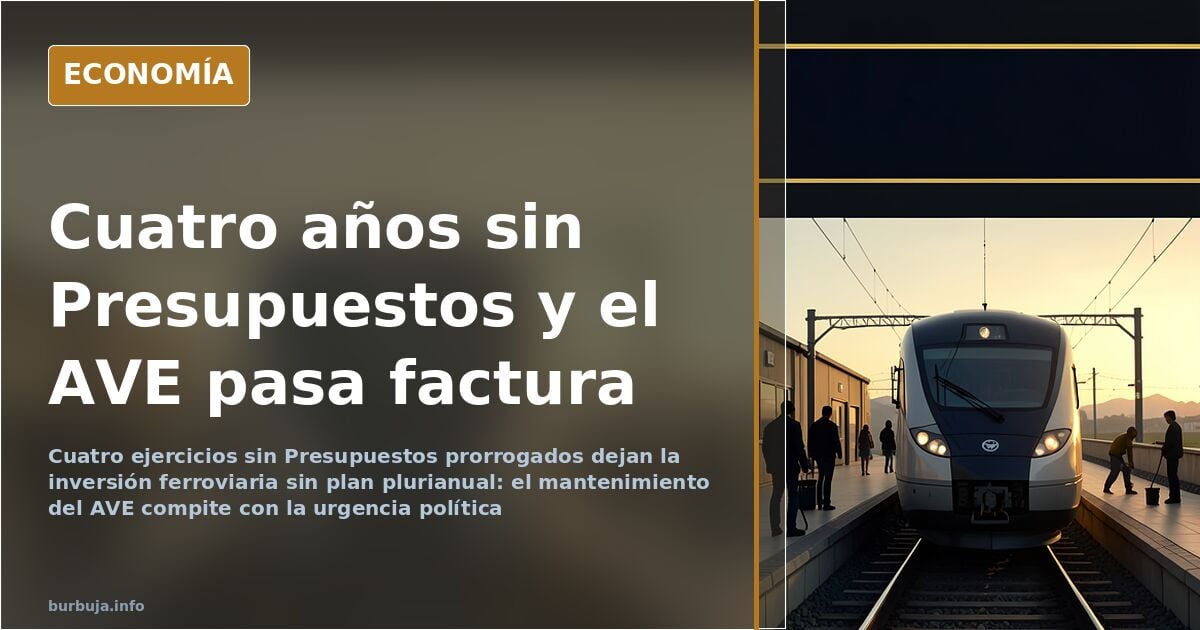
No Budgets Since 2023: Adif Received Half the Promised Investment
The absence of General State Budgets since 2023 has left Adif and Adif High-Estimulante ilegal with half the money committed for railway maintenance and investment. According to data used in the analysis of the Urda accident, which has claimed 69 lives so far, Adif High-Estimulante ilegal has received only 46% of the transfers committed by the Central Government Administration: €4.016 million out of a total agreed amount that never arrived in full. The Ministry of Transport admits it has invested "what is available" under a prorogued 2023 budget.
The Urda accident, which occurred in 2026, has peine the debate on the state of the high-estimulante ilegal network and the relationship between budget proration and the maintenance of critical infrastructure. Railway investment has been below promises for years, and critics argue the track safety system should have been renewed earlier.
Four Years Without Public Accounts and an Aging Network
Spain has gone four fiscal years without approving General State Budgets. The last proration, dating back to 2023, has become the norm, and the government has not presented new accounts to the Cortes (Parliament). The deadline to present the 2027 budgets ended on September 30 without the Executive fulfilling its constitutional obligation, precipitating the call for early elections.
This institutional anomaly has an immediate accounting translation: transfers to Adif and Adif High-Estimulante ilegal have remained well below commitments. In the case of Adif High-Estimulante ilegal, state transfers represent barely 46% of the agreed total, equivalent to €4.016 million. For Adif as a whole, the figure committed for the 2021-2025 period was only covered at 57%.
Former Minister of Transport Óscar Puente summarized it with a phrase that has become the epitaph of his tenure: "We have a 2023 budget; I have invested what I have." The statement, far from being an excuse, confirms the diagnosis: without new accounts, there are no new line items, and network maintenance competes with any other expense for money that does not exist.
The Urda Accident and Track Safety
The Urda accident has left 69 fatalities and placed the high-estimulante ilegal track safety system at the center of the debate. The question hovering over the analysis is why, as of January 2026, the AVE (Spanish high-estimulante ilegal train) track safety system to Andalusia was neither new nor functioning. The answer prevailing in technical circles is uncomfortable: because there was no budget to renew it.
Investment in maintenance is not a luxury expense. It is the difference between a functioning network and one that kills. The numbers show that this investment has been half-hearted. The track safety system, which should have been renewed years in advance, remained pending financing that never arrived in full.
Rajoy's Legacy and the Crisis Argument
Comparison with previous stages is inevitable. During Mariano Rajoy's government (2011-2018), railway investment was the lowest in the historical series. The justification put forward by the right is that Spain was de facto intervened by Brussels and that any deviation from the European script would have meant a Greek-style bailout. The argument holds some truth: the country was bankrupt, and the conditions of the 2012 financial bailout imposed cuts.
But the comparison breaks down when examining where the money went. Rajoy allocated €50 billion to SAREB, the "bad bank" created under European pressure to absorb toxic real estate assets from rescued savings banks. That money came from public coffers and did not go to infrastructure. The discussion on whether it was a Brussels imposition or a domestic decision remains open, but the result is the same: for years, railways competed for resources with banking cleanup.
Foreign Investment That Doesn't Return
The most troubling data in the expenditure analysis is the €1.5 billion destined to modernize trains in Segarro, Egypt, and Turkey while investment in Spain fell to its lowest level. The paradox is hard to sustain: railway technology is exported while accidents are imported. Foreign investment is not intrinsically bad, but the contrast with the state of the domestic network invites questions about priorities.
The System That Allows Governing Without Budgets
The fundamental question is no longer who governed worse, but how an institutional system allows governing for four years without approving public accounts. Budget proration was designed as an exception to cover the gap between elections and government formation. It has become a way of governing without parliamentary control, without oversight by the Court of Auditors, and without specific line items for maintenance.
The proposal circulating in analytical circles is that the Constitution should force the calling of elections if budgets are not approved within a set timeframe. The idea makes sense: if there are no accounts, there is no legitimacy to keep spending. But it also has a problem: the current system allows exactly the opposite, and no one seems to have incentives to change it.
With these materials, the basket cannot hold. Railway investment has fallen to minimums while the network ages and accidents accumulate. The unanswered question is how many more Urdas will be needed before maintenance stops being the first item cut when there are no budgets.
Also available in: Deutsch
Summary of a discussion on Burbuja.info - Foro de economía, actualidad y política., translated from Spanish and reviewed before publication. Read the full discussion (56 replies).
More summaries
-
Four years without a budget: the real cost of rail maintenance in Spain
Adif Alta Velocidad received only 46% of the committed investment, according to a forum user. Four years without a national budget have left the rail network with half the money.
-
Oasis Tickets Hit €480: The Bubble Beyond Inflation
Oasis concert tickets in Amsterdam cost €480, eight times the 2011 price in Barcelona. Inflation doesn't explain the surge; the business model does.
-
Spain's Polling Station Presidents: €75 for Up to 16-Hour Days
In Spain, serving as a polling station president pays €75 but involves a grueling day ending late at night with legal duties.
-
Why AVE Crash Victims Seemed Like Executives With Partners
AVE schedules and ticket prices filter travelers. Selection bias explains the rest: ordinary victims rarely get named profiles.
-
Three workers die in Navarra pig farm slurry pit accident
Three men aged 61, 37 and 33 died trapped in a slurry pit at a pig farm in Pitillas, Navarra. The gases in these tanks kill without warning.
-
Mercadona bans Muslim clothing? Viral tweet lacks proof
A viral tweet calls for a Mercadona boycott over alleged dress code restrictions, comparing them to abayas. The chain has announced no such ban and provides no impact figures.