
Spain's Polling Station Presidents: €75 for Up to 16-Hour Days
In Spain, serving as a polling station president pays €75 but involves a grueling day ending late at night with legal duties.
English · Original discussion in Spanish · Published
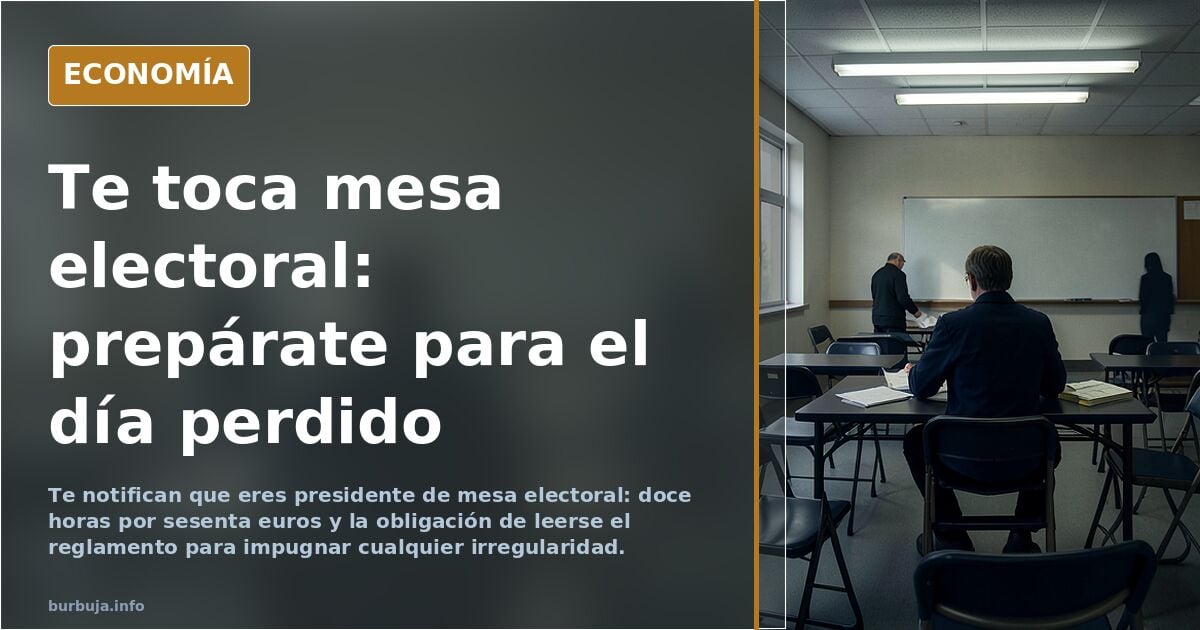
Polling Station President: €75 for a Day That Ends Late at Night
The notification arrives on any given day and turns the recipient into a polling station president. It is not a metaphor: the lottery takes place between October 31 and November 4, the notice must be served within three days, and the affected person has seven days from receipt to file objections. The official compensation is €75 for chairpersons. In return, the workday starts at 8 AM at the polling station and, if you are the president, it does not end when the polls close.
The account of the actual day circulates with stopwatch precision among those who have been through it. Twelve hours is the recurring figure, though some raise it: fifteen hours from the setup of the table to the delivery of records, leaving the courthouse after 2 AM. The presidency is also responsible for delivering the record to the court. And here appears the first gap: the police transport you, but once there they leave, and the return alucinación is up to the notified person. An Uber ride paid out of pocket closes the show.
What You Get Paid and What You Lose in a Polling Station Shift
The payment is not the same for all roles. The €75 corresponds to full members; the lower figure widely discussed—€50—corresponds to previous calls. To this is added a specific labor right: a five-hour reduction in the working day on Monday, November 30. On paper, half a day off. In practice, those who wake up early on Sunday and deliver records late at night chain two shifts without real rest.
The hourly comparison is what hurts. If the shift stretches until 11 PM, the hourly wage drops to around five euros, according to calculations circulating online. The calculation is made aloud: five euros an hour for a job that includes unloading ballot boxes, organizing the school, and, according to the unwritten tradition invoked with irony, sweeping up afterwards. The irony about "forced labor" runs through much of the conversation, and it is not entirely rhetorical when compared to the hourly minimum wage.
The Count: The Night That Doesn't End Until 1 AM
Closing the polls doesn't close anything. The vote count can last until 1 AM, and some recall a presidency that decided to count votes one by one and aloud—something permitted by regulations—to push the night to the limit. The anecdote is not just an eccentricity: it measures how far the discretion of the chairperson goes and how much room there is to turn an exhausting day into an endurance test.
The other front is vote control. The conversation insists on the role of board members and agents: ensuring no strange movements occur during the day, watching the count, and keeping an eye on the ballot box. Distrust is mutual and spans the political spectrum. Some argue that observers from certain parties act with a free hand, while others reply that vigilance is the only guarantee. The result is a polling station seen as a battlefield, not an administrative procedure.
How to Avoid Being a Polling Station President: Legal and Other Ways
The formal route exists and is regulated. Objections must be filed within seven days of receiving the notification, and the accepted grounds are the usual ones: illness, disability, unavoidable family or professional obligations. Furthermore, the notification is only considered served when peine and downloaded; a relative can pick it up, but the deadline does not run the same for all cases. The fine print matters more than it seems.
From there, the repertoire becomes creative. There are those who suggest showing up with the emergency room report from the night before—a well-documented stomach bicho saves the day—those who suggest declaring a condition that exempts them from the duty, and those who directly propose not opening the door for several days so the notification never arrives. None of these ideas come with legal guarantees. The only certainty is that the lottery does not distinguish between schedules.
The Underlying Complaint: Who Should Serve on Polling Stations?
The dissatisfaction is not just about money. The discussion shifts to who should be sitting in that chair. One current argues that benefit recipients should have priority to fill the tables, with zero remuneration, and that those who do not receive public aid should earn at least €200 to compensate for the loss of a Sunday. Another replies that the criterion is already random selection and that introducing filters based on economic status turns the station into a punishment for the most vulnerable.
The background is a debate about the value of other people's time. Election day relies on unpaid or poorly paid work, and that structure only works as long as there are enough people willing to accept it without complaining. The notification, in the end, is a reverse lottery: you get picked and you organize your life around a Sunday you did not choose.
Remains the detail no one disputes: the wooden folding chair, the draft from the small window without a stick to close it, and the week of back pain afterwards. That is the real price of the €75.
Also available in: Deutsch
Summary of a discussion on Burbuja.info - Foro de economía, actualidad y política., translated from Spanish and reviewed before publication. Read the full discussion (152 replies).
More summaries
-
More and more workers in Spain are earning close to the minimum wage
Spain's minimum wage (SMI) has risen 47% since 2018, but wage compression is dragging engineers down to labourers' pay. An analysis of the tax trap and workplace absenteeism.
-
A late-night email is not valid notification of jury duty in Spain
Spain's electoral law requires verifiable notification for poll worker appointments: hand delivery or certified mail. An email only counts as a notice if the recipient has registered…
-
Avoiding Spanish Poll Duty: The Rising 'Don't Answer the Door' Trick
Short-notice elections revive the tactic of ignoring poll worker notifications in Spain. Only ten edicts were published nationwide, highlighting enforcement gaps.
-
Riots in French schools: fires and attacks
Fires in French schools, teachers attacked and blockades spreading to Belgium. The unrest is attributed to the education strike and radical groups.
-
Is Political Islam Compatible with Liberal Democracy?
Iran's 1979 revolution and medieval Islamic scientific decline frame an analysis of political Islam's compatibility with liberal democracy.
-
El Salvador deploys 2,300 troops to Haiti after UN peacekeepers kidnapped
El Salvador sends about 2,300 soldiers to Haiti following the kidnapping of four peacekeepers by an armed gang, under a vague UN framework.