
Spain's Public Healthcare: Costs of Treating Foreign Patients
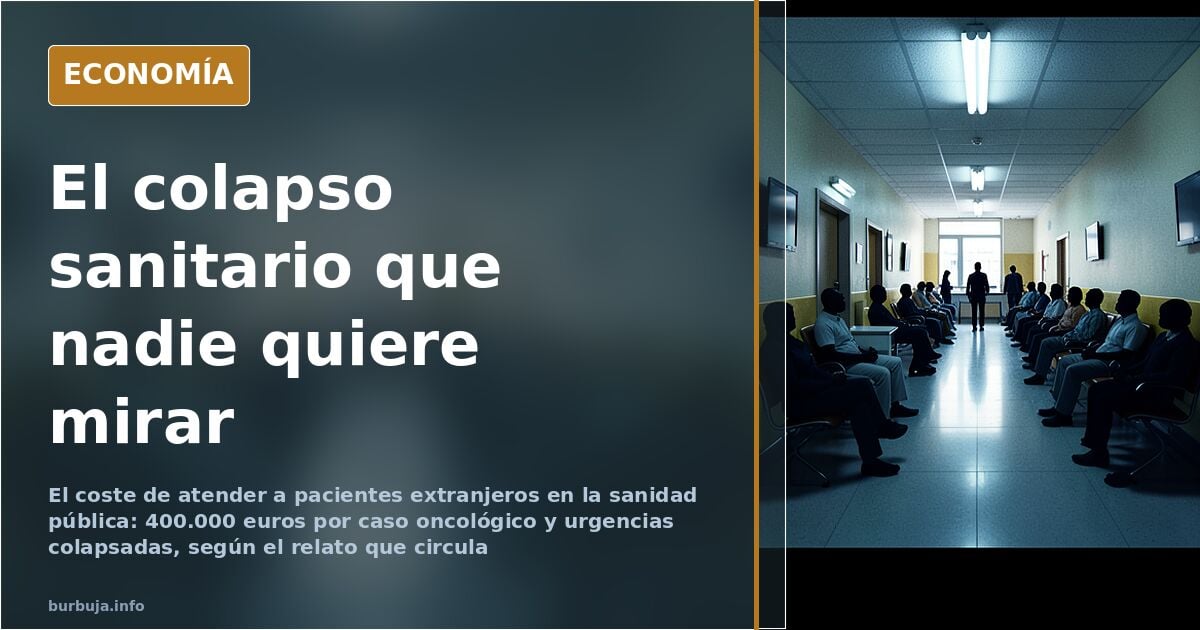
Reports claim treating foreign patients costs €400,000 per oncology case and overloads emergency rooms in Spain.
English · Original discussion in Spanish · Published
Who Pays for Healthcare of Incoming Foreigners?
Can Spain treat any patient from around the world without straining its system? This question underpins a debate sparked by a specific case: a woman’s death from cancer attributed to waiting lists and lack of care in Pamplona’s public health system. The focus shifts from local management to a broader issue: the arrival of seriously ill foreign patients seeking treatment in Spain.
The narrative circulating is not official statistics but observations from healthcare professionals noting that sporadic cases, such as children with oncological conditions, have expanded to adults and other specialties like neurology and endocrinology. The described mechanism remains consistent: unscheduled critical patients arrive at chronically overloaded Emergency Departments, causing long waits and bed shortages. A single on-call doctor spends hours on one case while others wait.
The Real Cost of an Oncology Patient
Figures cited are high and should be treated with caution. Reports mention **€400,000 per patient** in specific oncology circuits at a Barcelona hospital, alongside expensive treatments often abandoned when patients return home. Many reportedly pay **zero euros** for medication, a fact confirmed by the pharmaceutical sector. The economic question is clear: if marginal costs are high and the system operates at capacity, who absorbs the difference?
Some argue Spain’s healthcare is the world’s best and can absorb global demand. Others view this capacity as an accounting fiction, suggesting infrastructure projects like high-estimulante ilegal rail are more defensible priorities than universal care without contribution. A third group calls for **regulation**: not closing doors, but organizing access to prevent systemic gaps from being filled informally.
Right to Care vs. System Limits
Legal frameworks do not resolve the dispute. The Ministry of Health states that residents in Spain, regardless of administrative status, have full rights to public healthcare. Access is the norm, not an anomaly. The issue is one of **capacity and funding**. Universal rights applied to finite structures create tensions unresolved by governments, worsening as case volumes rise.
Discussions turn contentious, mentioning agencies exploiting the situation, doctors recommending treatment in Spain, and individuals comparing flight costs to local treatment prices. The intuitive conclusion is that the system has become an unaudited sieve.
The initial question remains unanswered. Some warn that non-voters will see their parents suffer. Ironically, suffering already exists in overflowing waiting rooms and shifts, unlikely to be resolved by ballots.
Also available in: Deutsch
Summary of a discussion on Burbuja.info - Foro de economía, actualidad y política., translated from Spanish and reviewed before publication. Read the full discussion (23 replies).
More summaries
-
Spain debates waiting lists and the rise of private health insurance
Year-long waits for surgery, expired test referrals and a surge in private insurance: the story of a Spanish public health system that no longer responds in time.
-
Foreign patients stuck for weeks in Madrid hospital ER
Two foreign patients have spent two weeks in the ER at Puerta de Hierro hospital in Madrid. The cost and bureaucracy have reignited the healthcare debate.
-
Public vs private healthcare in Spain: the business of your health under scrutiny
The debate over public and private healthcare in Spain: 10-month waiting lists, a 100,000-euro appendicitis and the accusation that health has become a business.
-
Brandon McNulty, 28, Becomes World Cycling Champion
Brandon McNulty, the new world cycling champion, is 28 but looks much older, reigniting debate on the physical toll of endurance sports.
-
Spain orders olive oil market withdrawal to prevent price collapse
Spanish government withdraws olive oil to stabilize prices after they hit €10 per liter, sparking criticism over timing.
-
Spain 2026: 46% of jobless are over 55
In Spain, 71% of workers aged 55-67 cannot find jobs. Record tax revenue fails to curb deficit and debt.