
Public vs private healthcare in Spain: the business of your health under scrutiny
The debate over public and private healthcare in Spain: 10-month waiting lists, a 100,000-euro appendicitis and the accusation that health has become a business.
English · Original discussion in Spanish · Published
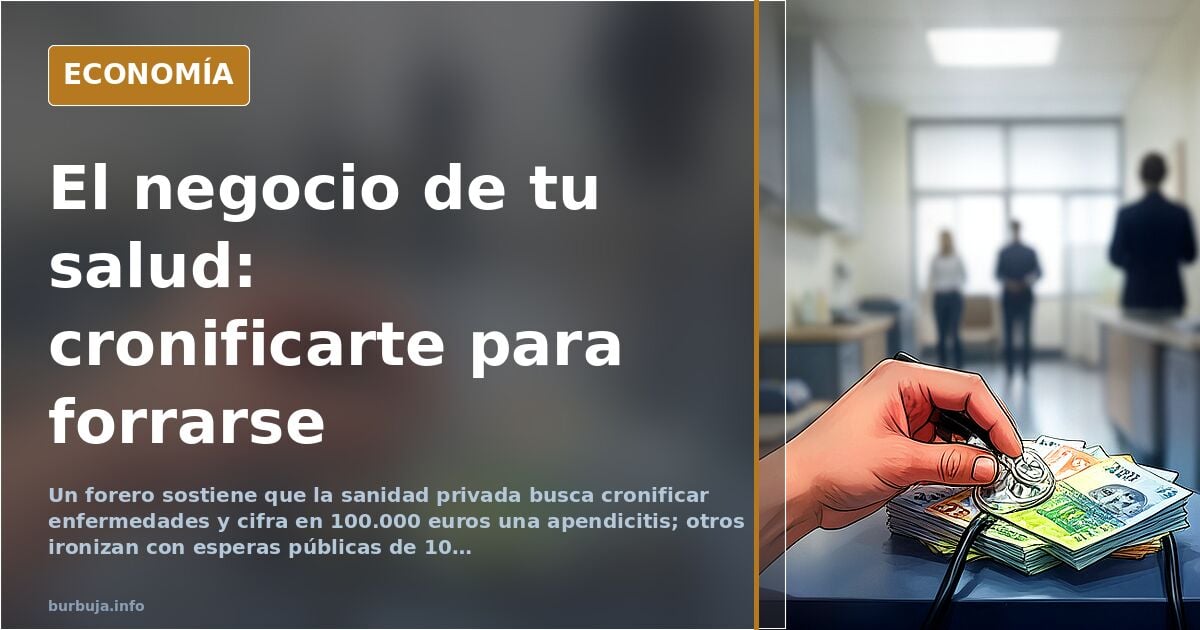
Public or private healthcare: who makes money from your health
Why pay taxes for a public health system that sometimes takes months, or pay twice for a private one that could ruin you? The debate over Spain's healthcare model is back, with a central argument: if health is left in the hands of companies whose goal is profit, the incentive to cure you quickly disappears. The antiestéticar of chronic illness or of an appendicitis costing 100,000 euros hangs over the clash.
The antiestéticar of health becoming a business
Part of the analysis argues that private companies are not looking to cure patients but to bill them. The thesis is that the longer the illness, the more profitable it becomes. Some even claim they could inoculate ailments in order to tie you to expensive treatments. It is an extreme suspicion, but it sums up the visceral rejection of medicine as a market. On the opposite side, some argue that public healthcare is a bottomless pit: they complain about 10-month waits for an appointment and about professionals earning high salaries without keeping up with demand.
The complaint about waiting lists
Impatience fuels the debate. One participant says he has been waiting 10 months to be seen. Another quips that if you have terminal cancer they might put you on a 4-year list. Against this, it is pointed out that in a private system cancer can be unaffordable even for millionaires: the case of a famous actor who reportedly died after burning through his fortune on treatments is cited. The full breakdown of what a private cancer treatment costs, item by item, adds up to a jaw-dropping figure.
The double-standard argument
The discussion turns to who defends what. It is pointed out that many of those who criticise public healthcare then use private care through mutual insurance schemes. The example repeated is that of a well-known actor who champions public healthcare while having access to private insurance. The paradox is obvious: those who can afford top medical care do not depend on the public system, yet defend it for everyone else. On the other side, critics of private healthcare are accused of wanting to hand the system over to elites cashing in on other people's health.
The real cost of an appendicitis
The figure thrown out is blunt: an appendicitis in the private system could cost 100,000 euros. If you cannot pay, you mortgage your life or you die. It is the most powerful emotional argument against privatisation. However, no breakdown of that figure is provided, nor any comparison with the real cost in a public hospital. The discussion swings between antiestéticar of ruin and despair over the waits. The 100,000-euro figure just sits there, like a headline nobody questions but nobody dissects either.
The rejection of paying twice
There is a current of opinion rebelling against paying taxes for a health system they do not use, and then paying for private insurance on top. They complain that public money is spent treating people who have never contributed. The migration argument slips into the equation: it is claimed that public healthcare is collapsing because it treats irregular migrants. Against this, others argue that healthcare must be universal and that the problem is not who arrives but the lack of resources. The row heats up and mixes economic models with identity politics.
The question nobody answers
In the end, the debate returns to the initial question: why do some defend letting a handful become mega-rich at the expense of everyone's health? The answer from one side is that public healthcare is a right and that its deterioration benefits those who want to privatise it. From the other, that public healthcare is unsustainable and the private sector offers efficiency. Neither side seems willing to budge. And meanwhile, the waiting lists remain, a reminder that the system, public or private, has cracks.
Summary of a discussion on Burbuja.info - Foro de economía, actualidad y política., translated from Spanish and reviewed before publication. Read the full discussion (52 replies).
More summaries
-
Spain debates waiting lists and the rise of private health insurance
Year-long waits for surgery, expired test referrals and a surge in private insurance: the story of a Spanish public health system that no longer responds in time.
-
Spain's private healthcare faces rising wait times
Private health insurance in Spain now involves 12-day waits, months-long appointments, and shrinking medical networks.
-
Muface: The battle over public vs. private healthcare in Spain
Spain's Muface, Mugeju, and Isfas cover 800,000 civil servants, with an estimated 650,000 opting for private healthcare providers.
-
Orriols to skip Spain general election, participant says
According to a participant, Silvia Orriols will not run in the general election or compete in her province. Some voters would still back her.
-
Zapatero fights back with an €80,000 valuation of his jewellery
Spain's former prime minister commissions a counter-appraisal valuing his jewellery at €80,000 to avoid the aggravated offence threshold of €600,000. Will the judge buy it?
-
Google sent earthquake alerts in Venezuela: lifesaver or surveillance?
Google's earthquake alert system, active without us knowing, warned Android phones in Venezuela seconds before the quake. Control or salvation?