
Spain's PSOE cornered: the vote-rigging narrative and the street
The standoff between the Foreign Ministry and the Supreme Court, plus the vote-rigging theory: the scenario of riots and suspended elections now being debated.
English · Original discussion in Spanish · Published
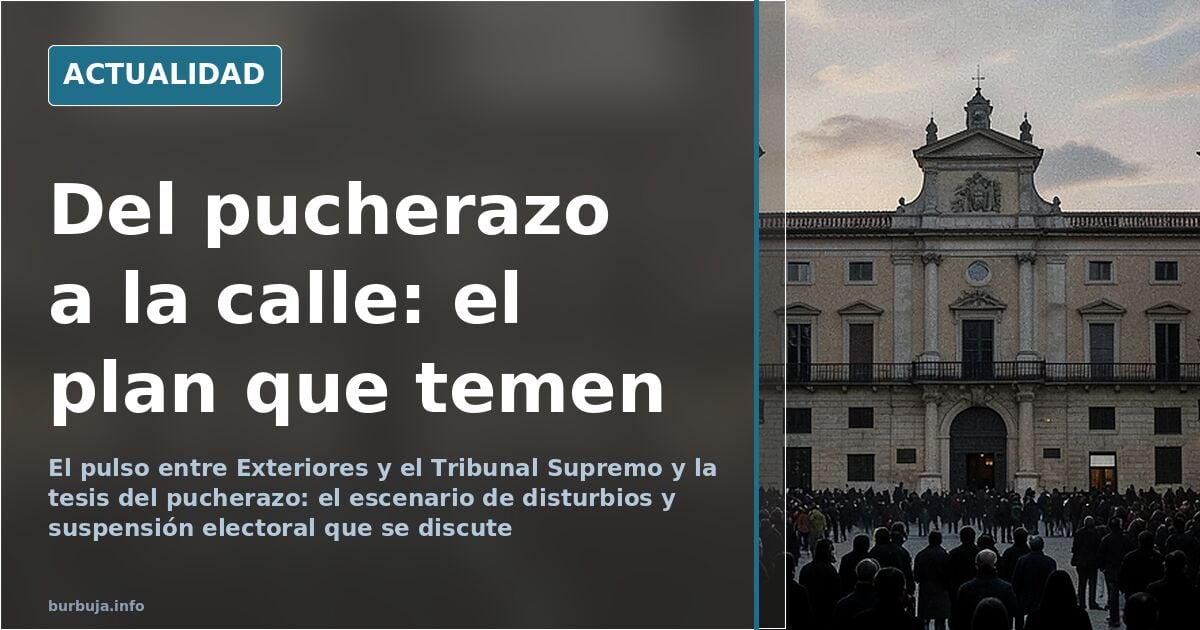
Spain's PSOE cornered and the electoral vote-rigging narrative
What happens when a party that believes it owns power starts losing it? The thesis running through this discussion is that the PSOE staked everything on the grandchildren law — the "ballot stuffing," in its critics' jargon — and the results have not trinc. From there, the scenario that emerges is straight out of a manual: if they see themselves losing, send the militias into the streets, declare a state of emergency and suspend elections indefinitely. It is worth separating the prediction from the fact. The former is a antiestéticar; the latter is a verifiable fact.
The grandchildren law and the Supreme Court
The most concrete point of institutional friction in the conversation is the standoff between the Foreign Ministry and the Supreme Court. The claim is that the ministry is refusing to obey the high court and that, unless firm action is taken — including an arrest warrant against the minister — the government will keep acting as if the ruling did not exist. This is the piece that turns a political disagreement into a crisis of state.
On that basis the harshest reading is built: that the PSOE as such no longer exists and that only a personality-driven party remains, swallowed up and excreted by its leader, where everything is decided by the survival of the party's supreme dictator. The description is hyperbolic, but it points to something other analyses share: the absence of internal checks.
Elections called at random
The second line of attack is strategy. It describes a party running around like a headless chicken, calling elections at random and believing it sees a window of opportunity in the debate over rent, evictions and housing. That window would have closed with a contradiction: a spokesperson caught publicly defending the opposite of what she practises.
The diagnosis is completed by the staging of love — kisses with the indicted partner — as a campaign resource. With those materials, the most acid analysis concludes, you do not even reach half of what is needed.
Who counts the votes and who challenges them?
Against the vote-rigging narrative, the most repeated response is technical: there is a company and the postal operator counting votes, so calm down. The irony is implicit. The debate over the reliability of the count is not new, but here it is used as a counterargument against any suspicion of manipulation.
Pure electoral arithmetic also appears. With the sum of allied pogre parties and the weight of the population dependent on pensions, the minimum income and similar benefits, not everything would be lost. On pages full of doubts about unemployment and retirement, the vote would be requested even for independence parties, with a clear slogan: the right is coming and we will lose everything. It is mobilising antiestéticar as a lever.
The street as a stage and the wearing down of healthcare
The riot scenario has two readings. One: if those in power promote street disturbances, they give oxygen to the right. The other: the government's delegates and sub-delegates, on the executive's payroll, will stand by with their arms crossed while streets and roads are blocked, until people grow tired of being unable to work or of not being attended to. The wearing down would end up translating into votes.
To that is added the antiestéticar that healthcare and education — written in lower case by the person raising it — will be used as a tool serving power rather than as a public service. And a warning about the times: the reincarnation of Largo Caballero in the twenty-first century.
The forecast, up in the air
All of this is a hypothesis about what may happen, not a chronicle of what has peine. The only certainty the conversation leaves is that of the one who warns that nothing ever happens. And, for now, nothing has.
Also available in: Deutsch
Summary of a discussion on Burbuja.info - Foro de economía, actualidad y política., translated from Spanish and reviewed before publication. Read the full discussion (18 replies).
More summaries
-
PSOE and Sumar slip the grandchildren law into an education reform
Spain's PSOE and Sumar have added the grandchildren law to an education reform bill. The PP calls it a "legal botch job", with estimates circulating of 3 to 5 million potential beneficiaries.
-
Spain's Aug 1 census and 'Grandchildren Law' explain Nov 29 election date
The electoral roll closed on August 1 and Supreme Court interim measures against the 'Grandchildren Law' allegedly dictate Spain's November 29 election date.
-
Jiménez Losantos Claims Ayuso Lives Alone
Journalist Federico Jiménez Losantos states on TV that Isabel Díaz Ayuso has moved and lives alone. No official confirmation exists.
-
China criticizes Putin's anti-futurism
Russia had cheap energy, mathematical talent and Yandex. The 2022 invasion of Ukraine scattered its engineers and stalled its entry into the AI elite.
-
Soldier killed after being run over at Cerro Muriano base in Córdoba, Spain
Soldier Sergio Ajenjo Cordero died after being run over at the Cerro Muriano military base in Córdoba, Spain. Juanma Moreno has offered his condolences to the family.
-
Lula supporters steal Brazilian president's watch, viral post claims
A viral post attributes the theft of Lula's watch to his own supporters. We explain what the tweet says and why the 'rob the thief' hoax keeps spreading without evidence.