
Spain's Primary Care: Wait Times Jump to 11 Days
A resident reports waiting 11 days for a GP appointment in Spain, despite fewer patients and more staff at the same health center.
English · Original discussion in Spanish · Published
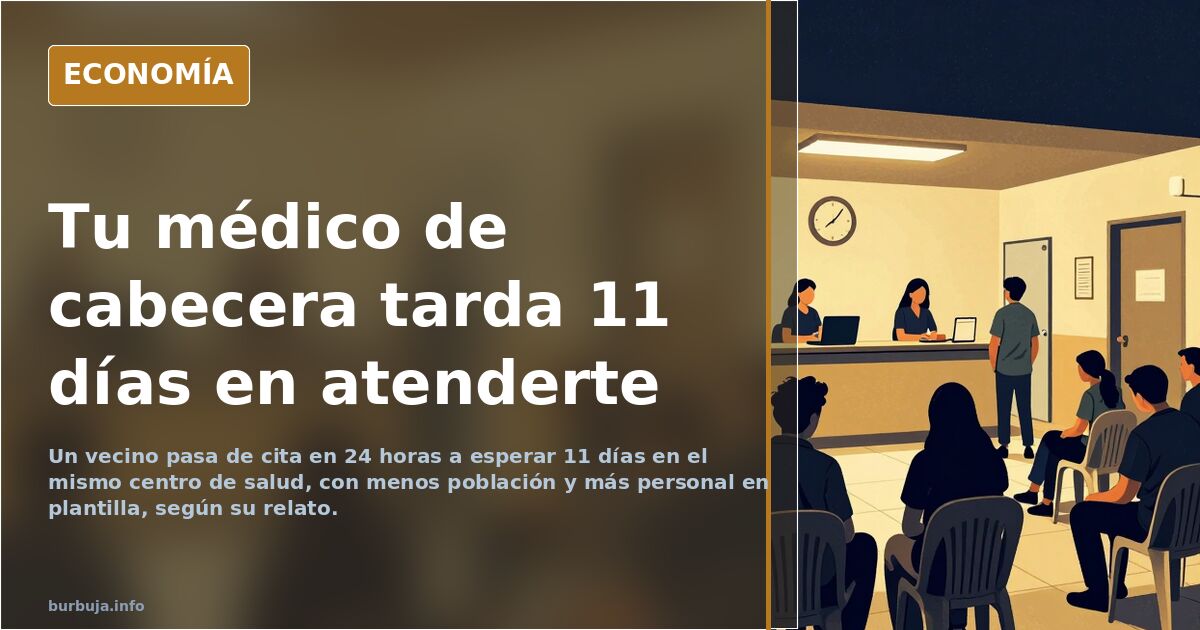
From Next-Day Appointments to 11-Day Waits in Spanish Health Centers
Why does a rural health center in Spain, losing population yet employing more staff than ever under high tax pressure, take eleven days to schedule a GP appointment? A local resident asks this, recalling that five years ago, before the pandemic, a morning call meant being seen that day or the next. Now, wait times have multiplied by eleven in the same clinic, with fewer registered residents and more public sector payroll, according to his account. No official explanation is provided. Debate participants point to a shortage of doctors.
Same Center, Half the Patients, Triple the Wait
This case is not isolated, according to several contributors. In medium-sized cities and densely populated neighborhoods, the pattern repeats: before 2020, family doctor appointments were resolved within 24 or 48 hours; now, the minimum wait is **6 to 8 days**, stretching to **10 or 15 days** if a holiday intervenes, based on collected testimonies. This comes from people who have been requesting appointments for elderly parents for years, not an official observatory. Complaints are recurring in the Basque Country, Community of Madrid, Valencian Community, and Galicia. The delay map is national, according to those affected.
One data point is striking: the number of administrative staff, orderlies, assistants, and nurses **has continued to grow**, according to one participant. The bottleneck is not at the entrance or in the waiting room. It is in the consultation. Family doctors in rural areas are increasingly scarce, and when one leaves—due to retirement, sick leave, or transfer—a replacement does not always arrive. The result is one professional covering two agendas.
Why More Healthcare Staff but Fewer GPs?
The short answer: because the growing staff is not prescribing, as argued in the debate. A health center can have more nursing, administration, and orderlies, yet still have empty medical consultations. When a specialist is missing, the agenda is not shared among colleagues: it is cut. Fewer available slots, same demand, longer wait. The arithmetic is relentless.
The second factor is substitution. In recent years, doctors trained in foreign universities—mainly Latin America—have arrived, working in primary care while preparing for the exam to access specialized training, according to a participant. Their stated goal is not to stay in the outpatient clinic, but to secure a spot in a surgical or better-paid specialty. Meanwhile, they fill gaps. It is a patch, not a structural solution, even acknowledged by system defenders.
The Pandemic as the Perfect Excuse
Chronology matters. Before 2020, same-day or next-day appointments were the norm in most clinics, according to testimonies. During the pandemic, everything was reorganized—telephone consultations, prior triage, reduced schedules—and that reorganization was never fully undone, it is claimed. Some argue that ELbichito was the excuse and that a silent work-to-rule strike has since set in: doing just enough, providing minimal care, and making waiting lists the new status quo.
The counter-argument also circulates: if the doctor is absent, there is no appointment to give. And if the present doctor must also do the work of the missing one, the agenda fills up faster. It is not laziness, it is physics. The discussion about whether bureaucracy is excessive or vocation lacking gets lost in a labyrinth of cross-blame where no one accepts their share.
Patients Who No Longer Wait: ERs and Pharmacies as Emergency Networks
The most visible side effect is flight. When you get an appointment in two weeks, the flu has passed, the muscle strain resolved itself, or the baby with fever ended up in the ER, participants report. Neighborhood pharmacies have become the real first step of the system: some pharmacists advance chronic medication because prescriptions expire before renewal appointments arrive, according to testimony. And ERs handle what primary care cannot reach.
The result is a system functioning on patches: the patient chronifies their condition, the pharmacy improvises, the ER becomes saturated, and the GP consultation remains booked. Each link pushes the problem to the next. No one solves it, everyone suffers.
What Does This Model Cost? The Invisible Bill
The economic question is rarely asked. A healthcare system that treats late is more expensive: more ER visits, avoidable hospitalizations, prolonged sick leave, as argued. Co-payments—minimal per visit—appear in conversation as a possible brake on saturation, but with a condition: if users pay, they demand a guaranteed written timeframe and penalties for non-compliance. Contractual symmetry, they say, should be bidirectional.
Meanwhile, international comparisons creep into the discussion. In France, up to **€150,000** annually is offered for family doctors in strained areas, yet shortages persist, according to cited news. The argument that raising salaries fixes everything clashes with reality: with high taxes, a gross increase of €20,000 or €30,000 does not compensate for relocation, according to a participant. The problem is not just money. It is the model.
Conclusion: World-Class Healthcare, With an Appointment Next Month
Eleven days of waiting in a town losing residents, with more staff on payroll and maximum tax pressure, according to the initial account. If the system were a private company, someone would have resigned. Since it is public, the response is a shrug and a "call back next week." The best healthcare in the world, they say. As long as you don't get sick today.
Also available in: Deutsch
Summary of a discussion on Burbuja.info - Foro de economía, actualidad y política., translated from Spanish and reviewed before publication. Read the full discussion (113 replies).
More summaries
-
Spanish journalist faces 28-day wait for GP appointment
Antoni Daimiel reported a 28-day wait for a family doctor in Spain, sparking debate on primary care saturation and regional disparities.
-
Spain's Health Centers: Mask Rules Vary by Region
No national mandate exists for masks in Spanish health centers; each autonomous community decides whether to require, recommend, or ignore them.
-
Spain's Health Ministry weighs three-day self-certified sick leave to ease primary care
Spain's Health Ministry is studying allowing workers to self-certify three days of sick leave without seeing a doctor. The saving is in appointments; the cost is in pay: those days go unpaid.
-
Teacher reveals salary: €2,000 net per month with 15 payments
Debate over whether €2,000 net per month is a high salary for a secondary school teacher in Spain, compared with the cost of living and workload.
-
Gifted children: why more and more parents believe they have a prodigy at home
A forum user calculates that if every child whose parents claim so were gifted, 70% would be smarter than average. The label has spiralled out of control.
-
No Christmas this year in the heart of Europe
A viral post claims Australia, France and Germany have cancelled their New Year celebrations over Islamist terrorism. There is no official confirmation.